

Specialist · Spider Mites
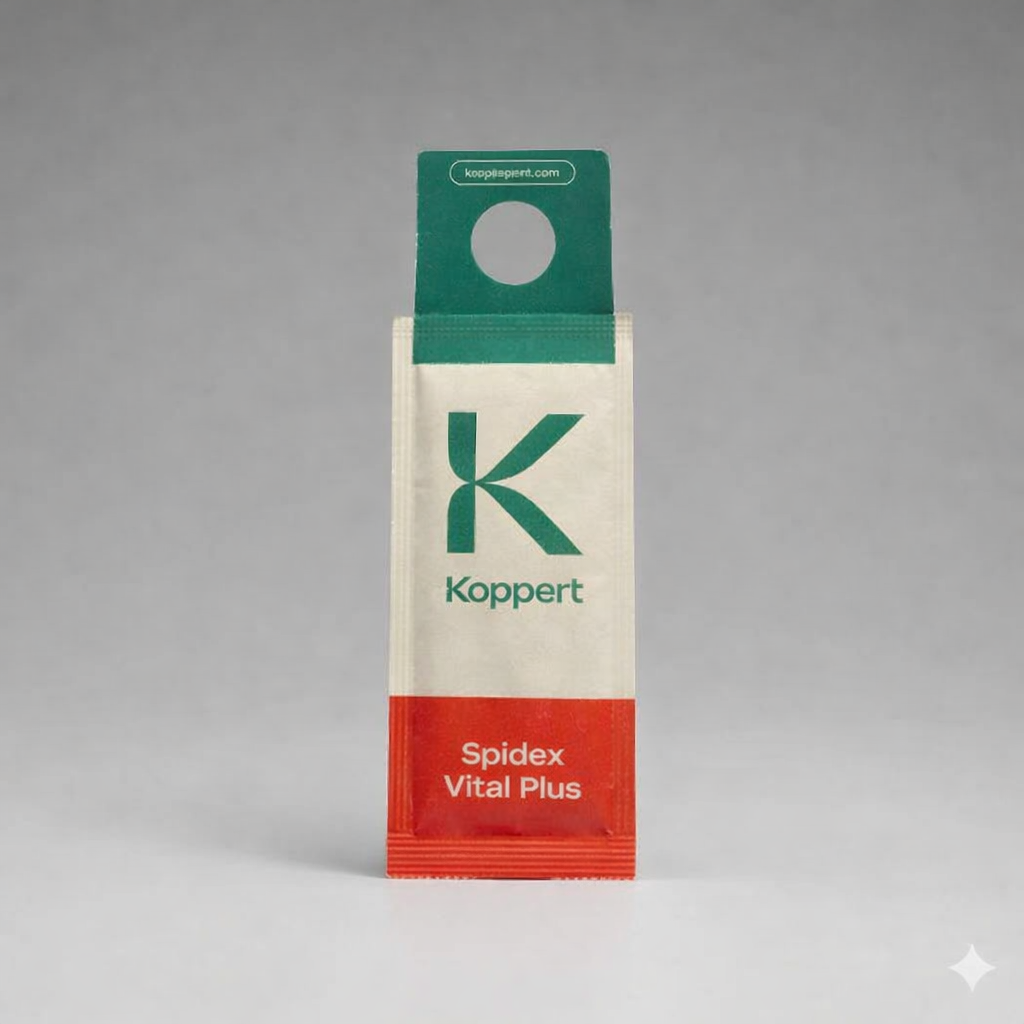
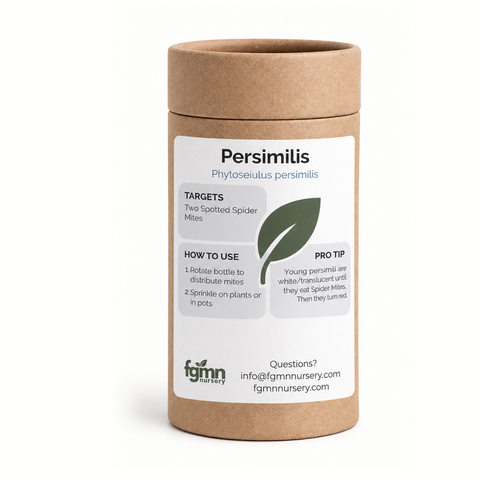
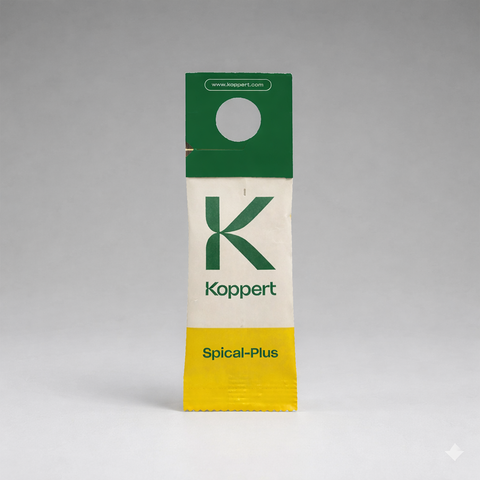
Phytoseiulus persimilis Slow-Release Prevention Sachets
Plants that always seem to get spider mites need a guard before the webbing appears. Each sachet releases the specialist for weeks. Prevention, not a rescue.
$5.25
Free Shipping for all orders over $30
If something's wrong when it arrives, email info@fgmnnursery.com within 72 hours of delivery for a replacement or store credit.
By placing your order you agree to our Shipping Policy and Live Delivery Guarantee.

Goes well with
-
Phytoseiulus persimilis
If you can already see webbing.
from $55
-
Neoseiulus californicus Slow-Release Prevention Sachets
If the room runs dry.
$3.75
-
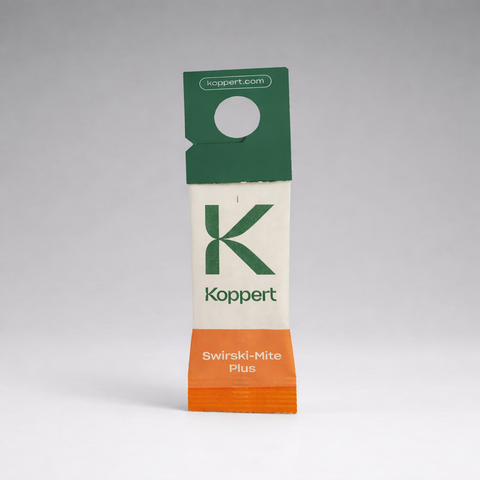
Amblyseius swirskii Slow-Release Prevention Sachets
If it is thrips, not mites.
$4.75
-
Root Network
For the roots: mycorrhizae and microbes that help roots take up water and nutrients. Use at repotting, then a monthly drench.
from $15

How many, and how often
One sachet every three to five linear feet as general prevention. Hang high in the canopy and replace every four to six weeks.
More about this dose
The three things people ask once they have their size. Open any of them.
Why more than one round?
Putting it out
- Hang it high, in the upper third of the plant. Persimilis climbs toward warmth and light, which is exactly where spider mites already are. Hanging it at the base means the colony spends its first days walking.
- Let it touch a leaf or stem. The sachet is the bridge onto the plant — resting against foliage gives the mites somewhere to walk to on the day they emerge.
- Keep water off the paper. Rain sheds, standing water does not. Avoid overhead irrigation, emitters and foliar sprays, and never let a sachet rest on wet soil. If the room is dry, mist the plants — never the sachet.
- Do not open it. Every sachet is pre-pierced. The mites emerge through that vent at their own pace over four to six weeks; tearing it open dries the colony out and ends the release.
- One every three to five linear feet as general prevention.
- Replace every four to six weeks while the season is running. An empty sachet is paper, and the plant is unguarded from that point on.
Everything else is optional. Get these four and the release has done what it can.
A cleaner way
On a display plant, tip small piles into bio-boxes or paper cups hung in the branches instead of dusting the foliage. Same dose, nothing visible on the leaf.
Is this the right beneficial for your problem?
Five questions, in the order a grower actually asks them: what have you got, is this the answer to it, what will it eat, how does it do the killing, and will it survive your room.
Is this your pest?
A sachet is prevention, so the honest question is what you are guarding against rather than what you are looking at. Persimilis guards against one thing and guards against it better than anything else in the catalog: web-spinning spider mites.
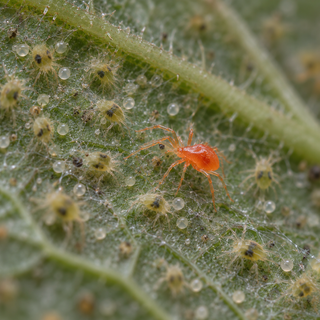
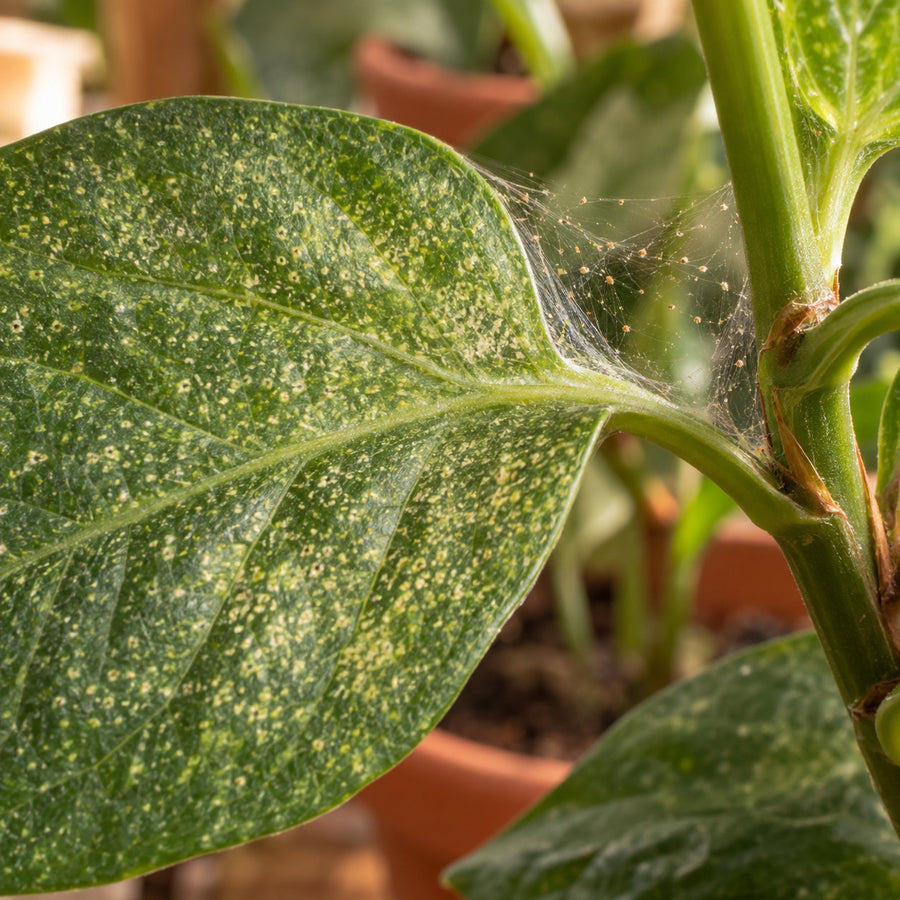
Spider mites are quiet until they are not. The first sign is fine pale stippling on the upper leaf surface, like someone went over it with a very fine airbrush. The colony itself is on the undersides. By the time there is visible webbing, the population has been building for weeks.
Persimilis takes the Tetranychus mites at every life stage — two-spotted, carmine red and Pacific — and it tracks them by scent, walking straight into heavy webbing that turns other predators back. What it does not do is anything else. It ignores thrips, aphids, broad mites and russet mites completely, because it is an obligate specialist and spider mites are the whole menu.
Then: is a persimilis sachet the right answer to it?
Choose this if
Choose persimilis sachets for high-value plants in a warm, humid room where spider mites are the worry and you would rather not have to rescue anything. Nothing hunts Tetranychus harder — it is the fastest predator in the range against them, it follows their scent to find colonies, and it goes through webbing that stops generalists. Running it takes about ten seconds: no mixing, no spraying, no dose to get right, no re-entry interval and no residue on the leaves. And because the medium stays inside the paper, there is nothing loose on your foliage — which is the reason this is the sachet people reach for on flowering plants and tissue culture coming out of a flask.
Choose something else if
It is a specialist, so anything that is not a spider mite needs a different sachet — thrips want swirskii or cucumeris, broad mites want cucumeris or californicus, and russet and rust mites are eriophyids that andersoni handles. It also wants humidity: below about 60% RH the eggs struggle, and a cool, dry or wildly swinging room is californicus's territory rather than this one's. And if there is webbing already, a sachet releases at the wrong speed entirely — that wants bottles first.
What it kills, and what it won't
Being a specialist cuts both ways, and the good side is this: persimilis will not wander off to graze on pollen while your canopy is clean, and it will not stop halfway through a colony because something easier turned up. It eats spider mites, it finds them by smell, and it keeps going until they are gone.
How a sachet works
What is actually inside it, how the mites get out, and what that buys you over a bottle.
A breeding colony, not packaging
The sachet is a nursery. Inside is a bran medium, a founding population of predators and a food source that keeps them laying for weeks. It is not a bag of mites waiting to be tipped out, which is why the one instruction that matters is do not open it.
Through a vent already built in
Every sachet has an exit hole in the seam. The mites leave through it at their own pace, a few at a time, day after day. That trickle is the whole point: a bottle gives you one wave and a sachet gives you a standing population.
A clean leaf, and nothing else
Because the mites walk out and the medium stays in the paper, there is no bran or vermiculite left on your foliage or in your flowers. If you have ever picked carrier out of a leaf sheath, that difference is worth something on its own.
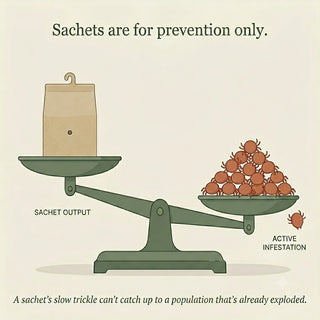
Prevention, not rescue. A sachet releases over weeks, which is exactly the wrong speed for an infestation that is already running. Bottles are the knockdown; sachets are what holds the line afterwards.
Will it work in your room?
Two checks. If the pest is anything other than a web-spinning spider mite, this is the wrong sachet — persimilis simply will not eat it. And if there is visible webbing or spreading stippling already, hang these behind a bottle release rather than instead of one.
About persimilis sachets
A breeding colony in a paper sachet, releasing eggs, juveniles and adults for weeks. Persimilis is the spider mite specialist — the one predator that does nothing else and does it faster than anything that does.
New to sachets?
Five things that catch almost everyone the first time.
After you hang it
What changes, how you would know, and when to replace it.
How you'll know it's working
Nothing visible, which is the point. No webbing appears and no fresh stippling shows up on the new leaves, and the sachet looks identical from the outside the entire time.
Judge it on new damage rather than on mites you can spot. Old stippling does not heal, so read the newest growth: that is where a failing defense shows first, and where a working one shows as nothing at all. Do not open the sachet to check — opening it ends the colony you were checking on, and we cannot replace it afterwards.
Mark four weeks on a calendar when you hang them. The failure people actually have with sachets is not a bad colony — it is a good one that ran out three weeks ago on a plant nobody has checked since.
Getting it to you
What is in the packet, how it travels, and what happens if it arrives wrong.
What arrives
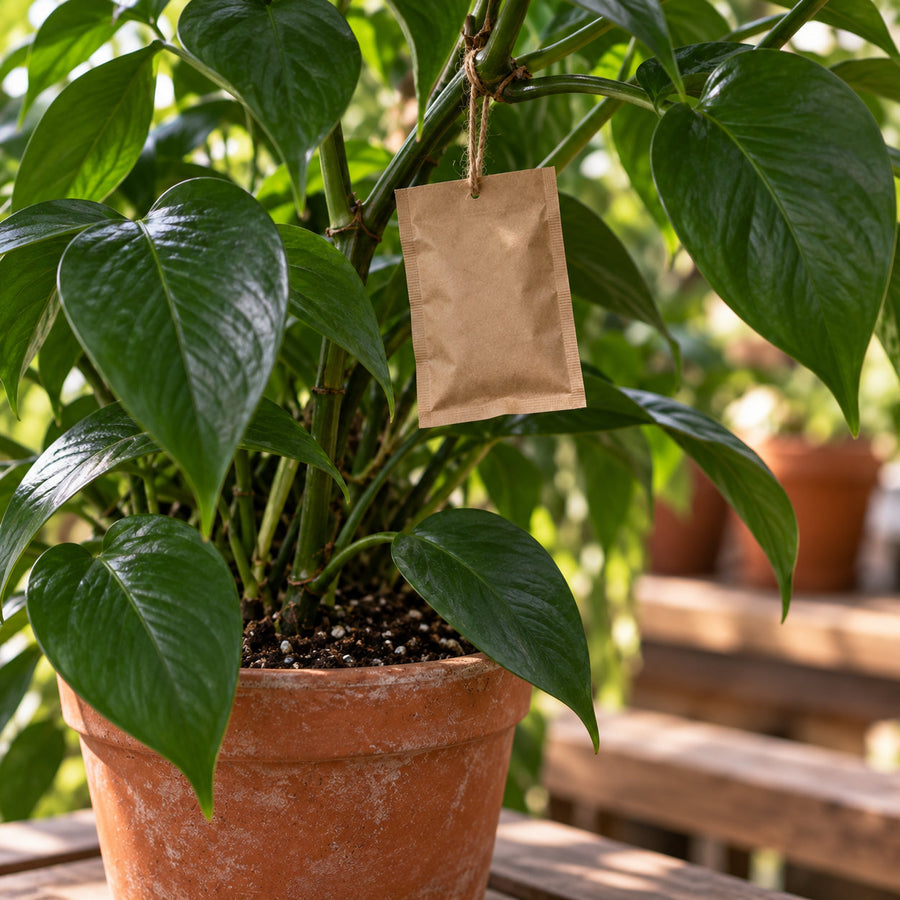
Sachets of paper, each one a live breeding colony on a bran medium with a food source sealed in beside it.
Nothing about the outside tells you anything. There is no window, no movement to look for, and no test you can run — the mites are half a millimeter and they are inside.
Hang them the day they arrive. These are living colonies rather than shelf stock, and every day in the box is a day off the release window you paid for.
When it ships, and when it lands
Shipping
We ship when they're ready to travel. Live orders go out Monday to Thursday. If a colony needs a beat to peak, or we're propagating a fresh batch, yours might hold up to a week. All mites and insects ship 2-day or Overnight depending on what's best for them.
When it lands
Unpack and hang the same day. One every three to five linear feet. On a stem in the middle of the foliage, in shade, above the soil line — not in a hot spot of direct light, and not where watering will soak it. Then leave it alone for four to six weeks.
Why we pack extra
Two days in a van is a long trip for something this small, so we send more than you paid for.
A predatory mite is the size of a grain of table salt, and a sachet is a breeding colony in a paper packet, in a van, for two days.
A trip like that is hard on anything this small, so we price it in: the founding population gets counted out, and then roughly 15% more goes in on top as a cushion.
Your sachet leaves here holding more than the label says — and unlike a bottle, the mites in a sachet keep breeding, so the number that matters is the one a week from now.
If you can see them
Ladybugs, lacewing larvae, Orius — the minute pirate bug — and the beetles. These are the ones big enough to photograph, and a picture tells us a lot.
Cold insects are very good at sitting still. That's normal. Release them as this page says, and watch the pest instead.
Something look wrong? Photograph them in the container and email the photo to info@fgmnnursery.com.
The photo is not us doubting you. It is how we tell a bad batch from a bad courier day from a mailbox that hit 104°F.
If you can't see them
Mites, nematodes, eggs — and sachets more than any of them. A sealed paper packet looks identical whether the colony inside is thriving or gone, and no photograph settles that. So we don't ask you to take one.
Email info@fgmnnursery.com and our entomologist takes you through the diagnostic instead — where the box sat, what your room was doing, whether the paper arrived damp, and then what the pest is doing about ten days later.
Please do not open a sachet to check. It is the one thing that guarantees the outcome you were worried about, and we cannot replace it afterwards.
Seventy-two hours from delivery, either way, with your order number. Replacement or store credit, your pick.
What it does not reach
Three gaps this page has already named, and the beneficial that closes each one.
Sachets hold a line; bottles take ground
Same predator, different delivery. A sachet trickles mites out over four to six weeks, which is the right speed for keeping a clean plant clean and the wrong speed for a colony that is already spinning webbing. A bottle puts the whole adult population on the leaf the day it arrives — and persimilis in a bottle is the fastest knockdown there is against two-spotted mites. Run the bottle at the hot spots, then hang sachets behind it to hold what you won back.
Below 60% RH the eggs are the bottleneck
Persimilis needs a humid canopy for its eggs to hatch, so a dry room — or one that swings hard between day and night — is working against it. Neoseiulus californicus is the spider mite predator built for exactly those conditions: it tolerates heat and low humidity, and unlike persimilis it can hold on pollen when the plant is clean, so the population stays put between pests.
A specialist will not improvise
The single-mindedness that makes persimilis so good on spider mites is also its whole limit: it will not touch thrips, whitefly or broad mites. If the silvery scarring on your leaves is thrips rather than mite stippling, Amblyseius swirskii is the sachet for a warm room, and cucumeris the one for a cooler one. They also take spider mites on encounter, so they are not a step backwards.
Two cheap things that make the rest work harder. Blue cards give you the dated count this page keeps asking you to read. Breeder's Blend is pollen and Artemia; it keeps the population fed through the lull when prey gets scarce.
Keep reading
Written by the people who raise and ship them.
- What’s Really Inside a Predatory Mite Sachet?Predatory mite sachets may look empty at first glance, but inside is a carefully balanced ecosystem of carrier material, feeder mites, and predatory mite…Read it
- Californicus or Persimilis?One of them clears a heavy infestation faster than anything else available. The other one is still there in a month.Read it
- You Did Not Lose to a Spider Mite. You Lost to Ninety-Six of Them.You sprayed. They went. They came back. That is not a story about you being careless — it is a story about the second…Read it
Questions
I have a minor spider mite infestation. Are sachets enough?
If you can see a few mites or very light stippling on a couple of leaves, you should combine sachets with a "Rapid Response" bottle of loose mites. Sachets are designed for prevention and work slowly over time; a minor active infestation requires an immediate "boots on the ground" force of adult predators to stop the population from exploding.
I don’t see anything moving inside the sachet. Is that normal?
Yes, that's normal. The mites are microscopic and stay tucked inside the breeding media until they are ready to emerge. They exit one by one through the pre-cut hole over a 4–6 week period.
Why use sachets instead of just spraying?
Sachets provide a continuous release of predators, whereas sprays only work at the moment of application. This creates a "rolling" defense that catches new spider mites as they hatch, keeping your garden residue-free.
Will they stay on the plant if there are no spider mites yet?
The sachet contains a small amount of food to keep the colony breeding. However, once they exit onto the plant, they will search for food. If your garden is 100% clean, they will eventually disperse or die off, which is why we recommend replacing sachets every 4–6 weeks.
Are these safe for flowering or "sticky" plants?
Yes. Because the carrier medium stays inside the sachet, this is the cleanest way to apply predators without getting debris on your flowers or resins.
Can I use these with other predatory mites?
Absolutely. Persimilis are specialists and will not interfere with generalist mites like Swirskii or Neoseiulus californicus.
Got my whole army in there hopefully it clears up anything and keeps my plants safe
Very easy and very effective. I keep these in all of my plant cabinets and they really seem to prevent pest outbreaks.
Arrived on time. Worth it to not have mites not eating my plants 🙂💚
Arrived on time and right to my front door 👌 $40 a month to not have spider mites eating my plants is something I can live with 😎
Hi!
Thank you so much! The review is showing as a 1 star, if there’s anything we can do to make your experience better, please don’t be afraid to reach out. :)
I released the predators throughout my plant collection and was ridiculously excited when I actually spotted one crawling around near the new growth doing its little predator business. Everything arrived well packaged and the whole process was super easy. FGMN Nursery has officially convinced me that outsourcing pest control to microscopic employees is the way to go.
Hi Amanda, we're thrilled to hear you're pleased with your new hires! ;) Thank you for the support.
Perfect, fast, as described, time will tell!!
Thank you! If you have any questions you know where we are. :)
Great
The first release didnt serm to do much after we had a brief cold spell during thst period. This second release seems to be making a big difference while not completely controlling the pests yet. May need a 3rd release. Definitely worth it.
I only received 9 of the 10 Satchets but the free addition of ladybugs was a nice surprise. I’ve had them for about 4 days and I’m still waiting for the mites to emerge, hoping to see some activity soon.
Hi there,
Thank you for your feedback and for giving our sachets a try! Have you reached out to us yet at info@fgmnnursery.com about the missing sachet? If not, please do so they can look into sending you one or offering store credit.
Just as a quick note on how sachets work: each one contains a mix of mite eggs and immature life stages. Rather than releasing a large burst all at once, they gradually produce and release a few adult predators each day (usually 2–3 per night). This slow and steady release helps establish a consistent predator presence in your plants, providing protection over the full 2–4 week period. Because of this, it can take a little time before you see visible activity.
We appreciate your order and are here if you have any questions!
Packaged well and received early.
The ordering process start to finish was easy. I placed the packets, and waiting to see how the trees do. If it will save my trees I will order more.
Excited to see how they work!
You're going to love them! Thank you for shopping with us!