
Webbing on a plant is one of those things that's genuinely alarming the first time you see it. It feels urgent — something is clearly happening, something that involves silk and colonization and probably a lot of tiny things you can't see. The instinct is to act immediately.
That instinct is right, but the action should start with identification, not treatment. Webbing on a plant can mean several different things, and a few of them aren't a problem at all. More importantly, the pest that causes the most economically significant plant damage indoors — broad mites — produces no webbing whatsoever. If you're looking for webbing as your primary indicator of a mite problem, you'll miss it entirely.
Here's how to actually figure out what you're looking at.
What spider mite webbing actually looks like
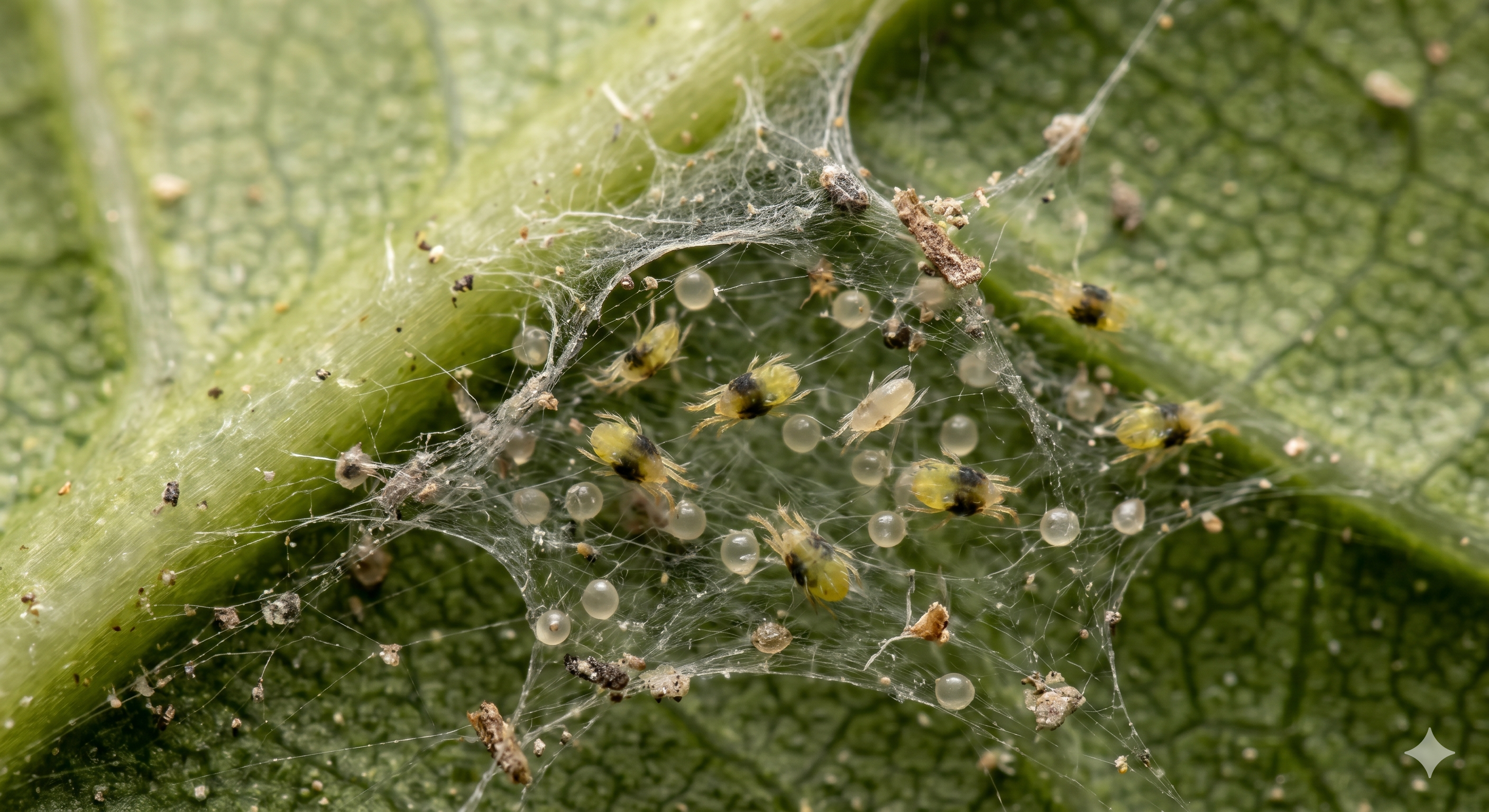
Spider mite webbing is fine, silky, and tends to feel almost powdery or dusty rather than sticky when you touch it — which is one of the key differences between mite silk and spider silk. It appears first on leaf undersides, in the junctions where leaves meet stems, and in the tight spaces between growing tips. In early infestations it's easy to miss entirely; in heavy infestations it can encase whole stems and new growth in what looks like a sheer, dirty veil.
The webbing serves as a protective environment for the mite colony — they live inside it, lay eggs inside it, and use it as a highway to move between feeding sites. It's not a trap the way a spider web is. It's infrastructure. This is why webbing appears specifically where the mites are concentrated, rather than stretched across open gaps between branches the way an actual spider web would be.
A few visual characteristics that are reliable identifiers:
- Location. Undersides of leaves, stem junctions, growing tips, and tight leaf axils. Not stretched across open space between branches.
- Texture. Fine and almost powdery. Catches dust. Looks slightly dirty or grey even when fresh.
- Pattern. Dense and irregular, not geometric. No obvious structure to it — it accumulates where the mites are feeding rather than being deliberately constructed.
- Progression. Starts small and concentrated on a leaf underside. Expands as the colony grows. In severe infestations, spreads across entire leaves and down stems.
- What's inside it. Moving specks if the infestation is active. White cast skins (shed exoskeletons). Eggs, which are spherical and translucent.

How to confirm it's spider mites
Visual inspection of the webbing gives you a strong indication, but the two most reliable confirmation methods are the white paper test and a hand lens. Neither requires any equipment you don't already have.
The white paper test
Hold a sheet of white paper under a suspect leaf and tap the leaf sharply. If spider mites are present, tiny specks will fall onto the paper. Watch them for a moment — if some of the specks are moving, you have spider mites. Smear the paper with your finger; spider mites leave a faint green or brownish streak, which is the plant cell contents in their bodies.
This test works because spider mites are dislodged easily and are dark enough to be visible against white paper despite being too small to see clearly with the naked eye. It also distinguishes mites from other debris — dust and dead plant material don't move, mites do.

The hand lens
A 10x–30x jeweller's loupe or hand lens lets you see spider mites directly. Check the underside of a leaf showing stippling or webbing. You're looking for oval-bodied mites, yellowish or greenish, often with two darker patches on their sides — those are the two-spotted spider mite's characteristic spots. You'll also see eggs (small, round, translucent) and cast skins (white, papery). Fast-moving pale specks alongside slower mites are likely predatory mites if you already have a biocontrol program running — a useful distinction to make before you do anything else.
Confirmed spider mites — what you'll see
White paper test: Moving specks that leave a green or brownish smear.
Hand lens (leaf underside): Oval yellowish-green mites, often with two dark spots. Spherical translucent eggs. White cast skins in webbing.
Plant symptoms: Fine stippling (tiny pale dots) on upper leaf surface where cells have been emptied. Leaves yellowing or bronzing in advanced infestations.
Webbing that isn't spider mites
Several things produce webbing or web-like structures on plants that are not spider mites. Misidentifying these leads to unnecessary treatment — or worse, treating for the wrong thing while the actual problem continues.
Actual spiders
The most common source of confusion, especially outdoors. Spider webs are geometrically structured — orb webs, cobwebs, funnel webs — and are built across open spaces to trap flying insects. They're deliberately placed where insects travel, not wrapped around leaf surfaces. Spider silk is also thicker, stronger, and stickier than spider mite silk. If there's a visible spider in or near the web, that's what you're looking at. Garden spiders are genuinely beneficial and should be left alone.
The tell: spider webs connect objects across gaps and have structure. Spider mite webbing hugs plant surfaces and has no structure — it's a dense accumulation, not a constructed shape.
Fungal mycelium
Some fungal infections produce white, thread-like mycelium on plant surfaces that can resemble webbing at first glance. Powdery mildew in particular produces a white powdery coating on leaves that can look superficially similar to spider mite silk on new growth. The differences: fungal growth tends to be powdery or fluffy rather than silky and fine; it usually grows on the upper leaf surface rather than the underside; and there are no moving specks on the white paper test. Fungal mycelium also doesn't cross from leaf to stem the way heavy spider mite webbing does.
Caterpillar tent webbing
Tent caterpillars and fall webworm produce large, obvious silk tents in tree branches — much coarser and bulkier than spider mite webbing and always accompanied by the caterpillars themselves. Eastern tent caterpillar tents appear in the crotches of branches in spring; fall webworm tents enclose branch tips in late summer. Neither is easily confused with spider mite webbing up close, but from a distance on a tree they can trigger alarm. The presence of caterpillars, frass, or consumed leaves inside the silk tent confirms what you're dealing with.
Mealybug waxy coating
Heavy mealybug infestations produce waxy, cottony white material that can accumulate in leaf axils and stem junctions in ways that superficially resemble webbing. Up close it's clearly different — cottony and waxy rather than silky — and the mealybugs themselves are visible as oval white insects covered in the waxy coating. No webbing structure, and the white paper test produces no moving mites.
| What you're seeing | Texture | Location on plant | Confirmation |
|---|---|---|---|
| Spider mite webbing | Fine, silky, slightly dusty. Catches debris. | Leaf undersides, stem junctions, growing tips. Hugs plant surfaces. | Moving specks on white paper test. Mites visible under hand lens. |
| Garden spider web | Thicker, stronger, clearly sticky. | Across open gaps between branches or structures. Geometric. | Visible spider present. Structured web shape. |
| Powdery mildew | Powdery or fluffy. Not silky. | Upper leaf surface mainly. White powdery coating. | No moving specks. Wipes off as white powder. |
| Caterpillar tent | Coarse, thick silk. Much bulkier. | Branch crotches or tips. Encloses caterpillars inside. | Caterpillars, frass, or consumed leaves visible inside. |
| Mealybug wax | Cottony, waxy. Not silky. | Leaf axils, stem junctions. White cottony masses. | Oval white insects visible. No mites on white paper test. |

Mites that don't produce webbing
This is the piece of the identification picture that most growers don't know — and it matters a lot.
Broad mites (Polyphagotarsonemus latus) are arguably the most damaging mite pest for indoor tropical plant collectors, and they produce no webbing at all. They're also significantly smaller than spider mites — roughly 0.2mm, compared to spider mites' already-tiny 0.4mm — and are essentially invisible to the naked eye. You will not find them through the white paper test or casual visual inspection. A 30x or higher loupe is required to see them at all.
The symptoms of broad mite damage are distinctive once you know what to look for: twisted, cupped, or bronzed new growth; stunted or distorted growing tips; new leaves that emerge hard, brittle, and abnormal rather than soft and flexible. The damage concentrates on new growth because broad mites prefer the youngest, most tender tissue. Old leaves may look fine while every new leaf is coming in deformed.
If your new growth looks wrong but there's no webbing
Twisted, cupped, or hard new leaves on tropical plants with no visible webbing is the classic broad mite presentation. Broad mites are so small they require magnification beyond what most hand lenses provide — a USB microscope or 60x+ loupe is needed for direct confirmation. The symptom pattern is more useful than trying to see the mites directly.
Broad mites also move between plants on insects, on growers' hands, and on air currents. A new plant with distorted growth brought into a collection is a risk vector for the whole collection.

Russet mites (Aculops lycopersici) are another no-webbing mite, particularly common on tomatoes, peppers, and cannabis. They're eriophyid mites — a completely different family from spider mites — and cause upward leaf curling, bronzing of stems, and a russeted appearance on fruit. A hand lens may show them as tiny white or straw-coloured cigar-shaped mites along stems and on leaf undersides, but they're at the edge of visibility even at 30x.
What to look for before webbing appears
By the time webbing is visible, the spider mite population is already well established. Webbing is a sign of a colony that has been growing for some time — it's not an early warning, it's a confirmation of an infestation already in progress. The earlier warning signs are:
- Stippling. Tiny pale dots on the upper leaf surface where cells have been emptied. Each dot is a feeding site. Under a hand lens the dots are clearly visible as individual punctures. On smooth-leaved plants like Monstera and Pothos this appears first as a slight dullness or loss of sheen before the dots are obvious.
- Dusty or gritty leaf surface. Spider mites leave cast skins and debris as they feed. Leaves in an active infestation feel slightly gritty when you run a finger across them — this is one of the early tactile signs before stippling is obvious.
- Leaf discoloration progressing from the underside. Early spider mite feeding causes yellowing that starts on leaf undersides and progresses through. A leaf that looks pale or slightly off on the underside before showing obvious damage on the top is worth investigating with a hand lens immediately.
- Conditions that favour mites. Hot, dry weather or a hot, dry indoor environment. Water-stressed plants. Recently sprayed plants where predatory mites may have been killed. These conditions are spider mite accelerators — when they're present, increase monitoring frequency.

The misting myth
Misting leaves is widely repeated as a spider mite preventative — the idea being that mites hate humidity. It doesn't work, and it has a downside. Mites are resilient to ambient humidity changes from surface moisture, and the wet leaf surfaces created by misting are genuinely hospitable to fungal pathogens like powdery mildew and botrytis. Maintaining adequate ambient humidity in your growing space is useful; spraying water on leaves to deter mites is not. Focus on plant health, early detection, and a resident predator population instead.
The monitoring habit that catches infestations early
A 10x–30x hand lens checked weekly on the underside of a few leaves per plant will catch spider mites at the stippling stage — before webbing, before visible damage, when treatment or predator release is most effective. The growers who find spider mites early are almost always the ones who check leaf undersides routinely rather than waiting for visible symptoms. By the time webbing is visible from standing height, you're dealing with an established infestation.
What to do once you've confirmed spider mites
Do this first — before anything else
Move the plant away from your collection the moment you suspect an infestation.
Don't wait for formal identification. Spider mites travel on air currents, on clothing, and through plant-to-plant contact. By the time webbing is visible on one plant, mites may already be on its neighbours. Isolation buys time. A staging area — a separate room, a bathroom, anywhere away from the main collection — is the single highest-impact thing you can do before you do anything else.
Once you've confirmed spider mites — moving specks on the white paper test, or mites and eggs visible under a hand lens — the next decision is treatment strategy. The presence of webbing is relevant here: heavy webbing protects the mite colony from contact sprays, reducing their effectiveness significantly. If webbing is established, mechanical removal (a spray of water or damp cloth on affected leaves) to break up the silk before any treatment gives better penetration.
For biological control, the relevant question is the severity of the infestation:
- Light infestation, no webbing yet: Predatory mite sachets provide continuous slow release and are the right tool — they establish a resident predator population that intercepts the infestation before it builds. Neoseiulus californicus and Amblyseius andersoni are the right species for most situations.
- Active infestation with visible webbing: A bottle release of predatory mites at higher density addresses the existing pressure. Mechanical removal of webbing first improves predator access. Follow with sachets for ongoing prevention once the infestation is brought under control.
- Heavy infestation, significant damage: A knockdown spray (insecticidal soap, 5-day clearance) followed by a bottle release, then sachets. The spray reduces the pest load to a level where predators can be effective; deploying predators into a very heavy infestation without first reducing numbers gives them a difficult start.
If your identification process revealed broad mites rather than spider mites, the treatment is different. Neoseiulus californicus targets broad mites as well as spider mites and is the right predatory mite for broad mite infestations. Isolation of affected plants before releasing is important — broad mites spread rapidly through plant-to-plant contact.
Common questions
Frequently asked
-
A few possibilities. The infestation may be old and the active mites have moved on — the webbing persists after mites leave a depleted leaf. A predatory mite program may have been effective and the pest population has collapsed. Or the webbing may not be spider mites — check against the comparison table for other webbing sources. If stippling damage is present alongside the webbing, the infestation was real at some point; check neighbouring leaves and newer growth for active mites.
-
This is the classic broad mite presentation. Broad mites produce no webbing and are too small to see without significant magnification (30x minimum, 60x to be certain). They feed on new growth specifically, injecting a growth-disrupting toxin that causes the characteristic twisting and hardening. The damage is permanent on affected leaves — new growth emerging after treatment begins to look normal as the mite population is suppressed. Neoseiulus californicus targets broad mites and is the appropriate predatory mite for this infestation type.
-
Indirectly. Dense webbing reduces light penetration to leaf surfaces, impedes airflow, and makes it harder for contact treatments to reach the mites. It also provides physical protection for the colony. The primary damage is from the feeding itself — the stippling and cell destruction — rather than the webbing. But heavy webbing that encases new growth and growing tips can physically impede leaf unfurling. Removing webbing mechanically with a water spray before releasing predatory mites or applying any contact treatment improves outcomes significantly.
-
Movement speed and colour are the most useful field indicators. Predatory mites are generally faster-moving and more active than spider mites, which tend to feed in place. Under a hand lens, predatory mites like N. californicus appear pale to translucent, while two-spotted spider mites are yellowish-green with visible dark spots. In a working biocontrol program, seeing both together is a good sign — a small pest population being actively suppressed by a resident predator population is the programme working as intended. If you see only fast-moving pale specks and stippling is declining, the predators are doing their job.
-
Yes — several ways. Spider mites move between touching plants directly through webbing and across touching leaves and stems. They also disperse on air currents, particularly when populations are very high and the colony is producing dispersal-ready females. And they transfer on hands, tools, and clothing. Isolating a heavily infested plant reduces spread, but in a dense collection with touching canopies, the mites will have already moved by the time webbing is visible on the first plant. This is why monitoring all plants routinely — not just the one showing symptoms — matters.
References
- Hahn, J. & Wold-Burkness, S. (n.d.). Twospotted spider mites in home gardens. University of Minnesota Extension. extension.umn.edu
- Talabac, M. (n.d.). Mites in home gardens. University of Maryland Extension. extension.umd.edu
- Dreves, A. (n.d.). How to recognize and manage spider mites in the home garden. Oregon State University Extension. extension.oregonstate.edu
- Hahn, J. (2011). Spider mites and their control. Ohio State University Extension. ohioline.osu.edu
- Fasulo, T.R. & Denmark, H.A. (2000). Broad mite, Polyphagotarsonemus latus (Banks). University of Florida IFAS Extension. EENY-183. edis.ifas.ufl.edu
- Gerson, U. (1992). Biology and control of the broad mite, Polyphagotarsonemus latus (Banks) (Acari: Tarsonemidae). Experimental and Applied Acarology, 13, 163–178. springer.com
Predatory mites find them where sprays can't reach — inside the webbing, on leaf undersides, in growing tips.
