Orius Insidiosus

Regular price $68.00

5 reviews
While uncommon, order processing can take up to 7 days depending on hatching rates and life stages.
Live Delivery Guaranteed

Free Shipping!
All mites and insects ship 2-day or Overnight depending on what's best for them.


Orius Insidiosus

At A Glance

Orius insidiosus, known as the Minute Pirate Bug, is the "Heavy Artillery" of biological pest control. While other predators are limited by size, Orius is a winged, aggressive hunter that specializes in eradicating adult thrips. If you see flying pests or heavy "silvery" scarring on your leaves, Orius is the most effective natural solution available.

  • Scientific Name: Orius insidiosus

  • Primary Target: Thrips (Adults & Larvae)

  • Secondary Targets: Aphids, Spider Mites, Whiteflies, and Moth Eggs.

  • Key Advantage: The only predator that hunts and kills flying adult thrips.

Target Pests

Orius insidiosus, known as the Minute Pirate Bug, is the "Heavy Artillery" of biological pest control. While other predators are limited by size, Orius is a winged, aggressive hunter that specializes in eradicating adult thrips. If you see flying pests or heavy "silvery" scarring on your leaves, Orius is the most effective natural solution available.

  • Primary Target: Thrips (Adults & Larvae)
  • Secondary Targets: Aphids, Spider Mites, Whiteflies, and Moth Eggs.
  • Key Advantage: The only predator that hunts and kills flying adult thrip
Environmental Needs

Because Orius is a flying insect with a complex life cycle, it is more sensitive to environment than soil microbes.

  • Light: Orius requires at least 12–14 hours of light per day to remain active and reproductive. In short-day winter conditions, they may enter diapause (hibernation).
  • Temperature: Performs best between 70°F and 90°F. They become sluggish below 60°F.
  • Humidity: Thrives in moderate to high humidity (above 50%).
Selection Guide

When deciding on a thrips treatment, it is important to understand the life cycle of the pest. Most predators only target one stage; Orius covers the canopy where the most damage happens.

  • Orius vs. Swirskii/Cucumeris Mites: Predatory mites are "ambushers" that can only eat tiny thrip larvae. They are helpless against adult thrips. Choose Orius to kill the adults that the mites cannot catch.
  • Orius vs. SF Nematodes: Nematodes stay in the soil to kill thrip pupae. They cannot reach the leaves. Choose Orius to protect the foliage while Nematodes handle the soil.
  • Total Canopy Coverage: Because Orius can fly, they search your entire grow space. This makes them superior for large, dense plants where mites might struggle to reach every "hot spot" of infestation.
How to Use

To get the best results from your release, you must account for the fact that Orius are attracted to light and are highly active hunters.

1. The "Evening Release" Strategy
Always release Orius in the late evening or just before your "lights out" cycle. If released during high light, they may fly directly into your grow lights or windows instead of settling on the plants.

2. Dosing for Success

  • Preventative: 1 bug per 10 sq. ft. (Best for gardens with pollen-producing flowers).
  • Active Infestation: 1–5 bugs per plant. Focus your release on "hot spots" where thrip damage is visible.

3. Use Release Boxes

  • Gently rotate the bottle to mix the bugs with the carrier (buckwheat hulls).
  • Pour the mixture into small cups tucked into the foliage. This prevents the bugs and carrier from falling to the floor where they are less effective.
How They're Shipped

Release Immediately: Orius have a high metabolism and cannot be stored. They must be released the day they arrive.

Storage (Emergency Only): If you must wait, keep the bottle horizontal in a cool, dark spot (50°F–60°F) for no more than 12 hours. Never refrigerate.

The Paper Test (Live Delivery): To verify activity, gently shake a small amount of the carrier onto a white piece of paper. You will see dark, fast-moving, shield-shaped insects—these are your hunters.

Join Karen's Live Shows — Pests, Plants & Predators on PalmStreet.

Every Friday at 7pm EST — plus additional shows throughout the week. Ask your pest questions in real time — we answer everything.
Bookmark our shows →

FAQ

What is your Live Delivery Guarantee?

We guarantee that your beneficial insects will arrive healthy and ready to work. Because we are shipping live organisms, we use packaging and expedited shipping to ensure their safety. In the rare event that your order is compromised during transit, please take a photo of the package and contact us within 24 hours of delivery so we can make it right.

How many thrips can one Orius kill?

A single Orius can kill up to 80 thrips per day. They are "voracious feeders," meaning they often kill more pests than they actually eat, making them incredibly efficient for rapid knockdown of infestations.

Will they stay in my grow room?

Orius will stay as long as there is food (thrips, mites, aphids) or pollen. If the pests are gone and your plants aren't flowering, they may fly away to find a new food source.

What environmental conditions do they need?

They perform best between 70°F and 90°F with at least 12–14 hours of light. In winter months with short days, they may stop breeding and go dormant.

Can I use Orius with other beneficials?

Yes. For the "Total Thrips Eradication" strategy, we recommend a "Triple Threat" approach:

  1. Orius for the adults in the canopy.
  2. Swirskii Mites for the larvae on the leaves.
  3. SF Nematodes for the pupae in the soil.
How do I know they arrived alive?

Because Orius are visible to the naked eye (roughly 3mm), they are easy to verify. Gently shake a small amount of the carrier material onto a white piece of paper. You will see dark, fast-moving, shield-shaped insects scurrying—these are your hunters.

Do Orius bugs bite humans?

Orius are "Pirate Bugs," and while they are completely harmless to humans and pets, they can occasionally give a tiny "test nip" if they land on your skin. It feels like a small pinprick and does not cause lasting irritation or inject any venom.

Help! I'm overwhelmed

Yeah, it's a lot the first time you're using predatory mites. Please email us at info@fgmnnursery.com and we'll be happy to help!

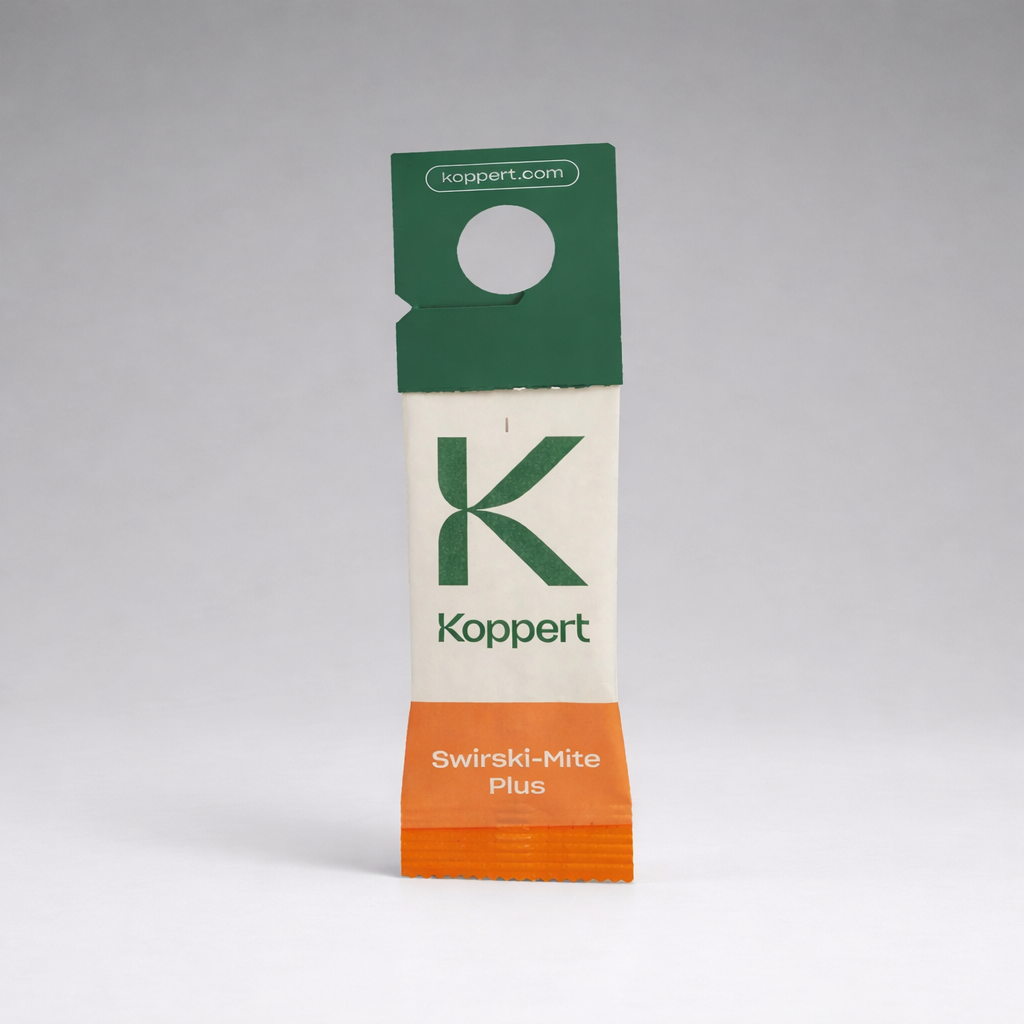
I don’t see anything moving in my bottle or sachet. Does that mean they’re dead?

Not at all! In fact, go ahead and deploy them.

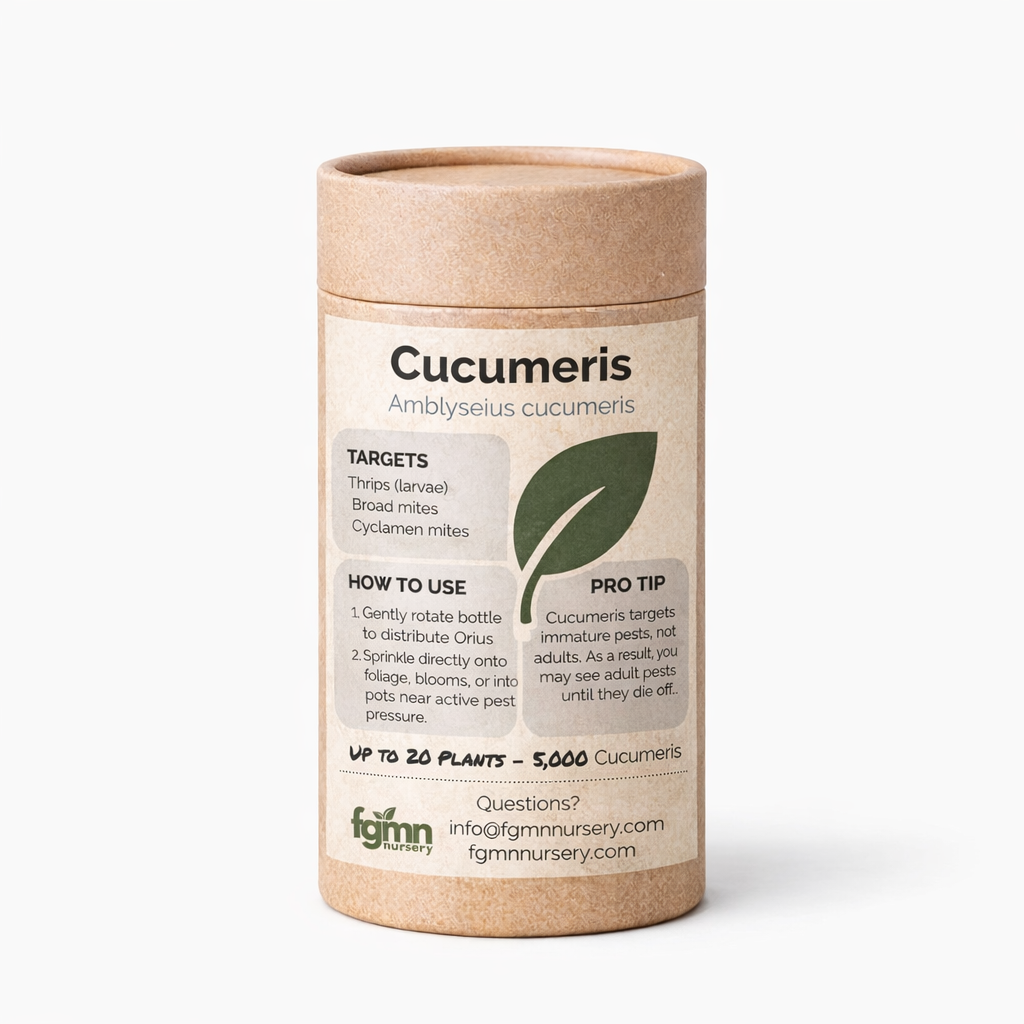
Predatory mites are microscopic (often less than 0.5mm) and naturally blend into their carrier medium (bran or vermiculite).

  • For Bottles: The mites often huddle in the center of the bottle for insulation during transit.
  • For Sachets: These are "slow-release" nurseries. The mites stay tucked deep inside the breeding media and emerge one by one over 2–4 weeks. Seeing an "empty-looking" sachet or bottle is not proof of a loss; it is simply how they are packaged for maximum survival.