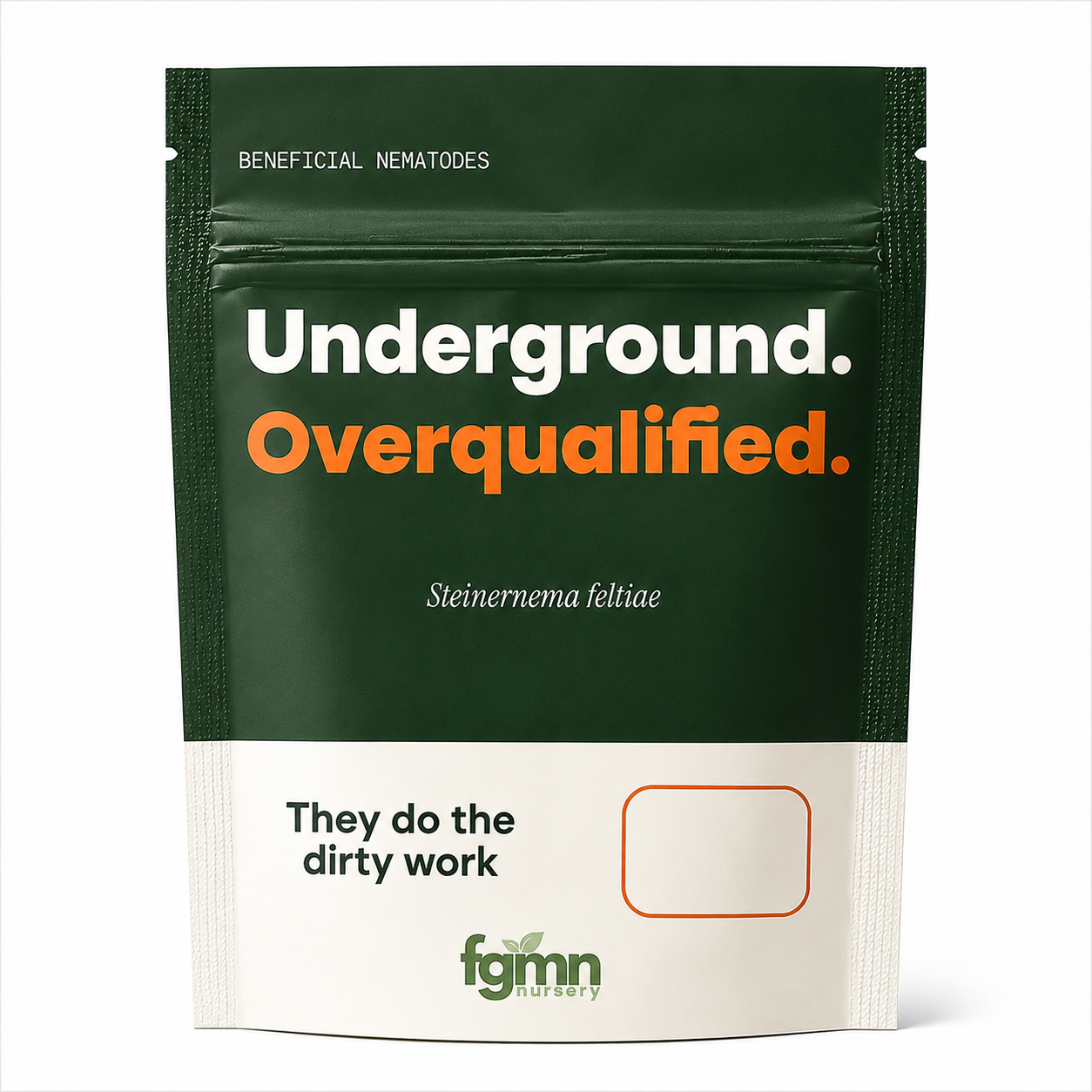

Beneficial nematodes.
For every soil pest.
Microscopic roundworms that hunt soil pest larvae from the inside out. No chemicals, no residue — the same approach commercial growers have used for decades, now sized for your collection.

Sf Nematodes

Sc Nematodes

Hb Nematodes

Triple Blend Nematodes
Species Guide
Which nematode does what — and why it matters.
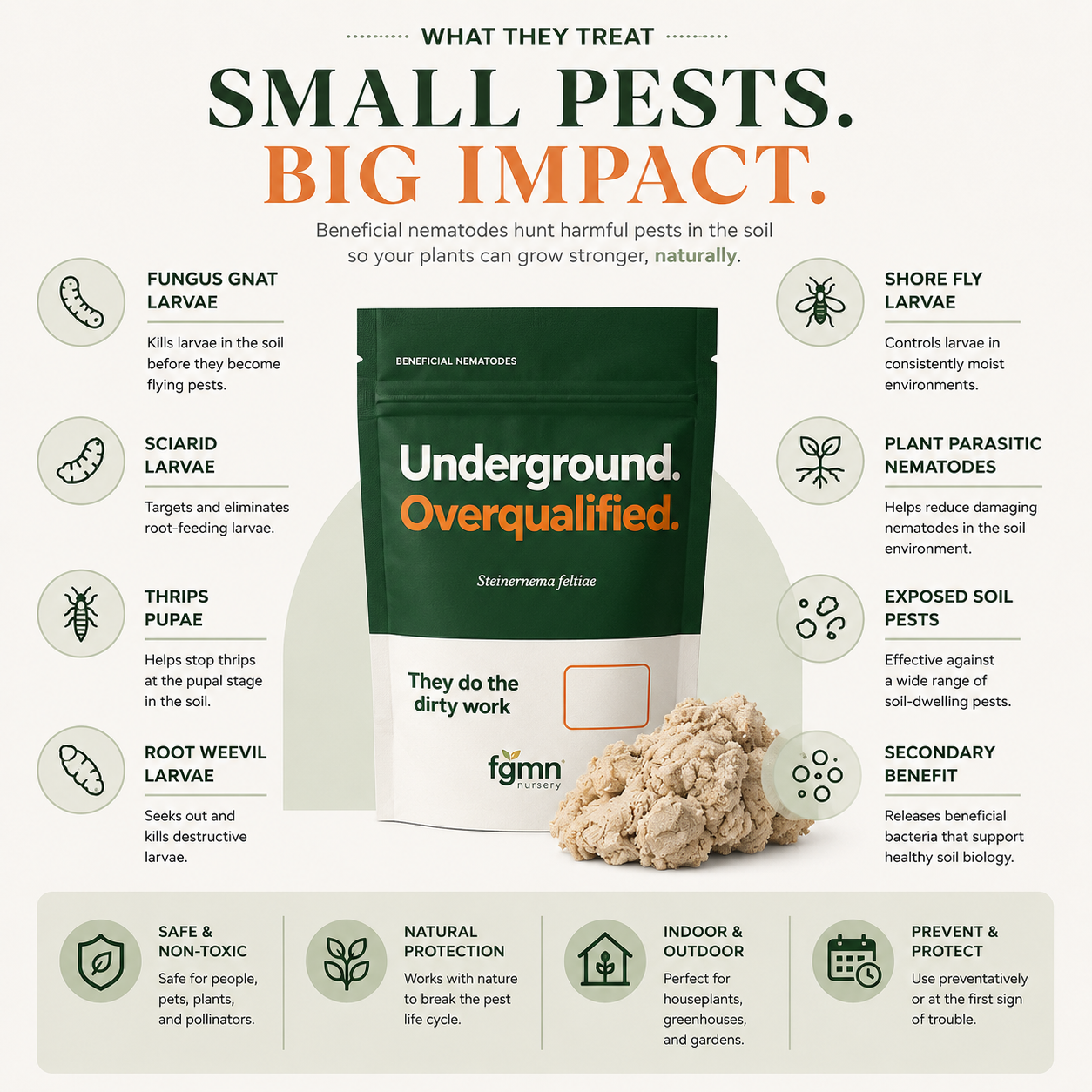
Not all beneficial nematodes are the same species, and species differences are not cosmetic. Each hunts differently, lives at different soil depths, and targets a distinct set of pest larvae. Using the wrong species against your pest is the most common reason nematodes "don't work."
Sf is the go-to for fungus gnats in houseplants and indoor growing media. It hunts in the upper 2–3 inches of soil where gnat larvae feed on roots and organic matter, using an "ambush" hunting strategy — it waits for host larvae to pass by. Cold tolerant and highly effective in the moist potting media conditions where gnats thrive.
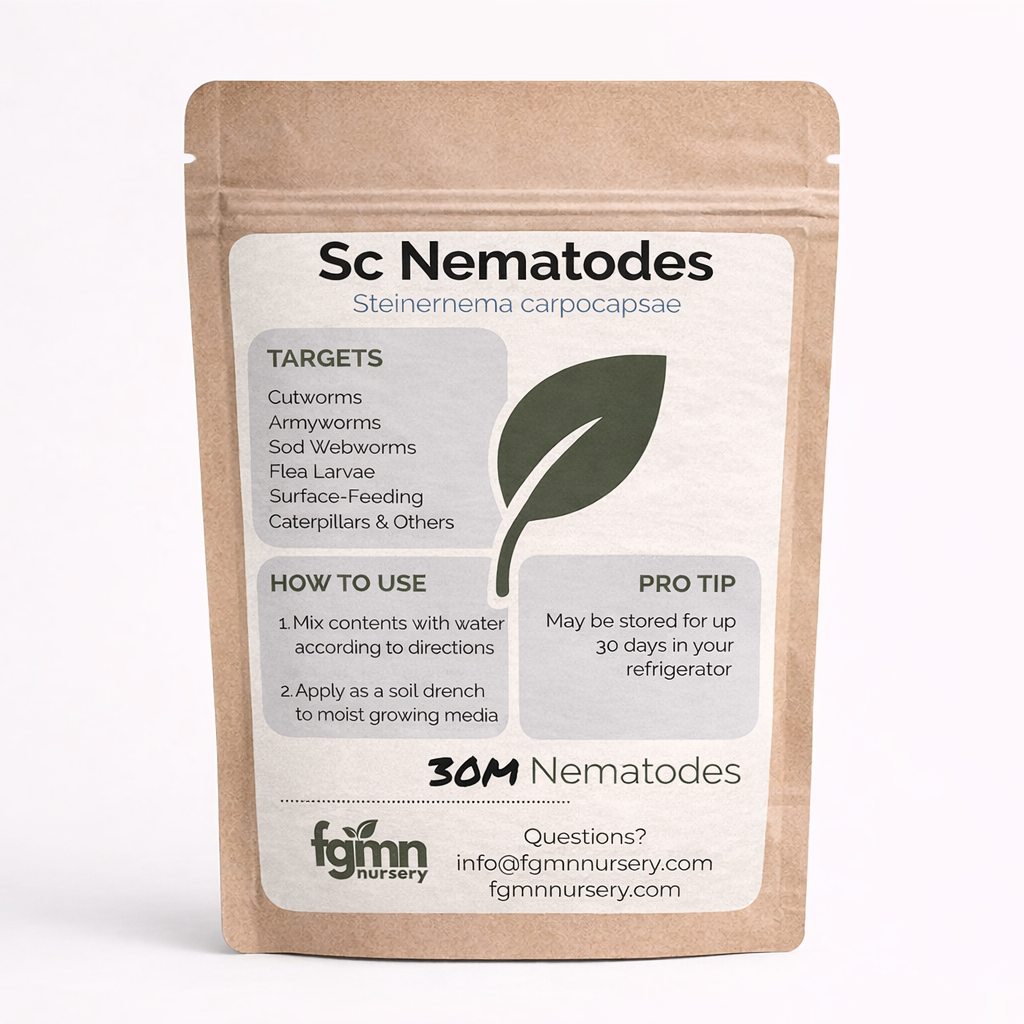
Sc uses a classic ambush strategy, standing upright at the soil surface to intercept mobile, active host larvae. It excels against fast-moving pests like flea larvae, armyworms, and cutworms. Unlike Hb, it does not pursue hosts deep into soil — it hunts at and just below the surface where these larvae live and travel.
Hb actively "cruises" through soil in search of hosts — it doesn't wait, it pursues. This makes it uniquely effective against deep-dwelling, sedentary grubs that other species struggle to reach. It carries a different bacterial symbiont (Photorhabdus luminescens) that produces a distinctive red-colored kill. Requires warmer soil temperatures to be effective.
When pest identity is uncertain, new beds are being established, or multiple pest types are suspected, the Triple Blend covers all soil layers and hunting strategies. Sf handles the top zone, Sc covers surface-active pests, and Hb goes deep after grubs. One application, three mechanisms. Slightly higher cost per application is often worth it when starting fresh or dealing with unknown soil history.
Why Beneficial Nematodes
Why buy nematodes instead of pesticides.
Pesticides work. So do nematodes. The difference is in what happens after — to your soil, your plants, and the next generation of pests.

Pests can't develop resistance to being eaten.
Pesticide resistance is one of the most well-documented problems in modern pest management. Repeated chemical applications select for survivors, and populations rebuild stronger. Nematodes kill through physical infection and bacterial toxins — a mechanism pests cannot evolve around. There is no documented case of a pest population developing resistance to entomopathogenic nematodes.
Nothing left behind in your soil.
Synthetic pesticides leave chemical residues in soil, growing media, and on edible crops. Some persist for weeks or months. Nematodes are living organisms — when the pest population is gone, the nematodes starve off naturally. No residue, no waiting periods, no concerns about what's accumulating in your soil over time.
They don't kill what you want to keep.
Broad-spectrum insecticides kill beneficial soil organisms alongside target pests — earthworms, mycorrhizal fungi, predatory beetles, and other organisms that make soil healthy. Nematodes are species-specific. Sf targets fungus gnat larvae. It doesn't touch earthworms, beneficial insects, or the soil microbiome you've spent time building.
No re-entry interval. No protective equipment.
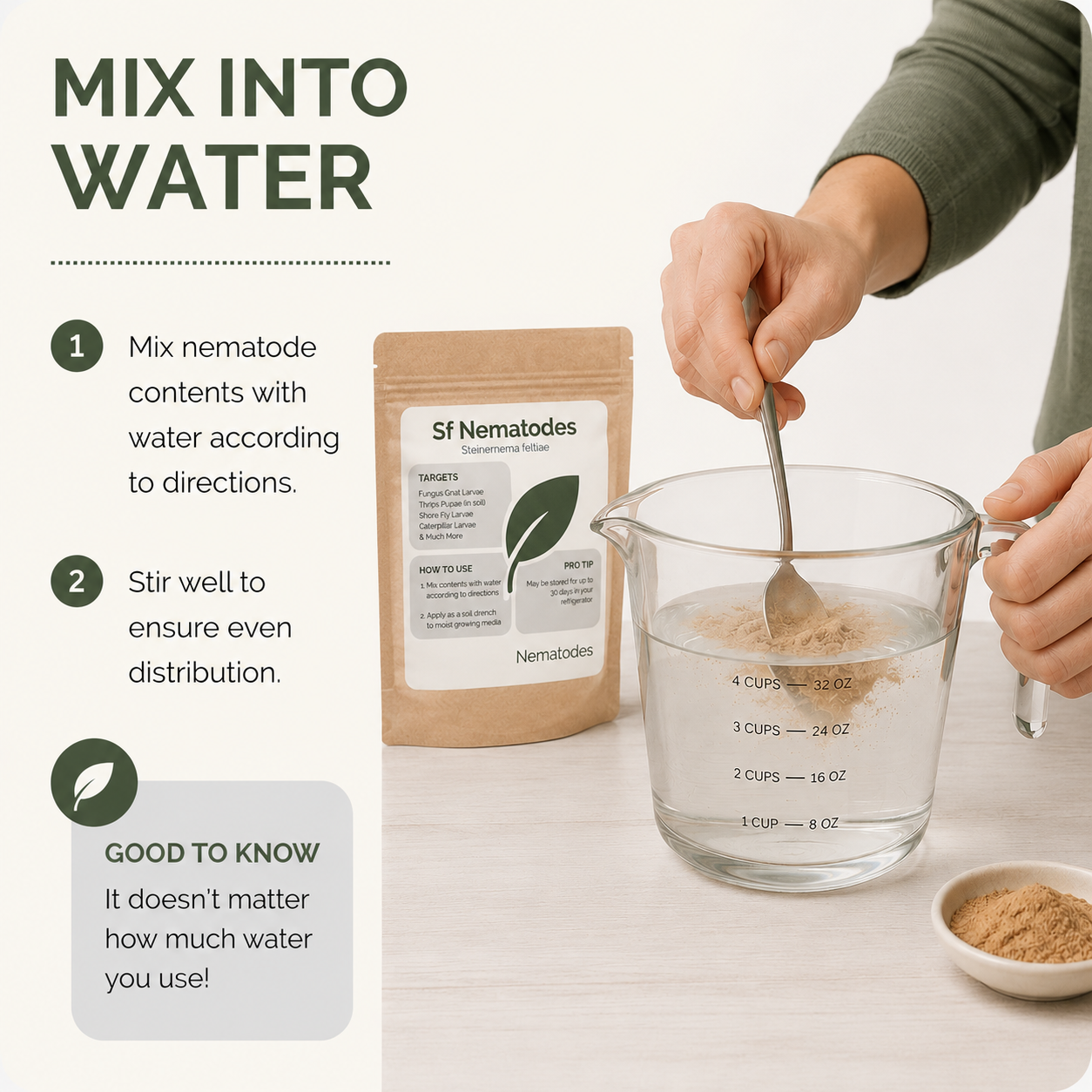
Many pesticides require you to stay out of the treated area for hours or days, and some require gloves, masks, or respirators during application. Nematodes require none of this. Apply with a watering can, re-enter immediately, no PPE required. This matters if you're growing edibles, working in a small space, or have kids or pets in the area.
You're treating the problem, not the symptom.
Contact pesticides kill the adult insects you can see. They don't address the larvae already in your soil, the eggs already laid, or the next generation already developing. Nematodes work in the soil where the pest life cycle actually lives — targeting larvae before they become the adults that damage plants and lay more eggs.
Safe for edibles, pets, and people.
Nematodes are non-toxic to mammals, birds, fish, and earthworms. They are approved for use in organic production and carry no food safety concerns on edible crops. If you're growing herbs, vegetables, or fruit alongside ornamentals, nematodes let you treat the whole space without segmenting what gets sprayed and what doesn't.
Where to Buy Beneficial Nematodes
Not all nematodes are the same. Neither are the places that sell them.
Beneficial nematodes are sold through garden centers, big-box stores, Amazon, and specialist suppliers. The product looks the same on the outside. The difference is in what's actually alive inside the package when it reaches you.
Garden centers and retail stores store nematodes at room temperature, often for months. By the time a package reaches the shelf, viability may already be severely compromised — within the printed date, technically, but far from full strength. You won't know until the treatment doesn't work.
FGMN ships direct from cold storage, Monday through Thursday, with temperature-monitored packaging. Every order is backed by a Live Arrival Guarantee. If they don't arrive alive, we make it right.

How Much to Buy
Size your order before you add to cart.
The most common buying mistake is underdosing. Nematode packages are sized by the millions — but those numbers only mean something in context of what you're treating. Use this table to figure out what you need before you buy.
| Pot Size | Nematodes Needed | FGMN Product |
|---|---|---|
| 4" pot | ~500,000 | Sf — smallest size |
| 6" pot | ~1 million | Sf — smallest size |
| 8–10" pot | ~2–3 million | Sf — mid size |
| 12–14" pot | ~5 million | Sf — mid size |
| Collection of 10–20 plants | ~10–25 million | Sf — large size |
Based on 6-inch pot equivalents. Adjust up for heavy infestations.
| Area | Nematodes Needed | Best Species |
|---|---|---|
| Up to 200 sq ft | 5 million | Sf or Triple Blend |
| 200–500 sq ft | 10–25 million | Sf, Sc, or Triple Blend |
| 500–1,000 sq ft | 50 million | Triple Blend |
| Lawn (grubs) | 50–100 million / 1,000 sq ft | Hb |
Heavy infestations warrant 2–3× the standard rate on first application.
How Many Applications to Buy For
One round is rarely enough. Plan before you order.
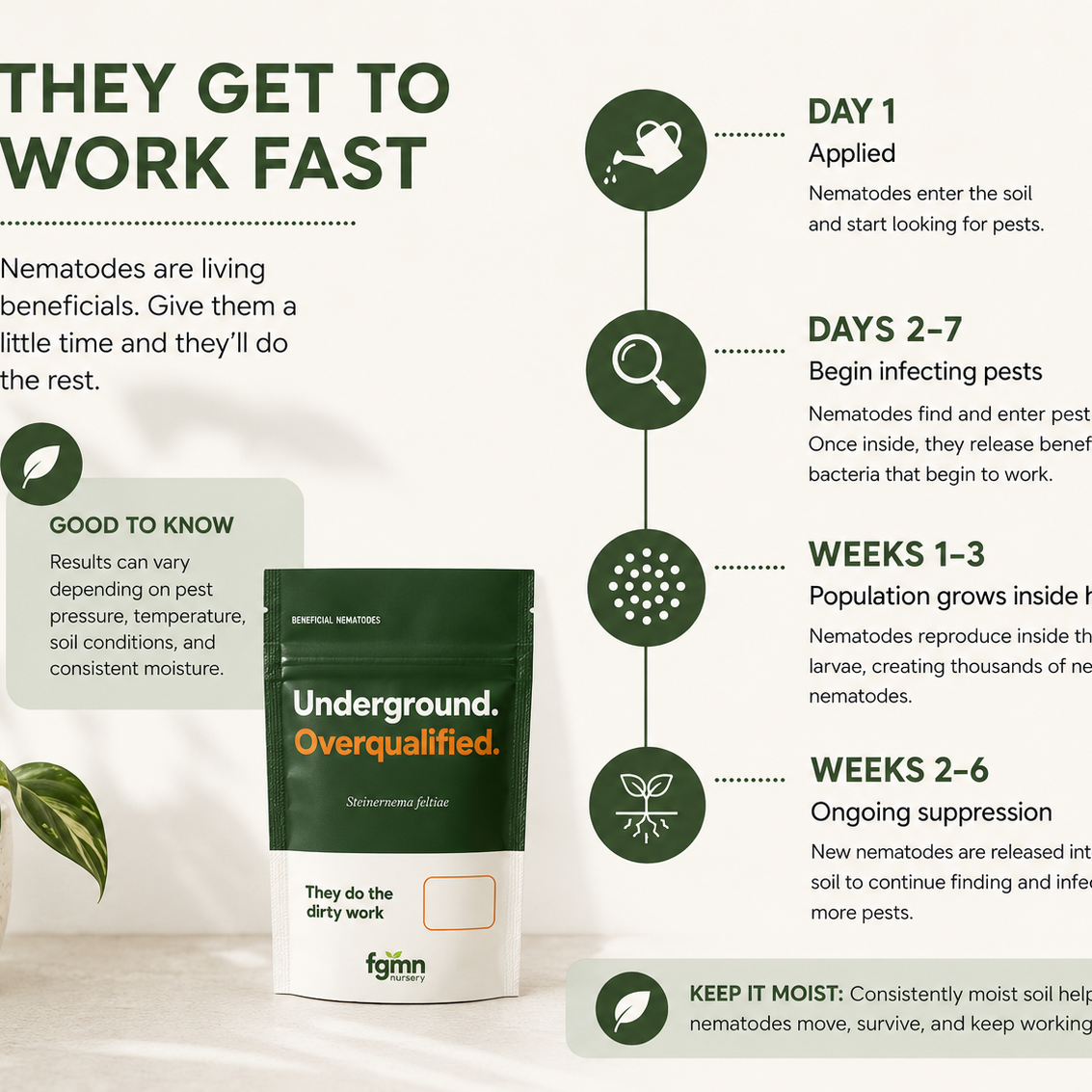
A single nematode application addresses larvae present in the soil at that moment. It doesn't prevent re-infestation from eggs already in the medium, or new adults laying eggs after treatment. Most successful treatments involve two to three rounds. Here's how to size your purchase.
You're seeing occasional adult gnats but no visible larval damage. One application with a follow-up 4–6 weeks later is usually enough to knock it down and keep it down.
Visible larvae, persistent adults, or signs of root damage. Plan for three rounds spaced 4–6 weeks apart. The first round crashes the population; the next two clean up the remainder and break the cycle.
You've cleared a past infestation and want to maintain clean soil. A recurring low-dose application every 6–8 weeks through the active growing season keeps populations from establishing. A subscription makes this significantly cheaper.
Mixed Collections
Buying nematodes when not all your plants are in soil.
Most serious growers have a mixed setup — some plants in soil or coco, some in LECA or semi-hydro, some in transition. Here's how to think about buying nematodes for a collection that isn't all one medium.
You probably don't need nematodes for fungus gnats.
Fungus gnats can't complete their life cycle without organic matter to feed on. A fully inert LECA setup with a clean reservoir gives them nothing to work with. If gnats are your only concern and you're fully in semi-hydro, save your money. If you're seeing gnats anyway, the source is almost certainly a soil-grown plant nearby — treat that instead.
Buy Sf and treat the soil plants. One dose covers your whole collection.
If you have even a few soil-grown plants in the same space, they're the gnat source for the entire room. Sf nematodes applied to those plants will knock the population down for everyone. You don't need to treat the LECA pots directly — address the breeding ground and the rest takes care of itself.
Treat before you transition, not after.
Plants coming out of soil often carry fungus gnat eggs and larvae in the root ball. Applying Sf as a drench before transitioning — while the plant is still in soil — clears the larvae before they travel with the plant. One application a week before your planned transition is the cleanest approach.
Sf works in coco. Apply the same way you would in soil.
Coco coir and organic-amended LECA support fungus gnat larvae the same way soil does. Sf nematodes move freely through moist coco and are just as effective here as in potting mix. Keep the medium consistently moist for two weeks post-application and you'll see the same results.
Pesticide Compatibility
What's safe to use alongside nematodes.
Nematodes are living organisms. Some common pest control products will kill them. Check compatibility before applying anything to treated soil.
Common Questions
Nematode FAQ
Complete the stack
Nematodes + Stratiolaelaps = the full fungus gnat solution.
Sf nematodes handle larvae in the root zone. Stratiolaelaps scimitus targets larvae at the soil surface and in substrate. Together, they cover both zones — no larvae escape.