


Specialist · Grubs
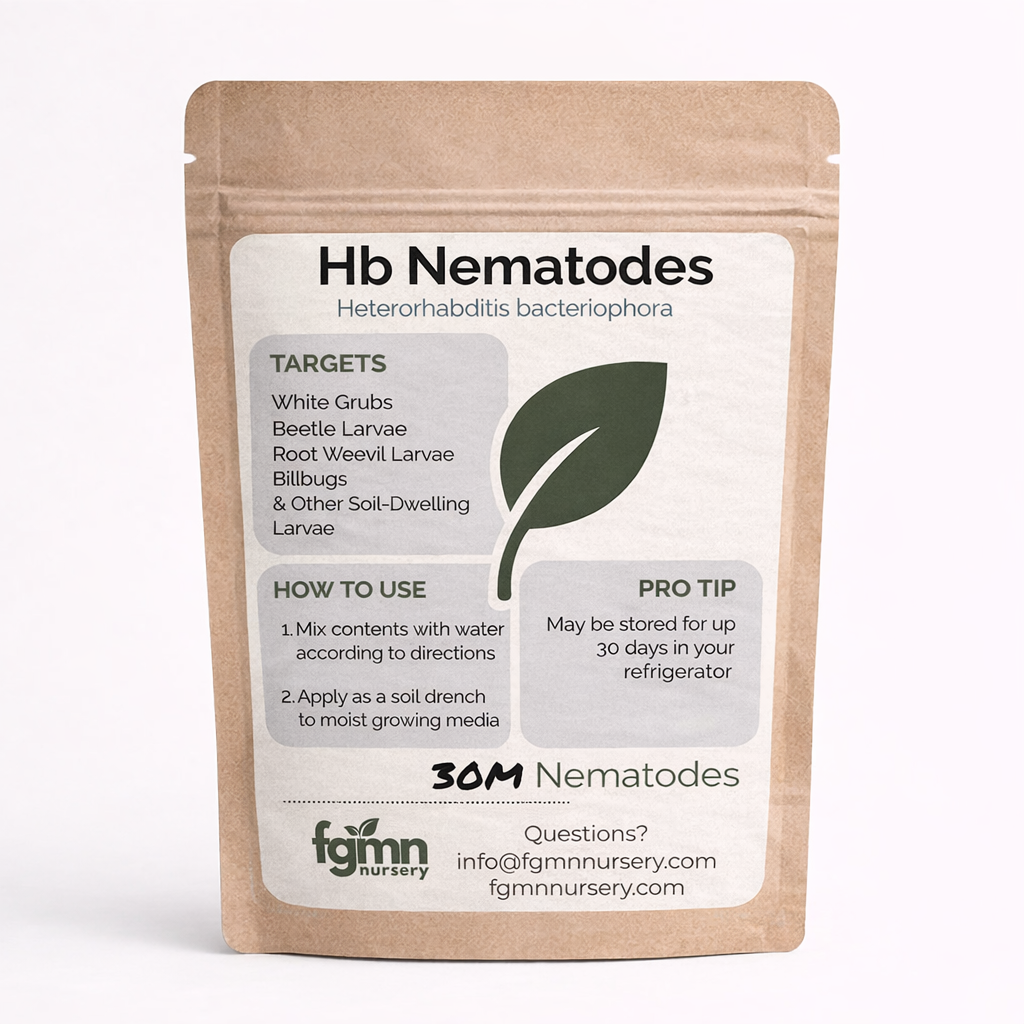
Hb Nematodes
The deep hunter — six to eight inches down after the grubs eating your roots, and one of the few nematodes that reaches an ant queen.
$45.00
Free Shipping for all orders over $30
If something's wrong when it arrives, file a report within 72 hours of delivery for a replacement or store credit.
By placing your order you agree to our Shipping Policy and Live Delivery Guarantee.
How much, and how often
Two questions — how bad it is, and how many plants. You get a size and the dates to put it out.
How bad is it?
Pick the one that sounds like your room. If you are between two, take the higher.
How many square feet?
Six-inch pots. Count a large specimen with a dense canopy as three or four.
Your size and schedule
More about this dose
The three things people ask once they have their size. Open any of them.
Am I light, moderate or heavy?
Light
- A few beetles about last summer, nothing visible in the turf
- You are treating in August as insurance
- No yellow patches yet
Moderate
- Yellow patches starting to show
- Turf feels spongy underfoot
- A few grubs when you cut a square and lift it
- An ornamental wilting with no obvious cause
Heavy
- Turf lifting like a carpet where the roots have gone
- Skunks or birds digging the lawn up
- Several grubs per square foot
- Patches joining up
The honest test is a spade. Cut a square foot of turf, lift it, and count the grubs underneath. A handful in a square foot is heavy pressure and wants the curative rate; one or two is light and the preventative rate will hold it.
On visible grub damage the curative rate is simply a different application: the same package over half the area, repeated. Spreading a preventative dose over an active infestation is the classic way to spend the money and not fix the lawn — the nematodes are real, there are just not enough of them per square foot to find the grubs.
Why more than one round?
Putting it out
- Mow short and water thoroughly first, so the nematodes can reach the soil instead of sitting on grass blades.
- Dissolve the carrier in dechlorinated water and stir well. Clumps are normal — break them up; they are carrier, not nematodes.
- Apply in the evening. UV kills infective juveniles on exposed surfaces. Use a hose-end sprayer on free flow or a watering can, with any mesh filter removed.
- Agitate constantly. They settle within minutes in a full can, so swirl between passes or your coverage is a lottery.
- Water again straight afterwards to wash them off the blades and down into the root zone — then keep the soil moist for at least two weeks.
Everything else is optional. Get these four and the release has done what it can.
A cleaner way
On a display plant, tip small piles into bio-boxes or paper cups hung in the branches instead of dusting the foliage. Same dose, nothing visible on the leaf.
The failure is forgetting. Very few programs fail because the mite underperformed. They fail in week five, when the plants look fine, the reorder does not happen, and the population holding the line ages out with nothing behind it.
A schedule is the same decision, made once. A pack when it looks bad, then another when it looks bad again, is already a rhythm — just one you have to remember at the exact moment the plants look fine.
Change the size or the frequency, skip a box, pause or cancel from your account at any time.
Is this the right beneficial for your problem?
Five questions, in the order a grower actually asks them: what have you got, is this the answer to it, what will it eat, how does it do the killing, and will it survive your room.
Is this your pest?
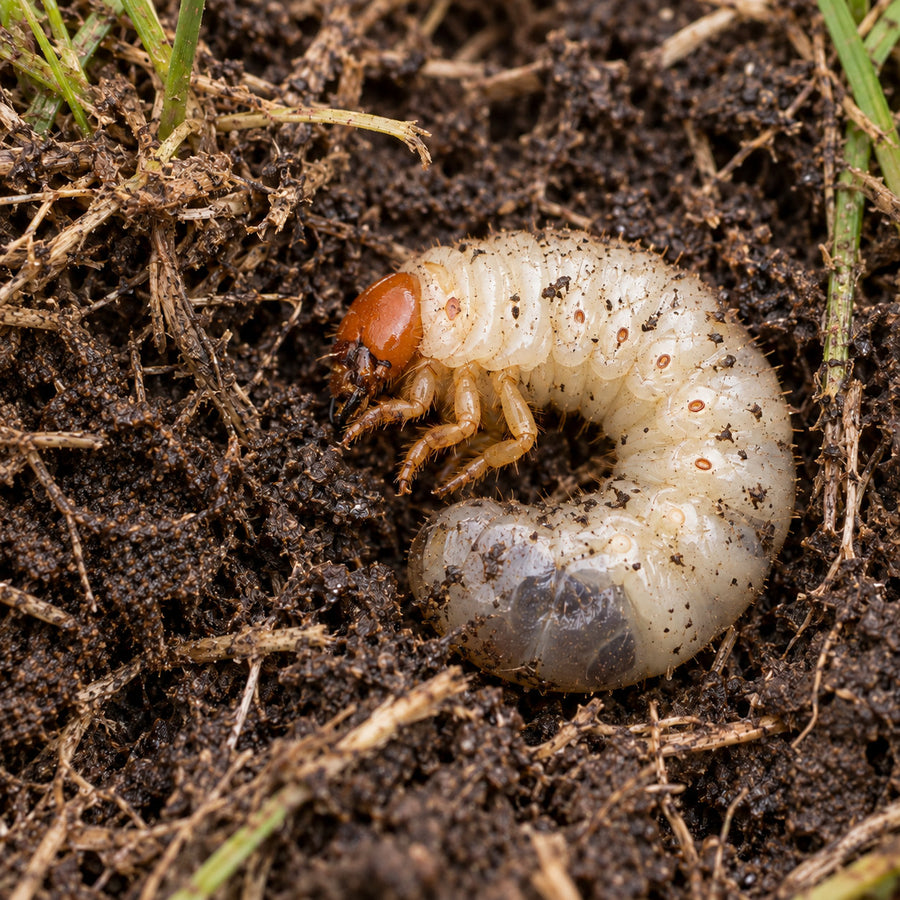
Hb is the deep hunter. Everything on its list is a fat, slow larva living several inches down and eating roots. If your problem is at the surface or in a pot, a different species does it better.
Grub damage reads from above before you ever see the insect: patches of lawn yellowing and thinning, turf that lifts like a carpet because the roots underneath have been chewed away, and sometimes skunks or birds digging it up to get at them. On ornamentals it is a plant that wilts for no visible reason.
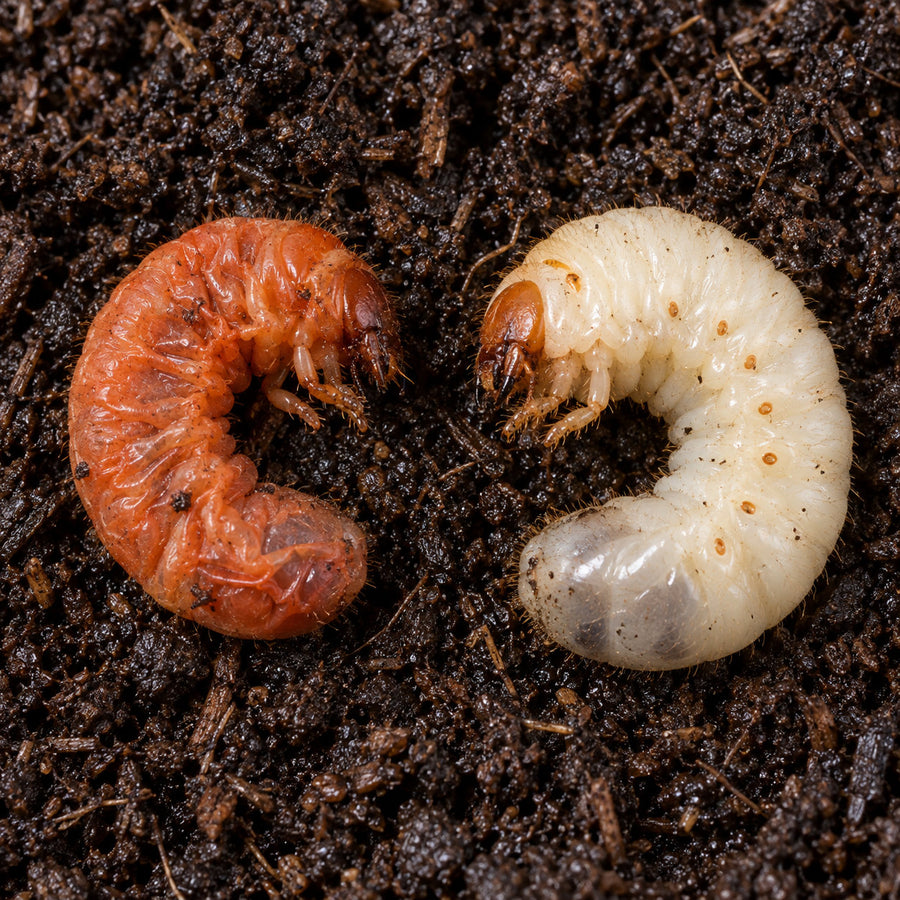
Underneath, the grubs themselves are unmistakable — fat, white, C-shaped, with a brown head. Japanese beetle, European chafer, masked chafer and June beetle all look much the same at that stage, and all of them are on this list.
Then: are Hb nematodes the right answer to it?
Choose this if
Choose Hb for grubs and root weevils in real soil. It is a cruiser — it actively tunnels down through the soil column hunting rather than waiting for something to walk past, and it will go six to eight inches or more in loose ground, which is deeper than any other species we sell. It bores straight through the host's cuticle, so nothing has to be swallowed for it to work. It is also one of the few nematodes effective against ants, because it can reach the queen deep in the nest.
Choose something else if
It is the most heat-tolerant and the least cold-tolerant of the three species, so this is a summer application rather than an early spring one. It is too deep-diving and too expensive for fungus gnat larvae in a pot, and too slow for fast surface movers like fleas. And it needs real moisture — dry soil stops it dead.
What it kills, and what it won't
It will not stop the beetles already flying around your roses. Hb kills the grubs in the ground so that they never become next year's beetles — a population strategy rather than a quick spray.
How it works
What it does to the pest, what it does on the plant, and what that leaves you looking at.
It bores in and lets the bacteria finish
The infective juvenile finds a grub, bores directly through its cuticle and releases its symbiotic bacteria. The host dies within 24 to 48 hours. No poison on your soil, no residue, and nothing for a grub to develop resistance to.
It goes and looks
Hb is a cruiser rather than an ambusher. It travels through the water film between soil particles, actively tunnelling toward hosts — six to eight inches down in loose ground, which is where the grubs that matter actually are.
A brick-red grub
The bacteria Hb carries turn a dead host a distinct reddish-brown within a day or two. Nothing above ground shows it, but if you want proof rather than patience, dig one up at four days and look at the colour.
Timing decides this one. Late summer to early autumn, August and September, is when the eggs hatch into young vulnerable grubs. Treating in spring is harder because by then they are large, tough and about to pupate.
Will it work in your soil?
Three things. Soil type — they move well in sand and loam but struggle in heavily compacted clay without aeration. Chemicals — no high-nitrogen fertiliser or herbicide for 72 hours either side, because chemical salts dehydrate them. And timing: August to September is the window that actually works.
About Hb nematodes
Microscopic roundworms that hunt several inches down in the soil. Millions of them arrive in a package that weighs almost nothing, and they are alive.
New to beneficials?
Five things that catch almost everyone the first time.
After you apply it
What actually changes, how to check rather than guess, and the one thing you can dig up.
How you'll know it's working
Hosts die within 24 to 48 hours, and nothing above ground shows it. What you notice instead is damage stopping — turf that stops thinning, plants that stop wilting for no visible reason.
If you would rather have proof than patience, dig one up at about four days and look at the colour. A grub killed by Hb turns a distinct brick red, which is the bacteria it carries rather than the nematode itself.
It will not do anything about the beetles already flying. Those are this year's adults, out of reach; Hb is what stops them being next year's as well.
Getting it to you
What is in the pack, how it travels, and what happens if it arrives wrong.

What arrives
Live infective juveniles on a moist inert carrier, shipped dormant as a powder or gel. Millions of them, in a package that weighs almost nothing.
The paste or powder looks completely inactive until it meets water, and it may arrive clumpy from absorbing moisture in transit. That is normal — break it up vigorously in the bucket.
Into the fridge on arrival. 38–42°F, and never the freezer. Hb has the shortest shelf life of any nematode we ship, so the cold chain is genuinely the whole job on your end.
When it ships, and when it lands
Shipping
We ship when they're ready to travel. Live orders go out Monday to Thursday. If a colony needs a beat to peak, or we're propagating a fresh batch, yours might hold up to a week. All mites and insects ship 2-day or Overnight depending on what's best for them.
When it lands
Fridge first, then an evening job. Mow short and water the ground thoroughly. Dissolve the carrier in dechlorinated water and stir well. Apply with a hose-end sprayer on free flow or a watering can, with any mesh filter removed, agitating as you go. Then water again immediately to wash them off the grass blades and down into the root zone, and keep the soil moist for a fortnight.
About the ones that don't make it
Some of them die on the way. That is why we send more than you paid for.
A nematode is microscopic, and it ships dormant in a pouch, in a van, for two days.
Roughly 15% will not survive that. We cannot prevent it, so we price it in: the number on the label gets counted out, and then the cushion goes in on top of it.
Your 80-million pack leaves here holding more than 80 million. The dead ones are already paid for.
If you can see them
Ladybugs, lacewing larvae, Orius — the minute pirate bug — and the beetles. Tip a few onto white paper and give them twenty minutes at room temperature before you judge anybody.
Cold insects are genuinely good at playing dead. The deceased have been known to get up and walk off the counter.
Still more than about one in seven not moving? Photograph them and file a report.
The photo is not us doubting you. It is how we tell a bad batch from a bad courier day from a mailbox that hit 104°F.
If you can't see them
Mites, nematodes, eggs — most of what we sell, and this one more than any of it. A pouch of carrier looks identical whether it holds 80 million live nematodes or none, and no photograph settles that. So we don't ask you to take one.
You file the report and our entomologist takes you through the diagnostic instead — the tap test on dark paper, where the box sat, what your room was doing, and then what the pest is doing about ten days later.
Worth saying plainly: Hb is the most heat-sensitive thing we ship, and a pack that spent an afternoon in a hot mailbox is a real failure mode. We would rather hear about it than have you drench and wonder.
Seventy-two hours from delivery, either way, with your order number. Replacement or store credit, your pick.
What it does not reach
Three gaps this page has already named, and the beneficial that closes each one.
Hb is overkill for a gnat larva
Hb is the deep hunter — six to eight inches down, after big slow grubs. Fungus gnat larvae live in the top inch of a pot, and Steinernema feltiae is both cheaper and better at that depth, as well as staying active in the cooler soil an indoor pot actually sits at.
Hb cruises; Sc ambushes
The two species hunt in opposite ways. Hb tunnels after slow, deep hosts. Fast surface movers — fleas, caterpillars, cutworms — outrun it, and those want Steinernema carpocapsae, which waits near the surface and strikes what passes.
Three species, every soil depth
Pure Hb is the concentrated answer to a single problem: grubs eating roots six inches down. If you have grubs and surface pests — fleas, gnats, weevils in different places — the Triple Blend covers every depth at once rather than making you choose which problem to solve first.
Two cheap things that make the rest work harder. Blue cards give you the dated count this page keeps asking you to read. Breeder's Blend is pollen and Artemia; it keeps the population fed through the lull when prey gets scarce.
Questions
When is the best time to apply for Japanese Beetles?
The ideal window is Late Summer to Early Fall (August–September). This is when the beetle eggs hatch into young, vulnerable grubs. Treating in Spring is harder because the grubs are large, tough, and about to pupate.
Will this stop the beetles flying around my roses?
Not immediately. Hb kills the larvae (grubs) in the ground, preventing them from turning into beetles next year. It is a long-term population control strategy, not a quick spray for adult beetles on leaves.
My lawn is brown. Is it too late?
If the grass is already dead (pulls up like a carpet), the roots are gone. However, applying Hb now will kill the grubs before they spread to the green parts of your lawn or return next year.
Can I use weed and feed products?
Avoid using high-nitrogen chemical fertilizers or herbicides for 72 hours before and after application. High chemical salts can dehydrate the nematodes.
How deep do they go?
Hb nematodes are capable of digging down 6–8 inches or more in loose soil to find prey, which is significantly deeper than other species like Sc or Sf.
Why is the carrier powder clumpy?
The carrier material can absorb moisture during transit. This is normal. Just break it up vigorously in the water bucket before pouring it into your sprayer. The clumps are just carrier; the nematodes will dissolve out into the water.