

Generalist · Soil Pests
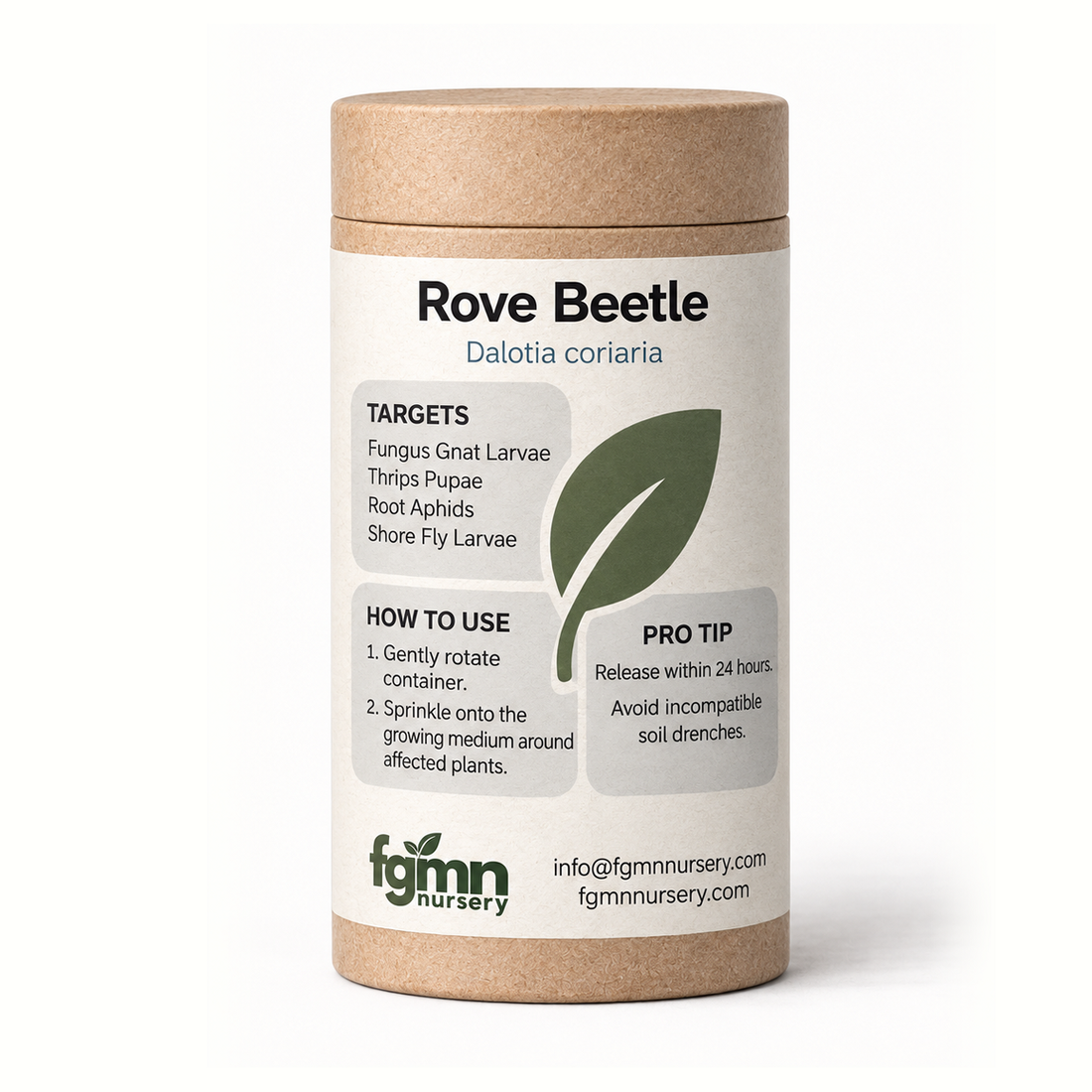
Dalotia coriaria - Rove Beetle
It flies, it breeds in your media, and it takes the thrips pupae hiding in the soil while you treat the canopy.
$20.00
Free Shipping for all orders over $30
If something's wrong when it arrives, file a report within 72 hours of delivery for a replacement or store credit.
By placing your order you agree to our Shipping Policy and Live Delivery Guarantee.
How much, and how often
Two questions — how bad it is, and how many plants. You get a size and the dates to put it out.
How bad is it?
Pick the one that sounds like your room. If you are between two, take the higher.
How many pots?
Six-inch pots. Count a large specimen with a dense canopy as three or four.
Your size and schedule
More about this dose
The three things people ask once they have their size. Open any of them.
Am I light, moderate or heavy?
Light
- A few gnats lifting off when you water
- One or two on a yellow card a week
- Only the wettest pot affected
Moderate
- Gnats up whenever you disturb a pot
- Cards filling steadily between checks
- Several pots affected across a shelf
- Seedlings or cuttings stalling for no obvious reason
Heavy
- Gnats in the air without anyone touching a plant
- Cards black between checks
- Larvae visible in the top layer when you scrape it back
- Shore flies as well as gnats
Count pots rather than plants for this one, and count every pot in the room rather than the ones you have noticed gnats around — the beetles will find the others, but only if there are enough of them to go round.
Under-seeding is the usual mistake here, and it is a false economy: too few beetles spread across too many pots never reach the density where they find each other and breed. Better to load two or three pots heavily as breeding stations and let them colonise outward than to sprinkle a thin dose over everything.
Why more than one round?
Putting it out
- Turn intense grow lights down first. Released under bright light they fly at the bulbs instead of settling.
- Tap small piles of the carrier onto the soil. Onto moist media or a rockwool block, never onto foliage.
- Do not spread the mix thin. Piles are breeding centres — they help the beetles find mates and establish immediately, and they fan out on their own from there.
- Put the piles where the pests are: the base of plants, near drain holes, the corners of grow beds, and above all the wettest pots.
- No watering over the piles for 24 hours, so they can burrow in — then keep the top layer damp from there on.
Everything else is optional. Get these four and the release has done what it can.
A cleaner way
On a display plant, tip small piles into bio-boxes or paper cups hung in the branches instead of dusting the foliage. Same dose, nothing visible on the leaf.
The failure is forgetting. Very few programs fail because the mite underperformed. They fail in week five, when the plants look fine, the reorder does not happen, and the population holding the line ages out with nothing behind it.
A schedule is the same decision, made once. A bottle when it looks bad, then another when it looks bad again, is already a rhythm — just one you have to remember at the exact moment the plants look fine.
Change the size or the frequency, skip a box, pause or cancel from your account at any time.
Is this the right beneficial for your problem?
Five questions, in the order a grower actually asks them: what have you got, is this the answer to it, what will it eat, how does it do the killing, and will it survive your room.
Is this your pest?
Everything this beetle hunts lives in the top layer of your media. If your problem is on the leaves, the product you want is a different one.
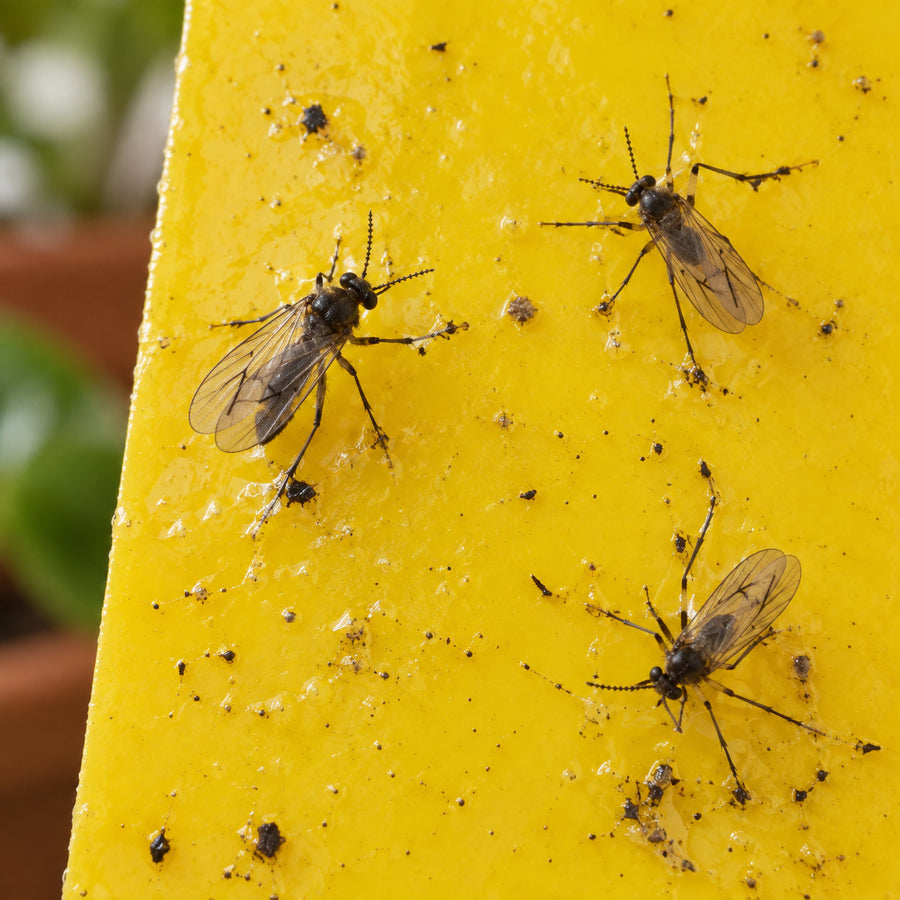
Fungus gnats are the small dark flies that lift off the soil when you water. The adults are harmless and annoying; the larvae in the media are the ones eating fine roots. Shore flies look similar but stockier, with pale spots on the wings, and many predators ignore them entirely.
And the third thing down there is thrips. Most thrips drop off the leaf to pupate in the top few centimetres of soil — the stage that survives everything you spray on the canopy. This beetle reaches all three.
Then: is Dalotia the right answer to it?
Choose this if
Choose rove beetles for a large tent, a greenhouse, or shelves that are not next to each other — they fly, so one release point colonises a whole room without your help. Both the adults and the larvae hunt, ten to twenty prey a day each, and they take shore fly eggs as well as larvae, which most predators will not. In moist media they breed and stay, so a single release can become a permanent colony.
Choose something else if
They need moist organic media — soil, coco, peat, moss — to reproduce, and they will not work a dry substrate. They are nocturnal and hide from bright light, so you will rarely see them. And if you keep a springtail culture in the same pots, know that rove beetles eat springtails on encounter.
What it kills, and what it won't
One honest note: rove beetles also take springtails and other soil decomposers on encounter. That is a fact about them rather than a reason to buy them — and a reason not to run them in a pot that is carrying a springtail culture.
How it works
What it does to the pest, what it does on the plant, and what that leaves you looking at.
It hunts, it does not wait
A 3 to 4mm beetle that searches actively through the top layer of the media, and eats ten to twenty prey a day. The larvae — pale, thin, dark-headed, and easily mistaken for something unpleasant in the bottle — are just as ferocious and do a great deal of the hunting.
It colonises the room
Both stages fly, which is the real advantage over a soil mite: one release point finds hot spots across a whole room, moves between disconnected shelves, and gets to the wet pot in the corner you had not thought about.
A population, not a treatment
Egg to adult is about 21 days and adults live another three or four weeks, so in moist media the numbers build rather than run out. That is why this keeps working long after a one-shot drench would have finished.
Do not spread the carrier thin. Small piles on the soil surface act as breeding centres — they help the beetles find each other and establish a colony immediately, and they fan out from there on their own.
Will it work in your room?
Two things. The top layer of your media needs to stay damp for the first few weeks or they will neither work nor breed. And if you run a bioactive enclosure with a springtail cleanup crew, these beetles will eat into it — that is worth knowing before rather than after.
About Dalotia coriaria
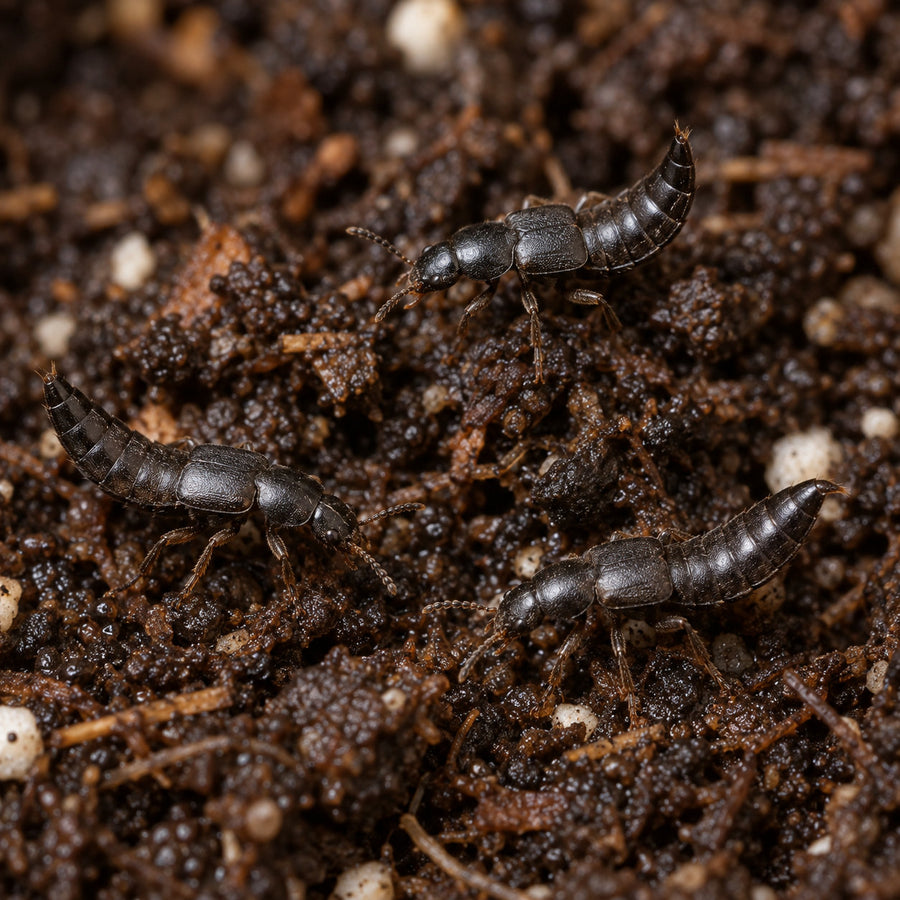
A 3 to 4mm rove beetle that hunts through the top layer of your media. Dark, narrow and fast, nocturnal, and entirely uninterested in you or your plants.
New to beneficials?
Five things that catch almost everyone the first time.
After you release it
What actually changes, how fast, and why this one keeps going.
How you'll know it's working
Fewer adult gnats — and track that on a yellow card rather than by eye, because judging a gnat population by how many fly up when you water is a good way to convince yourself nothing has changed.
You will rarely see the beetles themselves. They are nocturnal and they hide, which is exactly what they are supposed to do. The card count is the honest measure.
Unlike a drench, these establish. In moist media the population builds and stays, which is why the numbers keep falling in the second month rather than creeping back.
Getting it to you
What is in the bottle, how it travels, and what happens if it arrives wrong.
What arrives
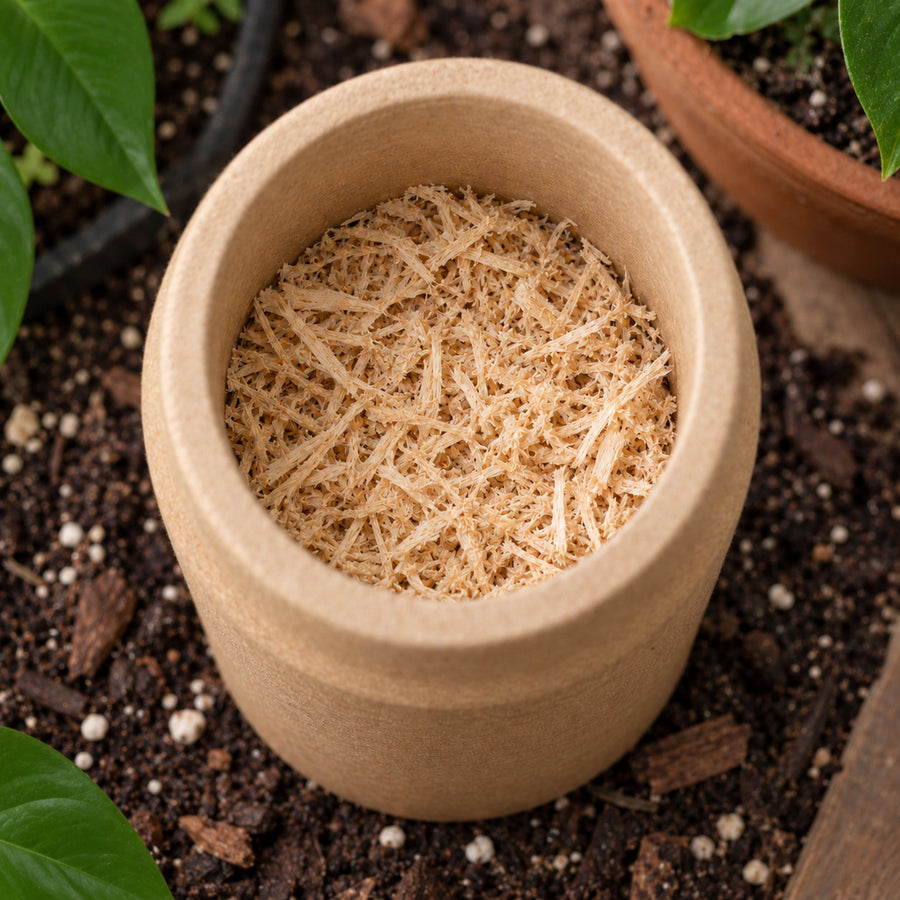
A mix of life stages — adult beetles, pale worm-like larvae and pupae — in a peat and vermiculite carrier, shipped 2-day express.
They are dark, narrow and fast, and they curl their tails up when disturbed, which reads as menacing and is entirely for show. The whole carrier goes onto the soil.
Release the evening it arrives. These are high-energy hunters with a short shelf life and they do not hold in a container. Turn intense grow lights down first, or they fly at the bulbs.
When it ships, and when it lands
Shipping
We ship when they're ready to travel. Live orders go out Monday to Thursday. If a colony needs a beat to peak, or we're propagating a fresh batch, yours might hold up to a week. All mites and insects ship 2-day or Overnight depending on what's best for them.
When it lands
Open it that evening, lights low. Tap small piles of the carrier onto moist soil surfaces — near the base of plants, near drain holes, in the corners of grow beds — concentrating on the wettest pots, because that is where the gnat larvae are. Then leave them alone: no watering directly over the piles for 24 hours while they burrow in.
About the ones that don't make it
Some of them die on the way. That is why we send more than you paid for.
A 3mm beetle with a very high metabolism ships in a bottle, in a van, for two days.
Roughly 15% will not survive that. We cannot prevent it, so we price it in: the number on the label gets counted out, and then the cushion goes in on top of it.
Your 250-beetle bottle leaves here holding more than 250. The ones that do not make it are already paid for.
If you can see them
Ladybugs, lacewing larvae, Orius — the minute pirate bug — and the beetles. Tip a few onto white paper and give them twenty minutes at room temperature before you judge anybody.
Cold insects are genuinely good at playing dead. The deceased have been known to get up and walk off the counter.
Still more than about one in seven not moving? Photograph them and file a report.
The photo is not us doubting you. It is how we tell a bad batch from a bad courier day from a mailbox that hit 104°F.
If you can't see them
Mites, nematodes, eggs — most of what we sell. Not this one: rove beetles are visible and quick, so the paper test above is the one that applies to you. Give them the twenty minutes first — a cold beetle is a convincing corpse.
You file the report and our entomologist takes you through the diagnostic instead — the tap test on dark paper, where the box sat, what your room was doing, and then what the pest is doing about ten days later.
We spell the other half out here so you can see the policy is the same either way.
Seventy-two hours from delivery, either way, with your order number. Replacement or store credit, your pick.
What it does not reach
Three gaps this page has already named, and the beneficial that closes each one.
The beetle flies; the mite stays put
Commercial programmes run both: the beetles do the bulk hunting and cover the room, the mites work the soil depth and stay in the pot you put them in. One thing to know up front — Dalotia competes with Stratiolaelaps and will eat some. Running both is still worth it; expecting two full populations out of one substrate is not.
Nematodes knock it down; beetles keep it down
For a massive infestation, Sf nematodes go in as a drench and work faster than anything else we sell. What they do not do is persist — they are a treatment, not a population. Nematodes to crash the numbers, beetles to hold the ground afterwards, is the sequence that ends a fungus gnat problem rather than managing it.
Cards down for ten days, then hang them high
Rove beetles fly, so a sticky card catches them too. Take yours down for seven to ten days while the colony establishes, then put them back — but higher up, away from the soil line. That catches the adult gnats without catching your beetles, and the count on the card is how you will actually know this worked.
Two cheap things that make the rest work harder. Blue cards give you the dated count this page keeps asking you to read. Breeder's Blend is pollen and Artemia; it keeps the population fed through the lull when prey gets scarce.
Questions
Do they fly? Will they infest my house?
Yes, they fly to hunt, but they prefer to stay near the soil where the food is. They are beneficial insects, not pests, and will naturally die off or disperse once their food source (the pests) is eliminated. They do not infest furniture or pantries.
I see "worms" in the bottle. Are those pests?
No! Those are the Rove Beetle larvae. They look like tiny, pale worms with a darker head. They are just as ferocious as the adults and do a significant amount of the hunting in the soil.
Are they safe for my reptile or terrarium?
Yes. Dalotia coriaria are harmless to vertebrates. In bioactive enclosures, they are a premium "Clean Up Crew" member because they eat mold, fungus, and rotting organic matter in addition to pests.
Why do they curl their tails up?
When threatened, Rove Beetles curl their abdomen up like a scorpion. This is purely a bluff to look scary! They do not have a stinger and cannot bite or harm humans.
Can I use sticky traps with them?
Use caution. Because Rove Beetles fly, they can get caught on yellow sticky traps. We recommend removing sticky traps for 7–10 days after release to allow the beetles to establish. Afterward, place traps higher up (away from the soil line) to catch adult gnats without trapping your beetles.
How long do they live?
The total lifecycle is about 21 days from egg to adult, and adults live for another 3–4 weeks. However, because they reproduce quickly, a single release can establish a permanent colony as long as there is food available.