




What to establish first, which additions are optional, and what to do when pests or struggling plants change the plan.
Decomposition starts beneath the plants. Pest control and root support are different jobs.
A new bioactive enclosure can turn into a surprisingly long shopping list. Springtails, isopods, predatory mites, fungi, bacteria. Somewhere between choosing the plants and ordering the fourth culture, it becomes unclear whether you are building a habitat or staffing a small company.
You do not need every organism with “beneficial” in its description. Start by deciding which work needs doing. A cleanup crew helps process organic material. Pest predators address particular pests. Root microbes are optional additions that may support compatible plants. These are different decisions, made at different points in the setup.
Start with the enclosure you actually have
For a new enclosure, the first job is establishing suitable conditions and a manageable living substrate. For an established enclosure that is doing well, there may be nothing to add. For one with a problem, identify that problem before choosing another organism.
This guide concerns planted terrestrial enclosures. A pond or aquarium section needs its own water-quality and filtration plan; adding root microbes is not a substitute for establishing an aquatic biological filter.
Write down the intended inhabitants, their temperature and moisture requirements, the plants, and how you will manage drainage and ventilation. Choose supporting organisms that can live within those conditions. A humid frog vivarium and a drier reptile enclosure should not receive an identical recipe.
| Your starting point | First decision | Additions to consider |
|---|---|---|
| New planted enclosure | Set conditions for the inhabitants and plants. | A suitable cleanup crew; optional root inoculants at planting. |
| Established and doing well | Continue the maintenance that is working. | No new organism is automatically needed. |
| Confirmed pest problem | Identify the pest and where its vulnerable stage lives. | A matching predator or treatment, after checking enclosure compatibility. |
| Plants declining | Check light, moisture, drainage, roots, and pests. | Correct the cause before deciding whether a root microbe has a useful role. |
Build the habitat before adding the helpers
Set up the substrate, drainage access, ventilation, lighting, and moisture routine first. Check conditions where the inhabitants will actually spend time. Do not make the entire enclosure wetter to accommodate an addition, or dry it beyond the resident animal’s needs to follow ordinary houseplant pest advice.
Plant next. This is the convenient point to apply a suitable root inoculant, if you choose one, because the roots are accessible. Then introduce a cleanup crew selected for that habitat and provide its appropriate leaf litter, shelter, and food. These steps can overlap; the important sequence is that usable habitat comes before expecting organisms to establish.
Let the planted setup settle while you check that its conditions hold. Animal introduction also depends on species-specific husbandry and quarantine. A calendar alone cannot certify that a vivarium is ready.

Make the cleanup crew part of the starting plan
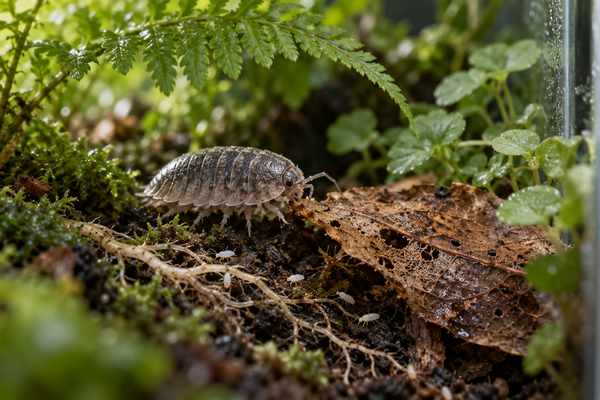
Many springtails feed on fungi, algae, and organic matter in soil and leaf litter. Isopods chew decaying plant material, breaking it into smaller pieces that microbes can continue to process. That is useful work beneath living plants. It also explains why an enclosure needs appropriate food and habitat for its cleanup crew, rather than simply a starter population.

Decomposition changes material; it does not make everything vanish. Nutrients can move into microbes, cleanup organisms, and plants, while some carbon leaves as carbon dioxide. Waste processing is therefore different from disinfection. An enclosure looking cleaner does not prove that pathogens are gone.
Keep removing accessible animal waste and uneaten food, and maintain water dishes and other animal-contact surfaces. If an animal is ill or needs quarantine, an easily cleaned setup may be more appropriate than preserving an elaborate living substrate. Veterinary husbandry guidance takes priority over keeping the cleanup crew undisturbed.
Isopods also are not universally plant-neutral. Some feed on tender living plants. Choose species for the enclosure’s inhabitants, moisture, and food supply rather than treating every culture as interchangeable.
Decide on root microbes while planting
You can build a functioning bioactive enclosure without buying a separate root inoculant. Consider one when you have a compatible plant and a reason to support root establishment, rather than adding it simply because the enclosure is new.
Mycorrhizal fungi form partnerships with compatible plant roots. Fine fungal threads reach into the surrounding substrate and can help the plant obtain nutrients, especially phosphorus. The plant supplies carbon in return. This is an exchange, not fertilizer appearing from nowhere.
For an enclosure keeper, that means a suitable inoculant belongs near compatible living roots. Sprinkling it across a rock wall or expecting it to digest animal droppings misses its main purpose. Plants and fungi must be a suitable match; an ordinary arbuscular mycorrhizal blend is not a universal inoculant for every plant, including orchids.
Added fungi may provide little noticeable benefit where appropriate fungi are already present or nutrients are readily available. High phosphorus can reduce mycorrhizal colonization. More inoculant is not automatically more benefit.
Trichoderma and plant growth-promoting bacteria are different again. Certain strains can colonize roots, compete with some plant pathogens, influence root development, or make existing nutrients easier for plants to access. Those abilities depend on the strain, plant, and conditions. A genus name on a package is not a guarantee that it performs every useful trick reported for that group.
The practical expectation is possible support for plant establishment and growth over time—not visible overnight transformation. None of these additions repairs roots that are continually deprived of oxygen in waterlogged substrate.
Follow the chosen product’s directions for root contact, dilution, and application. Place it where roots can encounter it, rather than distributing it decoratively over the whole enclosure. For an established planting, avoid uprooting healthy plants just to add an optional product. Do not invent a monthly redosing routine unless the product’s instructions and your purpose call for it.

Add pest control for a defined reason
Predators are a targeted part of the plan, not a mandatory ingredient in every new enclosure. Preventive use can make sense when a particular pest is a recurring, credible risk. “Something might arrive” is not enough to select the right predator.
For confirmed fungus gnats, Stratiolaelaps scimitus targets larvae near the substrate surface. Steinernema feltiae is another organism used against fungus gnat larvae in growing media. Neither is a replacement for the cleanup crew, and neither should be expected to remove the adults already flying around immediately.
Check the release instructions for the actual product and growing area. A bottle intended for a greenhouse bench is not automatically an appropriate whole-enclosure dose. Apply soil-targeted organisms to the suitable moist substrate described in their instructions, not into standing drainage water. The animal and product compatibility check below comes before release.

Does Stratiolaelaps consume springtails?
Stratiolaelaps scimitus is a soil-dwelling predatory mite used against fungus gnat larvae. Springtails are also listed among its prey in university extension guidance. But whether a predator can eat an animal and whether it meaningfully reduces that animal’s population in a planted enclosure are different questions.
A 2024 study of springtail cultures illustrates why that distinction matters. Researchers observed predatory mites consuming Arrhopalites caecus and collapsing cultures, but identified the mites only tentatively as S. scimitus or a related species. In their Folsomia candida cultures, they observed no significant predation or population decline. These were laboratory culture observations, not a controlled test of releasing confirmed S. scimitus into bioactive vivariums.[1]
The evidence reviewed here does not establish that adding S. scimitus to a bioactive vivarium causes a meaningful decline in its springtail population or impairs the cleanup crew’s work. That is not proof that an effect is impossible; it means the connection has not been demonstrated for this setting. A prey list is not a forecast for your enclosure.
Check compatibility before anything goes in
A plant-only terrarium and a vivarium containing frogs, geckos, or invertebrates are different use cases. Amphibian husbandry guidance, for example, specifically calls for substrate without chemical additives such as fungicides. Products sold for plants can contain carriers, fertilizers, preservatives, or other ingredients beyond the named organism.
Before using an addition in an occupied enclosure, establish what the complete product contains and whether its intended use is appropriate for those inhabitants. Where that information is missing, obtain product-specific guidance from the manufacturer and an experienced exotic-animal veterinarian. “Natural” does not answer that question.
This matters particularly in invertebrate enclosures: an organism chosen because it attacks insects may conflict with the animal you are keeping. Removing the resident during application does not necessarily remove later exposure once it returns.
Three plans you can actually follow
These examples show the decision process. They are not species-specific stocking or dosing recipes.
A new humid planted vivarium
Establish the humidity, temperature, drainage, and ventilation required by its future inhabitants. Plant it, deciding then whether an appropriate root inoculant is useful. Introduce a suitable springtail culture and, where appropriate, isopods, with the habitat and food those species need. Leave pest predators off the initial list unless there is a defined pest risk to address.
Watch whether the plants settle and the intended moisture conditions remain stable. Remove uneaten supplemental food rather than adding more to force the cleanup crew to multiply. The goal is a workable habitat, not the largest possible population.
An established enclosure with fungus gnats
Confirm that the flies are fungus gnats. Check for excess food, decaying plant material, and unwanted standing water while retaining the moisture the residents need. Select an appropriate larval control only after checking the complete product’s suitability for this enclosure. Record when you apply it and reassess the pest trend over subsequent checks.
Success means fewer gnats emerging over time—not necessarily an empty enclosure the next morning. If the problem persists, review identification, application, and conditions before stacking on more treatments. Follow the selected treatment’s guidance on repeats.
An enclosure with healthy cleanup organisms but declining plants
Do not assume that active springtails mean the roots are healthy. Check whether the plants receive suitable light, whether the root area stays waterlogged or dries excessively, and whether there are pests or damaged roots. Correct those conditions first. A root inoculant may have a supporting role afterward; it cannot make inadequate light or poor drainage disappear.
Follow the condition of new growth and whether decline stops. Existing damaged leaves may remain damaged. Growth also cannot prove that a purchased microbe established—several things may have changed at once.

Keep a small plan, not a permanent shopping list
For each addition, write down its job, where it goes, the product’s application instructions, and the change you expect to see. Note the starting condition and application date. That gives you something useful to compare with later.
A working enclosure still needs accessible waste removed, water maintained, and conditions checked. The goal is to give living processes useful work and enough support to do it. You remain responsible for the parts that do not fit in a culture cup.
Sources and further reading
Feeding biology and plant-microbe evidence below come largely from soil and horticultural research. They are not blanket safety trials for occupied vivariums.
- Martin, Sibley, and Prosser (2024). Characterization of Springtail (Arrhopalites caecus) for Use in Soil Ecotoxicity Testing. Environmental Toxicology and Chemistry, 43, 1820–1835. Laboratory culture observations; predator identification was tentative, and effects differed between springtail species.
- Wisconsin Horticulture — Springtails.
- Penn State Extension — Introduction to Invasive Terrestrial Isopods. Decomposition and potential plant feeding.
- University of Connecticut — Biological Control of Fungus Gnats. Predatory mite prey, including springtails, and nematodes.
- UC IPM — Fungus Gnats.
- Wisconsin Horticulture — Mycorrhizae.
- Washington State University — Mycorrhizal Inoculants, Yea or Nay?
- Mechanisms of Trichoderma–Mediated Plant Growth Promotion: From Metabolites to Plant Responses. Research review.
- Merck Veterinary Manual — Environment and Husbandry for Amphibians.
- Merck Veterinary Manual — Providing a Home for a Reptile.
