Biological control · Mealybugs

Mealybug treatment with the beetle that eats them

Pseudococcidae: citrus, long-tailed and obscure mealybugs

Mealybugs are small, soft insects wrapped in white wax, tucked into leaf joints and along stems, and they leave sticky honeydew behind. Their wax and cottony egg sacs shed sprays, which is why they keep coming back. Cryptolaemus montrouzieri, the mealybug destroyer, eats them wax and all: its larvae disguise themselves as mealybugs, feed inside the colony, even one ants are guarding, and chew into the egg sacs. Deal with ants first, release onto the clusters, and judge it by colonies thinning.

4.9 out of 5 · 24 reviews of our mealybug predators

A colony of citrus mealybugs, crawlers and a cottony egg sac in the leaf joint of a houseplant, with honeydew droplets on the leaf
Egg to adult
about 4–6 weeks in a warm room
Where they hide
leaf joints, stems and leaf undersides
How you'll know
colonies thin, starting where you released
Safe around
people, pets, plants and food crops
Build my mealybug plan

1Confirm it

How do I know it's mealybugs?

White, cottony clusters in leaf joints that squash wet and sticky mean mealybugs. Ants and honeydew are the giveaways.

Getting the pest wrong is the most common reason treatment fails. Check the signs, or answer a few quick questions.

  • White, cottony clusters

    Waxy tufts in leaf joints, along stems and where a leaf meets the trunk

  • Sticky leaves

    Honeydew on the leaves below, often followed by black sooty mold

  • Ants on the plant

    Ants farm mealybugs for their honeydew and guard the colony

  • Growth stalls

    Yellowing, dropped leaves and new growth that stops

Looks like mealybugs, but isn't

Still not sure? Work backwards from the damage or send us a photo.

2Pick a plan

Which mealybug treatment do I need?

Pick by what you see: a whole collection, clusters on a few plants, or wilting with white on the roots.

Find what you're seeing, then add that plan to your cart.

If you see

A whole collection or greenhouse

Colonies scattered across many plants

Cryptolaemus adults fly, so they find colonies you haven't spotted, and the females lay their eggs right inside them. Release near the infestation in the evening or early morning. On a serious infestation, add larvae to the worst clusters too.

$50.00

Arrives alive or we reship it

Start here

If you see

Clusters on a few plants

White tufts in the leaf joints of one or a few plants

Cryptolaemus larvae can't fly, so they stay on the plant you put them on and feed until the colony is gone, egg sacs included. Move them into the clusters with a small paintbrush. Two to five per infested plant, more where the wax is thick.

$25.00

Arrives alive or we reship it

If you see

Wilting, with white on the roots

The plant droops in moist soil; wax on the roots when you unpot

Root mealybugs live below where Cryptolaemus hunts. Stratiolaelaps scimitus is a soil mite you top-dress onto the pot, and it works the root zone. If there are mealybugs on the stems too, run both in the same pot.

$50.00

Arrives alive or we reship it

Good to know: Long-tailed mealybug, the one with long tail filaments and no cottony egg sacs, bears live young. The beetles eat it but can't breed on it, so plan on repeat releases there.

Prefer to build it yourself? Shop each predator. Just want to keep mealybugs out? See prevention. Not sure what you're seeing? Take the quick check.

Or build it yourself

Every mealybug treatment we sell

Bundles first, then each predator on its own. Most programs need one for the leaves and one for the soil.

Filters
Sort by

How it works

What eats mealybugs, and where?

Cryptolaemus larvae work inside the colony and chew into egg sacs; the adults fly to find colonies you missed.

In a warm room a mealybug goes from egg to egg-laying adult in about four to six weeks, and the generations overlap, so eggs, crawlers and adults share the same cluster. The egg sacs are waxy and shed water, which is why a spray knocks back what it touches and the colony returns from the sacs. Females never grow wings; males do, and they look like tiny gnats. Cryptolaemus larvae chew into the egg sacs.

Mealybug life cycle on a houseplant stem: cottony egg sac, crawler, nymph, wax-covered adult female and winged adult male
  1. Eggs are laid in a cottony, water-repellent sac tucked into a leaf joint, hundreds at a time.
  2. Crawlers hatch tiny and pale and spread across the plant before they grow their wax.
  3. Nymphs settle in a protected spot, feed and build their waxy coat.
  4. Adult females are wingless and fully waxed, and lay into a new egg sac for two to three weeks.
  5. Adult males grow wings and look like tiny gnats, with two long white tail threads. They don't feed and fly to females on other plants.

On the leaves

  • Cryptolaemus montrouzieri
    Cryptolaemus montrouzieri

    Eats mealybugs at every stage, egg sacs included

    The larvae: they can't fly, so they stay put. Clusters on a few plants, placed straight into the colony

    from $25

For the flying adults

  • Cryptolaemus montrouzieri
    Cryptolaemus montrouzieri

    Eats mealybugs at every stage

    The adults: they fly to find colonies and lay eggs inside them. Collections and greenhouses

    from $25

In the soil

  • Stratiolaelaps scimitus
    Stratiolaelaps scimitus

    Eats pests in the root zone

    Root mealybugs, alongside Cryptolaemus on the stems. Top-dress and leave it

    from $50
Compare every mealybug predator in one table
Mealybugs predators: where each one works, what it eats and when to choose it
PredatorWorks onEatsBest forFrom
Cryptolaemus montrouzieri Leaves Mealybugs at every stage, egg sacs included The larvae: they can't fly, so they stay put. Clusters on a few plants, placed straight into the colony $25
Cryptolaemus montrouzieri Flying adults Mealybugs at every stage The adults: they fly to find colonies and lay eggs inside them. Collections and greenhouses $25
Stratiolaelaps scimitus Soil Pests in the root zone Root mealybugs, alongside Cryptolaemus on the stems. Top-dress and leave it $50

One generation, start to finish

  1. EggWeek 1
  2. CrawlerWeek 1–2
  3. NymphWeeks 2–5
  4. Adult femaleWeek 5 on
  5. Adult maleWeek 5 on
What happens at each stage
Egg Week 1 · Leaves
Hundreds laid in a cottony, water-repellent sac tucked into a leaf joint
Crawler Week 1–2 · Leaves
Tiny, pale and quick. Spreads across the plant before it grows its wax
Nymph Weeks 2–5 · Leaves
Settles in a protected spot, feeds and builds its waxy coat
Adult female Week 5 on · Leaves
Wingless and fully waxed. Lays for two to three weeks into a new egg sac
Adult male Week 5 on · Air
Tiny, winged and gnat-like, with two long white tail threads. Doesn't feed, lives a day or two, and flies to females on other plants

3After it arrives

How do I release predators for mealybugs?

Ants first, sprays cleared, then larvae into the clusters and adults nearby, in the evening.

  1. Before you order

    1. Confirm it's mealybugs

      Cottony clusters in leaf joints that squash wet and sticky. If it pops off dry, it's armored scale

  2. While it ships

    1. Deal with ants

      Baits or sticky barriers two or three days before release. Ants guard mealybugs and go after predators

    2. Wait out sprays

      Neem is done once it's dry; insecticidal soap needs a day. Synthetic pyrethroids need 8–12 weeks

  3. Release day

    1. Release the day it arrives

      Evening is best. Mist the plants lightly first; the beetles are often thirsty after shipping

    2. Larvae into the clusters

      Move them with a small paintbrush or a leaf tip, straight into the colonies. Don't squeeze them

    3. Adults near the colonies

      Open the container by the infestation in the evening or early morning. Skip the white shirt: they land on light colors

  4. After release

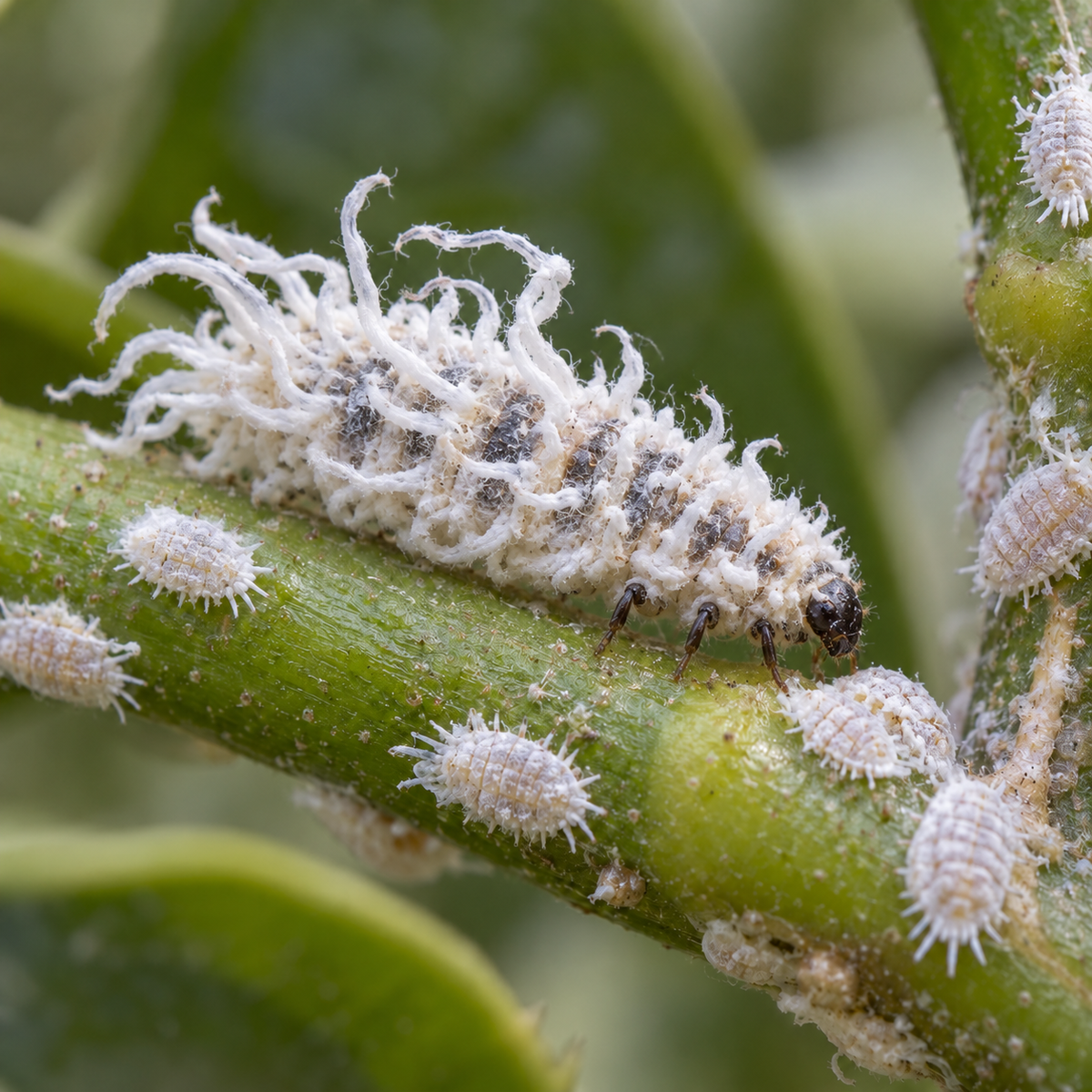
    1. Leave the white larvae alone

      Bigger white ones with long wax strands are yours. Look before you wipe

    2. Repeat if you need to

      Where the beetles can breed, one release often does it. Long-tailed mealybug needs repeat releases

    3. Finish properly

      Keep checking leaf joints until no new colonies turn up two weeks in a row

Conditions they like best

These are the ranges they like best, not hard limits. Short spells outside them won't hurt; only conditions that last for days slow them down.

  • Temperature64–90°FCryptolaemus is a warm-room predator. In a cool room they slow down, and adults may fly off
  • LightBrightUnusually for a predator, adults like light and are busiest on sunny days
  • AntsNone on the plantDeal with them two or three days before release
  • Spray residueClear before releaseNeem once it's dry, soap after a day, synthetic pyrethroids 8–12 weeks

What you'll see

  1. 1Right after release

    Larvae start on the cluster you placed them on. Adults may wander before they settle

  2. 2As it takes hold

    Colonies thin, starting where you released. New white, waxy larvae appear; they're yours

  3. 3Plants pick up

    New growth comes in without clusters. Sooty mold and old damage stay

  4. 4When it's working

    No new colonies two weeks running. Adults move on when the food runs out, and larvae pupate on the stems

Why mealybug treatment fails

Most failed treatments come down to ants, wiping off the larvae, or too few beetles for the colony.

  • Ants left on the plant

    They guard the colony and attack predators. Bait or barrier first

  • The larvae got wiped off

    White fluff after release is often your own larvae. Go by size and wax

  • Too few for the colony

    Two to five per infested plant, more where the wax is thick. Adults leave if there's too little to eat

  • A cool room

    Below about 64°F they slow down and adults may fly off

  • Sprayed just before release

    Residue harms the beetles and covers the scent they hunt by

  • It was armored scale

    If it pops off dry, Cryptolaemus won't touch it. That's a job for Rhyzobius

4Afterwards

How do I keep mealybugs from coming back?

Check new plants' leaf joints before they join the others, and keep ants off your plants.

Mealybugs almost always arrive on a new plant or cutting. Check the leaf joints and stems before a new plant joins the others, and keep it apart for a couple of weeks. Cryptolaemus is for colonies you can see, not insurance: adults leave when there's nothing to eat. If mealybugs keep coming back, check for ants and look at the roots.

Often shows up with mealybugs

Mealybugs questions

More about biological control in the Biocontrol FAQ, or ask us.

How do I know it's mealybugs?

Look for small, soft insects wrapped in white, cottony wax, tucked into leaf joints, along stems and where a leaf meets the trunk. Sticky honeydew on the leaves below, black sooty mold or ants on the plant are the other signs. Press one with a fingernail: mealybugs squash wet and sticky. If it pops off dry, it's armored scale, which needs a different beetle.

What are the tiny flies around my mealybugs?

Probably male mealybugs. Females never grow wings, but males do in their last stage: they're tiny, pale and gnat-like, with two long white threads trailing from the tail. They don't feed and live only a day or two, but they fly to females on other plants, which is how mealybugs turn up on plants that don't touch. Fungus gnats are darker, with long legs, and hang around the soil surface. The males come from the colony, so treat the colony.

I see huge white mealybugs after release. Are those my predators?

Probably. Cryptolaemus larvae wear white wax so they look like mealybugs, which lets them feed inside the colony. Go by size and wax: the larvae are bigger, up to half an inch, with long wax strands sticking out from the top and sides. Mealybugs are smaller, with only short wax around the edge. Look before you wipe anything off.

Larvae or adults?

Larvae can't fly, so they stay on the plant you put them on and feed until the colony is gone. They're the choice for clusters on a few plants. Adults fly, so they find colonies scattered across a collection or greenhouse. On a serious infestation, run both: adults across the room and larvae placed straight into the worst clusters.

Why do mealybugs come back after I spray?

Their wax and their cottony egg sacs shed water, so a spray reaches the mealybugs it touches and misses the eggs inside the sacs. A few weeks later the next generation hatches and the colony is back. Cryptolaemus larvae chew into the egg sacs, and adult females lay their own eggs right inside the colony.

Why did the adults fly away?

Adults fly to find food. If there aren't enough mealybugs to keep them busy, or the room is cool, they move on. A generous release onto a real colony keeps them where you put them. For a small, isolated problem, larvae are the better choice because they can't leave.

Do I need to deal with ants first?

Yes. Ants farm mealybugs for their honeydew and defend them, and they will go after your predators. Put out baits or sticky barriers two or three days before you release. The larvae's wax disguise helps them get inside a guarded colony, but it only gets them so far.

Do they work on root mealybugs?

No. Cryptolaemus hunts on stems and leaves and doesn't go below the soil line. If a plant wilts in moist soil and you find white wax on the roots or the inside of the pot, pair it with a soil predator: Stratiolaelaps scimitus or beneficial nematodes. Both can work in the same pot.

Are mealybug destroyers safe around kids and pets?

Yes. Cryptolaemus montrouzieri is safe around people, pets, plants and food crops. The beetles are strictly carnivorous, don't eat leaves, roots or fruit, and leave no residue.

How many releases will I need?

Where the beetles can breed, one release often does it: they need mealybugs to reproduce, and a real colony is a nursery for them. Long-tailed mealybug is the exception. It bears live young and makes no egg sac, so the beetles eat it but can't breed on it, and repeat releases are the plan.

Can I use neem or other sprays with them?

Not while the beetles are out. Before release, neem is done once it's dry and insecticidal soap needs a day. Synthetic pyrethroids need 8 to 12 weeks. Residue can harm the beetles or cover up the scent of the mealybugs they hunt by.

What growers say about our mealybug predators

4.9 24 reviews across 1 products Read reviews

Every order arrives alive or we reship it. Live Delivery Guarantee