


Hb Nematodes
Biological control is a programme, not a single release. A subscription puts the next one on its way before the last one runs out.
Skip a box, change how often it comes, or stop it — all from your account.
Heads up—this is just an estimate. We only ship when the bugs are happy and ready to travel (Mon–Thurs). If a colony needs a beat to peak, or we're propagating a fresh batch, your order might hold up to a week. Treatment bottles jump the line when you've got an active infestation.
Hb Nematodes
At A Glance
Heterorhabditis bacteriophora (Hb) is the heavy-duty "Hunter" of the nematode world. While some species wait near the surface for prey to pass by, Hb nematodes are "cruisers" that actively tunnel deep into the soil to hunt down sedentary pests. They are the gold standard for lawn care, specifically targeting the white grubs that destroy grass roots. Unlike chemical grub killers that can harm pets and pollinators, Hb uses a specialized tooth-like structure to break into pests and release symbiotic bacteria, turning the host into a nutrient source.
Field Notes — Heterorhabditis bacteriophora
| Species | Heterorhabditis bacteriophora |
| Common name | Hb nematodes |
| Type | Entomopathogenic nematode — microscopic soil roundworm |
| Sold by | Count — infective juveniles (IJs) |
| Ships as | Live IJs on a moist inert carrier |
| Hunting style | Cruiser. Actively moves through the soil column searching for hosts. Works deeper than either Steinernema species |
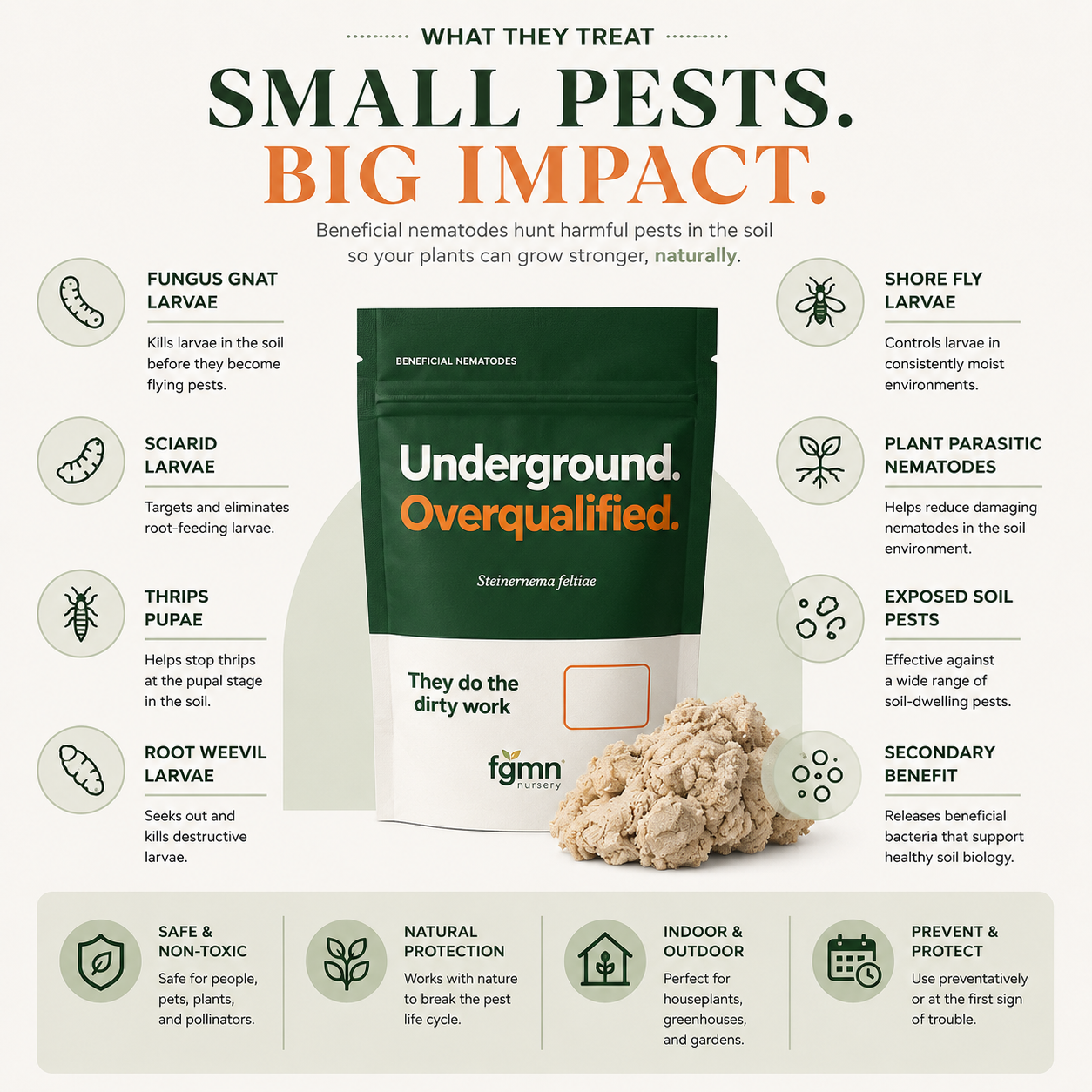
| Hunts | Beetle grubs and root weevil larvae — Japanese beetle, June beetle, chafers, black vine weevil, root weevils, strawberry root weevil, rootworms |
| Also kills | Fungus gnat larvae and other soil larvae it encounters, though it's not the efficient choice for them |
| Won't touch | Aphids, thrips, whitefly, mites, mealybugs, scale — anything on foliage. Surface-dwelling mobile pests are the ambusher's job |
| How it works | IJs penetrate the host directly through the cuticle — unlike Steinernema, which needs a natural opening — then release symbiotic Photorhabdus bacteria. Host dies within 24–48 hours and turns brick red. Nematodes reproduce inside and a new generation emerges |
| Time to visible effect | 2–4 days for host death; grub damage stops before you'd see anything above ground |
| Applied as | Soil drench. Suspend in dechlorinated water and water in thoroughly, then water again to move IJs down into the root zone |
| Soil temp | 65–90°F (18–32°C). The most heat-tolerant of the three and the least cold-tolerant — activity drops off below 60°F |
| Moisture | Soil must be moist at application and stay moist. Nematodes move in water films and die in dry soil |
| Light | Apply in evening or low light. UV kills IJs on exposed surfaces |
| Mix water | Dechlorinated. Chlorine and chloramine kill them |
| Mixed suspension | Apply within a few hours. Agitate gently while applying — they settle |
| Screens and filters | Remove filters finer than 50 mesh from watering equipment |
| Reapply | Every 7–14 days for 2–3 rounds against an active infestation |
| Refrigerate | Yes — keep the package cold until use. Exception to the no-refrigeration rule |
| Shelf life | Weeks refrigerated, and shorter than Steinernema — Hb is the least storage-stable of the three. Deploy promptly |
| Establishes | Short-term. Cycles while hosts are present, then dies out |
| Compatible with | Predatory mites, Stratiolaelaps scimitus, springtails, lacewings, ladybugs, Aphidius, Cryptolaemus, Trichoderma T-22, mycorrhizae |
| Not compatible with | Broad-spectrum soil insecticides. Fungicides are generally fine |
| Chemical interval | One day after neem oil or insecticidal soap. Never with sulfur, at any dilution |
| Safe around | Pets, children, plants, aquatic life |
Target Pests
Environmental Needs
Selection Guide
How to Use
How They're Shipped
Mix, drench, keep it moist.
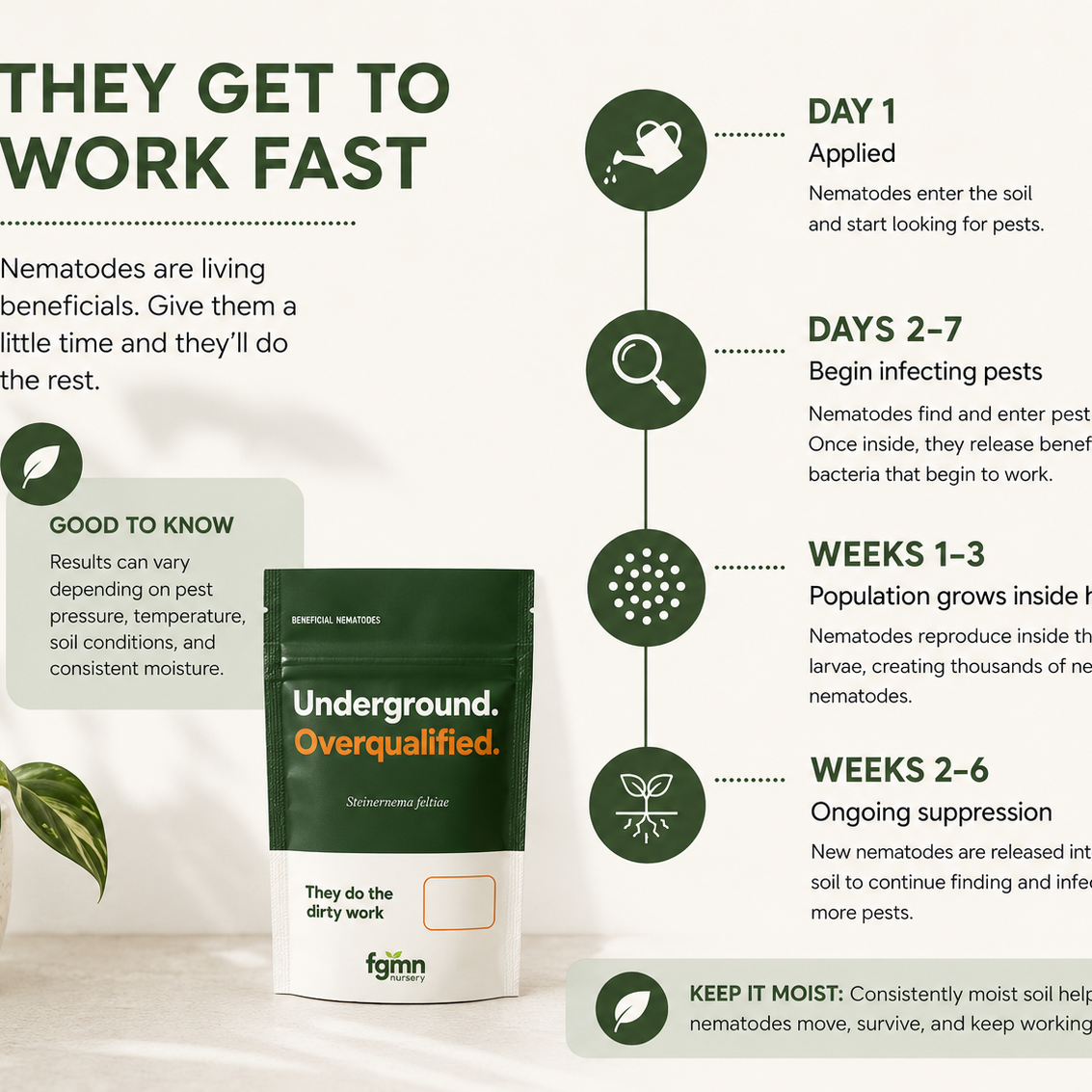
How to apply your nematodes, and how to read the results over the next few weeks. Nematodes need water to move, soil to live in, and protection from sunlight — the routine is built around all three.
-
01
Open the box right away
Bring the package indoors as soon as it arrives. Don't leave it on a hot porch, in a cold mailbox, or in direct sun. Nematodes ship in a moist carrier — sponge, gel, or clay depending on the species. A warm package is normal. Warmth speeds their metabolism up; it doesn't kill them, and a melted pack is expected. What isn't normal is a carrier that has dried out, or one that has gone the consistency of toothpaste after sitting in high humidity.
-
02
Apply now, or refrigerate
Best results come from applying the same day. If you need to wait, store the unopened package in the refrigerator (not the freezer) at 38–42°F. Most species stay viable for two to four weeks refrigerated; check the product description for the exact window. Pull from the fridge an hour before mixing to take the chill off.
-
03
Mix with cool water
Dissolve the carrier in a bucket of cool, dechlorinated water — tap water is usually fine if it's been sitting out for an hour, or use rainwater if you have it. Stir gently to suspend the nematodes evenly. Use a watering can with the rose removed, or a backpack sprayer with any fine screens taken out (mesh finer than 50 will strain them out). See the product description for water volume per package.
-
04
Drench at dusk or on a cloudy day
Nematodes die in UV light within minutes, so timing matters more here than anywhere else. Pre-water the soil so it's already damp, then drench evenly across the target area — pots, beds, or lawn. Keep stirring the bucket as you go so the nematodes don't settle to the bottom.
-
05
Keep the soil moist for two weeks
Nematodes move through water films around soil particles to find their hosts. Dry soil stops them. Water lightly every two or three days for the first two weeks — enough to keep the top few inches damp, not soaked. Pest reduction shows up over one to four weeks depending on species and pest. If you don't see improvement by week four, that's when to bring in our bug pros.
Something not quite right?
Reach out to our entomologist by filing a report within 72 hours of delivery, with your order number and a photo. Candidly, without a photo the team can't approve a live beneficial claim.
Read the full Live Delivery Guarantee →Join Karen's Live Shows — Pests, Plants & Predators on PalmStreet.
Every Friday at 7pm EST — plus additional shows throughout the week. Ask your pest questions in real time — we answer everything.






The Weekly Newsletter
A weekly excuse to be weird about bugs at parties.
Weekly dispatches on the quietly alarming things happening in your soil. All of it real.
No spam. Leave whenever.
You're in
The first strange true thing arrives next week.
FAQ
What is your Live Delivery Guarantee?
We guarantee that your beneficial insects arrive healthy and ready to work. They're living things, so we pack for the season and ship expedited to give them the best trip we can.
If something looks wrong when the box opens, take a photo and file a report within 72 hours of delivery, with your order number. Photos matter: candidly, without them the team can't approve a live beneficial claim.
When is the best time to apply for Japanese Beetles?
Will this stop the beetles flying around my roses?
My lawn is brown. Is it too late?
Can I use weed and feed products?
How deep do they go?
Why is the carrier powder clumpy?
Help! I'm overwhelmed
Yeah, it's a lot the first time you're using beneficial nematodes. File a report and our bug pros will walk you through it!
I don’t see anything moving in my bottle or sachet. Does that mean they’re dead?
Not at all! In fact, go ahead and deploy them.
Predatory mites are microscopic (often less than 0.5mm) and naturally blend into their carrier medium (bran or vermiculite).
- For Bottles: The mites often huddle in the center of the bottle for insulation during transit.
- For Sachets: These are "slow-release" nurseries. The mites stay tucked deep inside the breeding media and emerge one by one over 2–4 weeks. Seeing an "empty-looking" sachet or bottle is not proof of a loss; it is simply how they are packaged for maximum survival.
Mite Matters

Cucumeris: Why It Works (and Why It Fails)
Cucumeris is reliable, widely researched, and genuinely effective — within a specific set of conditions. Here's what it actually does, what it won't do, and how to tell if it's the right species for your situation.

My Plant Has Webbing. Help.
Webbing on a plant isn't always spider mites — and the mite that causes the most damage indoors doesn't produce webbing at all. Here's how to tell what you're actually looking at before you treat.

Native vs Invasive Ladybugs
Most ladybugs you'll encounter are red with black dots — and that description fits native, introduced, and invasive species equally. Here's how to actually tell them apart, what the harlequin ladybug has been doing to native populations, and where the real ecological concerns are.