




A bag of diatomaceous earth comes with an impressive unofficial résumé. It kills pests. It’s natural. It’s food grade. Somewhere between the bag and the internet, this becomes “put it on every plant.”
That is quite a promotion for a powder.
Diatomaceous earth can kill insects and mites. Whether it controls the pests on your plants depends on where those pests live, how they encounter the powder, and what happens when you water. If you’re using beneficial insects or predatory mites, there is another complication: the powder has no way to know who you hired.
What diatomaceous earth does to a pest
Diatomaceous earth, usually shortened to DE, comes from the fossilized remains of diatoms—microscopic aquatic organisms with silica shells. Those deposits are mined and processed into products that can look deceptively like ordinary flour.1
An insect’s outer covering helps keep water inside its body. DE particles take up oils and fats from that protective surface, while abrasion can contribute to the damage. The insect loses water and eventually dies. It does not need to eat the powder.1
You may have heard this described as “microscopic razor blades.” Memorable, certainly. But dehydration is the important part of the explanation. DE needs suitable contact and time; it is not an instant kill simply because an insect stepped near it.
This also explains why the conditions matter. Moisture reduces the performance of a dust that works by promoting water loss. A dry, sheltered surface and a regularly watered plant pot are very different places to ask it to work.2

A pot of soil is a difficult assignment
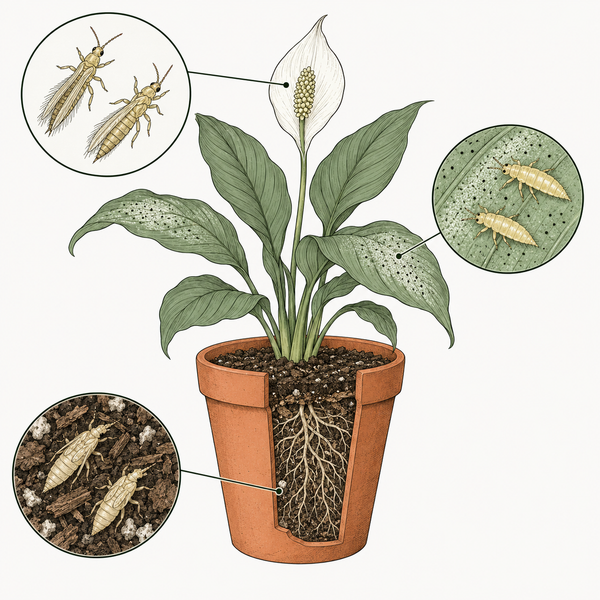
Fungus gnats are often the reason people reach for DE. Their larvae live in moist growing media, feeding on fungi and decaying material and sometimes damaging roots. The adults you see flying around are only the visible part of the population.3
A layer of powder on top sounds like a sensible interception point: adults should cross it as they emerge, and females should cross it to lay eggs. Researchers tested that idea. In a 2007 study, dry and moist DE layers, approximately ⅛ and ¼ inch thick, generally failed to prevent adult emergence or egg laying.4
That does not mean DE cannot kill an individual gnat. It means that killing an exposed insect and interrupting an infestation are different accomplishments. A white surface is not evidence that the larvae underneath have been controlled.
Suitable DE reaches the body.
Protective surface is disrupted.
Water loss can become lethal.
Larvae develop within moist mix.
A surface layer does not treat every stage.
Adults can still emerge and lay eggs.
For fungus gnats, the more useful target is the larval population in the mix. Correct excess watering and poor drainage, and let the surface dry between waterings where the plant tolerates it. Where treatment is needed, appropriately labeled Bacillus thuringiensis israelensis (Bti) products or Steinernema feltiae nematodes can target larvae. Sticky traps help track and catch adults; they do not treat the larvae.3
Do not turn a moisture-loving plant into a drought experiment to preserve a layer of powder. The plant is still the reason we are doing any of this.

Spider mites, thrips, and the problem of reach
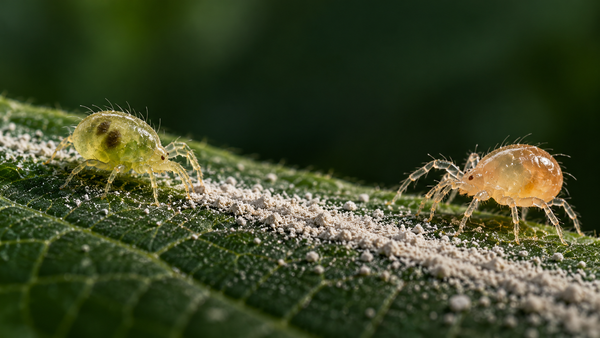
Moving the powder onto the foliage changes the exposure, but does not make DE a universal treatment. In a 2019 laboratory study, a tested DE spray killed about a quarter of directly treated adult female two-spotted spider mites after 72 hours. Other research has found stronger effects under different conditions. Formulation, concentration, exposure, and the pest being tested all matter.5, 6
For a collector, the practical question is whether the application reaches the pest where it actually lives. Powder on the potting mix cannot be assumed to control mites feeding on leaves above it. Nor does treating one exposed stage establish that hidden or later stages of thrips, mealybugs, or scale have been controlled. That is a limitation of contact coverage, not a promise that applying more will solve it.
Before choosing DE, identify the pest and check that the actual product is labeled for the intended plant and use. A long online list of insects it “kills” is not a treatment plan.7
What happens to the plant?
DE is not automatically a plant poison. Researchers have used particular DE formulations on crops, including maize, and studied diatomaceous materials as soil amendments. That does not establish that any powder, at any dose, is harmless to every houseplant.8, 9
For foliage, avoid both extremes: “it will destroy the leaves” and “more is always better.” A heavy coating leaves residue and makes it harder to see the leaf surface clearly. Claims that DE inevitably clogs leaf pores, stops photosynthesis, or burns foliage need evidence for the product and conditions involved; those outcomes should not be presented as a certainty. Follow the plant-use directions and any sensitivity precautions on the label.
The soil-amendment claims deserve the same scrutiny. A porous mineral can influence a growing medium, but the effect depends on the material, particle size, amount, and the mix receiving it. Fine insecticidal powder should not be assumed to behave like a coarse horticultural aggregate. Adding it by the handful is not a demonstrated fix for poor drainage.
And yes, DE contains silicon. That does not mean a dusting feeds your plant a useful dose. In rice experiments, DE’s effects on silicon uptake and yield depended on soil type and water conditions. Those results support studying particular amendments for particular crops; they do not establish a general fertilizer recommendation for a monstera.9
If the goal is better roots, start with the potting mix, drainage, and watering. If the goal is pest control, judge the powder on pest control. It does not need a second career as a plant supplement to justify the purchase.

Beneficials can be exposed too
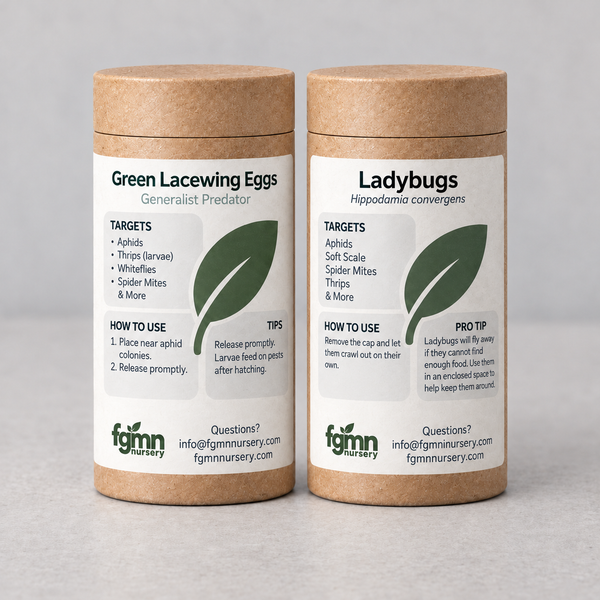
A ladybug crossing treated foliage can encounter the same material as its prey. Extension guidance warns that DE can kill beneficial insects, including ladybugs. Broad dusting therefore deserves particular caution wherever predators and pollinators are active.2
Predatory mites need a more specific answer than “safe” or “dead.” The 2019 study found substantially different effects when predators were sprayed directly versus exposed to residues. A separate study included Amblyseius swirskii and found that mortality increased with concentration and exposure time. The application matters, and so does the species.5, 6
There is also evidence that carefully chosen combinations can work. A 2026 laboratory study found better spider-mite suppression from DE combined with Phytoseiulus persimilis than from either treatment alone. The authors explicitly called for greenhouse and field testing.10
That is useful research. It is not permission to coat a collection in an unrelated DE product and release predators into it. “These treatments worked together in this experiment” and “all DE is beneficial-safe” are very different claims.
Which product and concentration?
Direct application or remaining residue?
Which surfaces are treated?
Which species and life stage?
Will it cross those surfaces?
Was that exposure actually tested?
For home use, our conservative recommendation is to avoid overlapping DE with surfaces where you are releasing beneficial insects or mites unless you have product- and species-specific compatibility guidance. A sachet does not resolve exposure once its mites leave and walk onto treated foliage. Soil predators likewise deserve consideration if you are dusting the surface they use.
Nematodes and beneficial microbes are different organisms again. Evidence about an insect’s outer covering does not establish what DE does to nematodes, mycorrhizal fungi, or bacteria in a watered pot. Neither “it sterilizes the soil” nor “it is harmless to every beneficial” is a defensible blanket conclusion.

Already used DE before a beneficial release?
Do not assume that waiting a few days makes the residue inactive. DE does not simply break down in sunlight, and dry, undisturbed deposits can remain effective.1 Nor should misting be treated as a verified compatibility test.
Identify the exact product, including any other active ingredients, and where it was applied. Follow its cleanup directions and seek guidance for the beneficial species you intend to release. Removing accessible residue can reduce exposure, but it does not establish a universal safe waiting period. There is no responsible “wait three days” rule covering every DE product and every beneficial.
Food grade is not a breathing instruction
“Food grade” describes a category of use; it is not a substitute for a pesticide label. NPIC recommends choosing a product labeled for pest control, with directions for where and how to use it. Do not substitute pool-filter DE for a plant pest-control product.7
The dust can irritate eyes and airways. Follow the label’s protective-equipment instructions, avoid creating airborne clouds, and keep children and pets away during application. This is especially worth remembering indoors, where the treatment happens in the same room you intend to keep breathing in.1, 7
DE has legitimate uses when the product, pest, and conditions fit. On a living plant, you also have to account for water, hidden pest stages, and everything else sharing the leaves. Those details determine whether it belongs in your treatment—or whether you have simply made the problem white.
Sources and further reading
- National Pesticide Information Center — Diatomaceous Earth General Fact Sheet. Origin, mode of action, persistence, and exposure.
- Hillock & Bolin. Earth-Kind Gardening Series — Mechanical Pest Controls. Oklahoma State University Extension. Humidity limitations and beneficial-insect risk.
- University of California IPM — Fungus Gnats. Biology, watering management, monitoring, Bti, and nematodes.
- Hogendorp & Cloyd (2007). Effect of diatomaceous earth and Trichoderma harzianum T-22 on the fungus gnat Bradysia sp. nr. coprophila. Journal of Economic Entomology 100:1353–1359. Surface-layer findings concern the tested growing medium and laboratory conditions.
- Shah & Appleby (2019). Testing the contact and residual toxicity of selected low-risk pesticides to Tetranychus urticae and its predators. Sarhad Journal of Agriculture 35:1113–1121. Direct and residual laboratory exposures; results are not a universal release interval.
- Mahmoud, Abdel-khalik & Kassem (2024). Efficacy of diatomaceous earth and sulfur on some mites under laboratory and semi-field conditions. Persian Journal of Acarology 13:829–839. Includes spider mites and Amblyseius swirskii.
- National Pesticide Information Center — Is food grade diatomaceous earth okay for pest control? Product selection, labels, and exposure precautions.
- Bio-Efficacy of Diatomaceous Earth, Household Soaps, and Neem Oil against Spodoptera frugiperda Larvae in Benin (2021). Insects 12:18. A crop-specific efficacy study; not evidence of universal houseplant safety.
- Sandhya, Prakash & Meunier (2018). Diatomaceous earth as source of silicon on the growth and yield of rice in contrasted soils of Southern India. Journal of Soil Science and Plant Nutrition 18. Soil and water conditions influenced responses.
- Kök, Yaşar & Kasap (2026). The effect of the combination of diatomaceous earths and Phytoseiulus persimilis on the biological control of Tetranychus urticae under laboratory conditions. Acarologia 66:406–413. University-hosted abstract. The authors identify greenhouse and field validation as future work.
