


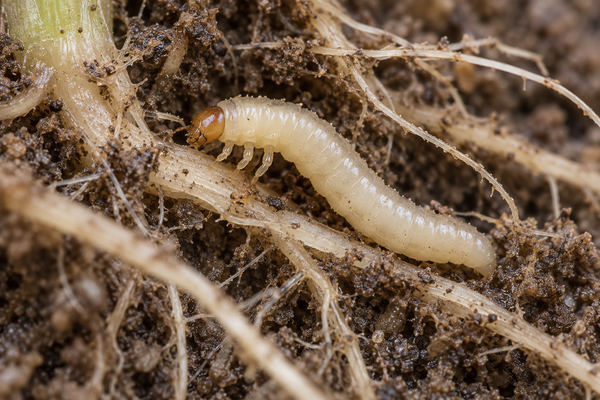

Finding an insect underground is enough of a project without also having to arrange a date inside it.
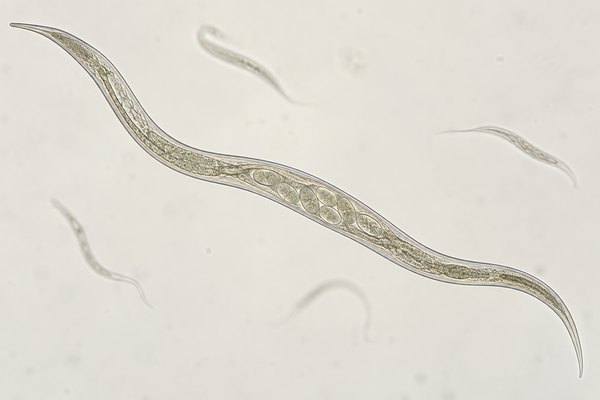
Hb has an unusually convenient way around that second problem. Its soil-searching young, called infective juveniles, can develop into self-fertilizing hermaphrodites: adults that produce both sperm and eggs. A successful founder of Heterorhabditis bacteriophora does not necessarily need a second nematode to begin reproducing. Males can appear in later generations; this is not a species with no use for mating, just one that can begin without it.1

The founder must still establish a successful infection. Self-fertilization removes the need to find a mate; it does not remove the need for a suitable host and the bacterial partnership that supports development.
The next generation starts inside the mother
Hb can lay eggs, but eggs also hatch within the maternal body. The young develop at the expense of her tissues, eventually killing her. The technical term is endotokia matricida. It is every bit as uncomfortable as it sounds.2
This internal development also brings offspring into contact with the bacteria they will carry. Researchers using fluorescently labeled Photorhabdus followed the bacteria from the maternal intestine into her tissues and then into the developing young. Infective juveniles acquired their partners before departure.2

The insect contains several overlapping lives: the maternal nematode, her offspring, and bacteria moving between them. The bacterial partnership has to survive this transition for the cycle to continue.
Growing up can wait
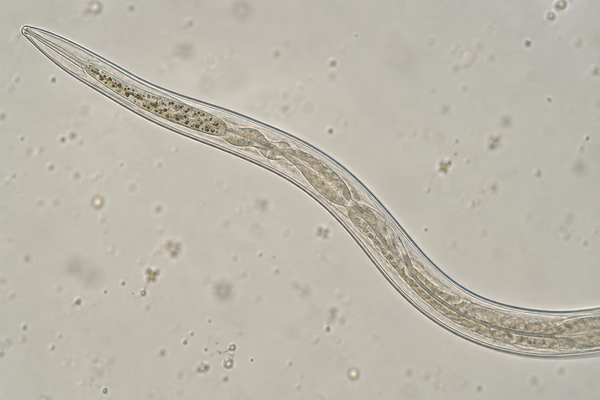
An infective juvenile is a paused developmental stage. It is equipped to persist outside an insect and seek another host, rather than continue feeding and growing where it is. Resuming development is called recovery—a slightly misleading word if it makes you picture an injured worm getting better.
In 2012, researchers identified an Hb chemical called ascC11EA that inhibited this recovery in their experiments. It belongs to a group of signaling compounds called ascarosides. Related chemicals from the laboratory nematode Caenorhabditis elegans did not substitute for Hb’s compound.3
The demonstrated effect was keeping infective juveniles from resuming development. The researchers proposed that this could help juveniles remain in the dispersal stage as a population accumulates in a host. Exactly how the signal operates during a natural infection remained a question; the experiment did not show a chemical ordering worms to leave.3
For a young Hb, reaching adulthood too soon would mean giving up the stage suited to finding its next insect. Sometimes the useful developmental decision is to wait.
Sources
- Zioni, Glazer and Segal (1992), life cycle and reproductive potential of Hb strain HP88.
- Ciche et al. (2008), Cell Invasion and Matricide during Photorhabdus luminescens Transmission by Heterorhabditis bacteriophora Nematodes.
- Noguez et al. (2012), an ascaroside controlling the parasitic life cycle of Hb.
AI-generated editorial header and conceptual teaching illustrations; these are reconstructions, not microscopy or field photographs. Organisms and internal details are enlarged or simplified where noted.
