


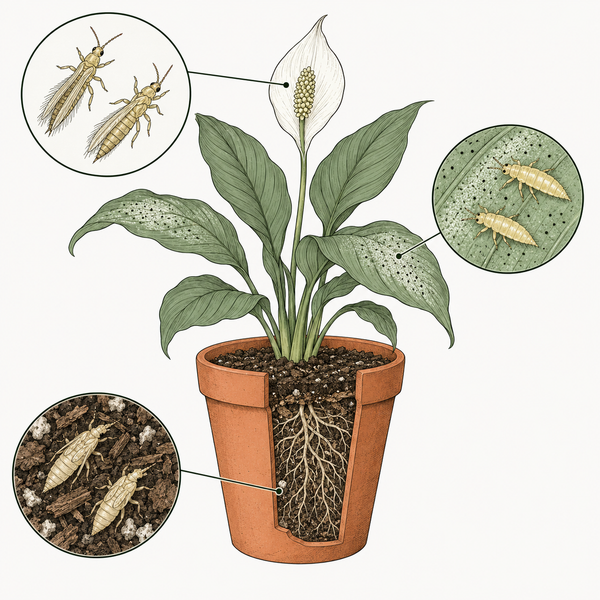
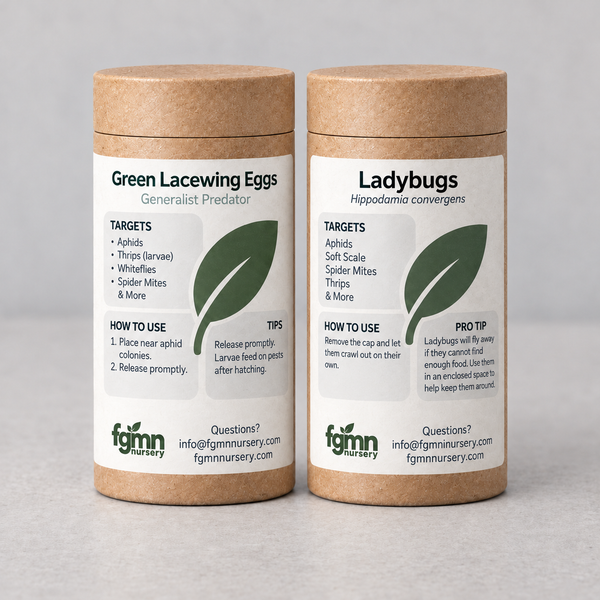
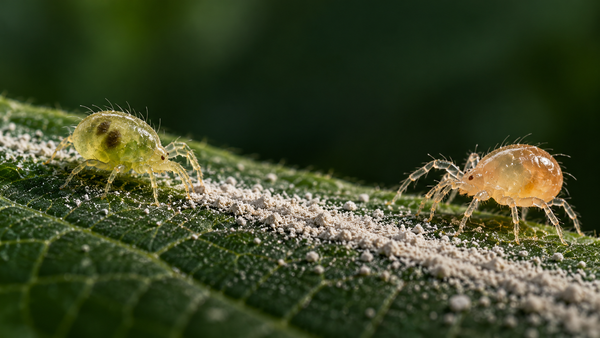


You release predatory mites, then return to inspect the plant. An adult thrips walks across a leaf. It does not appear concerned about the arrangements you have made.
It's easy to read that sighting as a failure. You released something that eats thrips, and there is a thrips. But the missing piece is which thrips the predator can eat.
The mites used against young thrips larvae are working on an earlier part of the population. The adult on your leaf has already passed through it. Orius insidiosus, the minute pirate bug, can prey on adults as well as larvae.1 Understanding that difference changes how you read what is happening on the plant.
Follow one generation
Picture the infestation as a succession of insects growing up. Some are young larvae now. Others have already become adults and can produce the next generation. They are sharing the plant, but they are not equally vulnerable to the same predator.
When a mite consumes a young larva, that individual will never become an adult. The effect reaches forward: fewer young thrips can make it through to reproduce. It does not remove the adults that were already there.
Orius reaches that older group too. Together, those feeding habits explain why a treatment plan may include both mites and Orius: one targets young larvae, while the other can also reach adults. Researchers have examined Orius predation on flowers and whole plants under laboratory and greenhouse conditions.1
Go back to the adult you found after the mite release. Its presence tells you that adults remain. To understand whether the population is changing, you also need to look at the younger insects and return to the same plants over time. If you can distinguish larvae from adults in your notes, you can see changes that an undifferentiated count of “bugs” would hide.
You are not trying to keep a census of every insect in the house. You are trying to compare like with like. Looking at the same parts of the same plants for a similar amount of time gives the next inspection something useful to build on.
A predator still has to live somewhere
Once you understand what Orius eats, the next question is what happens between encounters with prey. This is where the plant itself becomes more than a hunting surface.
Orius can use floral resources, and laboratory work has shown that the resources offered can affect its longevity and reproduction.2 A flowering plant can therefore help support a predator in ways that a collection of leaves alone may not. Plants included for that purpose are often called banker plants.

That sounds like a neat answer: provide flowers, support Orius, reduce thrips. Living systems have a habit of adding another step.
In a study on ornamental grasses, Orius releases reduced thrips, but adding Black Pearl pepper banker plants did not improve suppression beyond the releases alone.3 The extra plant had a sensible purpose. That purpose did not automatically become an extra reduction in pests.
Taken together, those studies suggest that flowers can support Orius without guaranteeing better thrips control. So if you add a flowering plant, keep checking the infested foliage. A well-fed predator and a shrinking pest population are two things worth knowing, and one does not prove the other.
Back to the leaf
At your next inspection, the old scars will still be there. They tell you what happened to that leaf, not how many insects are feeding today. Look for live thrips and follow the developing growth; the treatment progress article walks through that longer timeline.
That brings you back to the adult on the leaf. It has already grown beyond the young larval stage the mites target. Orius can prey on it, but finding Orius is not proof of control either. The useful result is fewer thrips across repeated, comparable inspections.
Once you know which part of the population each predator can reach, an insect sighting becomes information you can use. Before that, it is mostly an insect ruining your afternoon.
Sources and further reading
- Herrick, N. J., Cloyd, R. A., Conner, M. A., & Motolai, G. (2021). Insidious flower bug, Orius insidiosus, predation on western flower thrips on Transvaal daisy cut flowers and chrysanthemum plants under laboratory and greenhouse conditions. Biological Control, 163, 104739. Study title shortened here for readability.
- Hinds, J., & Barbercheck, M. E. (2020). Diversified floral provisioning enhances performance of the generalist predator, Orius insidiosus. Biological Control, 149, 104313. Laboratory evidence on floral resources and predator performance; not a houseplant thrips-control trial.
- Wong, S. K., & Frank, S. D. (2012). Influence of banker plants and spiders on biological control by Orius insidiosus. Biological Control, 63, 181–187.
