



Hb entered the scientific record through a moth in South Australia. A fairly obscure entrance for an animal now associated with lawn grubs, but the moth did not get to choose its contribution to science.
In 1976, George Poinar described Heterorhabditis bacteriophora from material associated with Heliothis punctigera at Brecon, South Australia. The description established a new genus and family, too. “Hb” is considerably easier to fit into a conversation.1
South Australia is its first recorded address, not a boundary around its natural range. In 2019, researchers reported Hb from agricultural soils in Kashmir’s Pir Panjal Range, after surveying vegetable fields and walnut orchards. This insect parasite was already living underground before anyone thought to put it in a package.1
A hunter that has to get inside
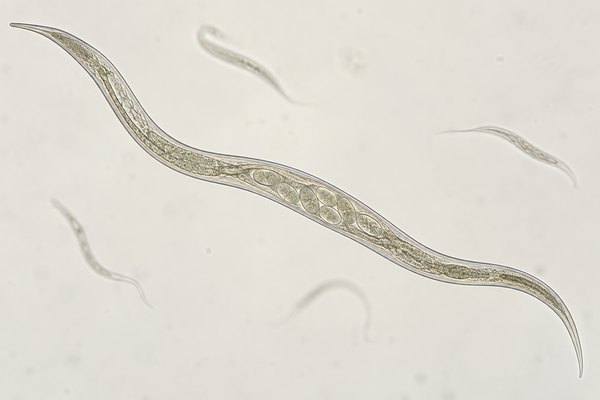
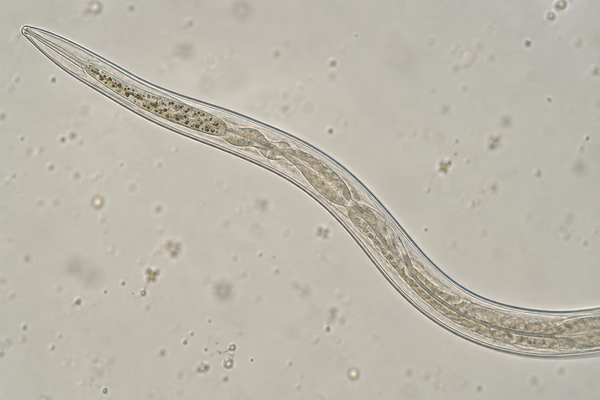
Hb is a roundworm. Its soil-searching stage, the infective juvenile, is extraordinarily slender: one Kashmir strain averaged about 0.02 inch long and one-thousandth of an inch wide. That is roughly half a millimeter by 25 micrometers. Adults developing inside an insect become much larger.1
The juvenile actively searches for a host, a hunting style researchers call cruising. Carbon dioxide and insect odors provide chemical information along the way. Hb can detect these cues without seeing their source; experiments have traced responses to specialized sensory neurons.2

Once it reaches a suitable insect, Hb enters through a natural opening or penetrates its outer covering. Inside, the juvenile releases bacteria carried in its gut. The resulting infection allows the partnership to exploit the insect, and the nematode resumes development and reproduction.2 The bacteria’s contribution to feeding is a story of its own.

From an insect parasite to biological control
For people hoping to use Hb against pests, finding it was only the beginning. They also needed ways to raise large numbers without losing the qualities that made it useful. A 1991 analysis compared Hb raised in insects, on solid culture media, and in liquid culture. The nematodes’ production history affected their performance against beetle larvae in those trials. Raising more worms and raising effective worms were separate problems to solve.4
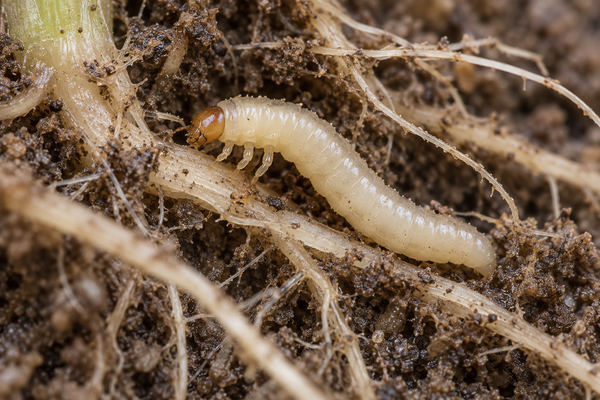
White grubs, the larvae of scarab beetles, became an important part of Hb’s biological-control reputation. But “grub” is a description, not a species identification. In a comparison of 12 white-grub species, Japanese beetle and black turfgrass ataenius larvae were highly susceptible to Hb; several others were much less susceptible.3
Hb also attacks western corn rootworm larvae, the subject of an experiment in breeding Hb to follow root signals.5
A pest list can tell us which insects have been attacked. Understanding Hb means following the whole encounter: the search through soil, entry into a particular host, and the partnership that makes reproduction possible inside it. There is a great deal of biology packed into those two letters.
Sources
- Bhat et al. (2019), description of Hb isolates from the Kashmir Valley. Includes the original description’s history and citation.
- Hallem et al. (2011), A sensory code for host seeking in parasitic nematodes.
- Koppenhöfer et al. (2004), pathogenicity against 12 white-grub species.
- Gaugler and Georgis (1991), culture method and efficacy of entomopathogenic nematodes.
- Hiltpold et al. (2010), Hb selection and western corn rootworm.
AI-generated editorial header and conceptual teaching illustrations; these are reconstructions, not microscopy or field photographs. Organisms and internal details are enlarged or simplified where noted.
