


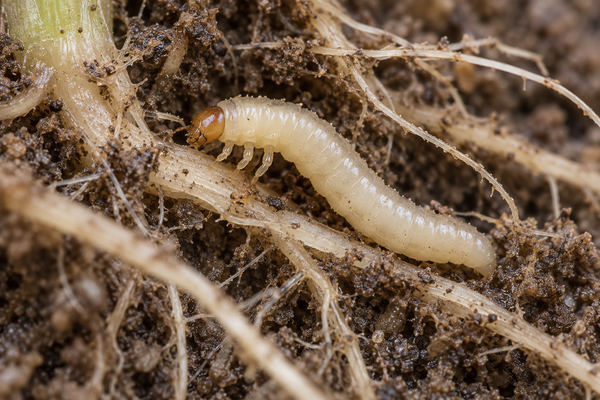

Calling Hb a delivery service for bacteria gives the bacteria nearly all the credit. It is a tidy explanation. Unfortunately, the nematode has been doing additional work.
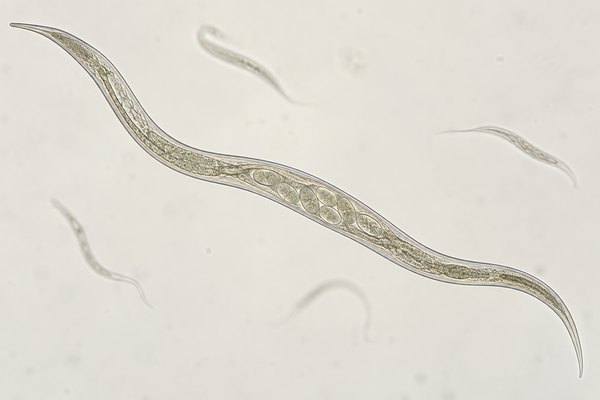
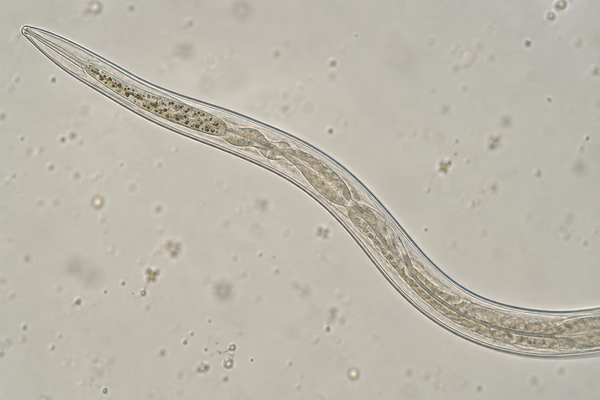
Hb, or Heterorhabditis bacteriophora, carries Photorhabdus bacteria in its gut. The searching juvenile takes them into an insect, where they are released and multiply. The nematode’s movement and ability to penetrate an insect bring the bacteria directly to the site of infection.1
The meal is part of the partnership
What does the worm get? Food, among other things. Hb feeds on its bacterial partners, and bacterial activity supplies nutrients needed for its development and reproduction. In laboratory production, researchers can grow the nematodes in media prepared with those bacteria; the entire insect is not required as a container.3, 4
That arrangement can sound a little awkward. The bacteria are both partners and food. But a bacterial population can multiply while nematodes consume some of its members. The association continues through bacteria carried by the next generation of worms, rather than through every individual bacterium surviving.

Before either partner can make much use of an insect, they face its immune defenses. Hb helps with that, too. In laboratory experiments, secretions from Hb exposed to insect body fluid suppressed a measured antibacterial response in fruit flies. Injecting those secretions alongside Photorhabdus helped the bacteria multiply and hastened fly death.1
Those injection experiments isolate part of the process; they do not recreate every natural infection. They do show why the delivery-service description falls short. The driver has apparently also been interfering with security.
Changing jobs inside the worm
An insect infected by bacteria and a nematode carrying them are very different places to live. To continue into the next generation, the bacteria must establish themselves in young Hb. Simply remaining successful insect pathogens would leave them in a dead insect when their transport departed.
A 2012 study of Photorhabdus luminescens found a reversible switch in a section of DNA that controls gene activity. Flipping that section changed the bacteria between a form associated with insect disease and a smaller form able to establish the nematode partnership.2
The smaller form colonized the mother and her developing offspring. Inside the young worms, bacteria switched back toward the insect-pathogenic form. The same bacterial lineage was changing roles as it moved between hosts.2

By the time an infective juvenile leaves, the association has survived feeding, reproduction, and a transfer between generations. That transfer takes place inside the mother, and it is considerably less gentle than “passing something on” usually suggests.
Sources
- Kenney et al. (2019), Hb secretions and suppression of the insect Imd immune pathway.
- Somvanshi et al. (2012), A single promoter inversion switches Photorhabdus between pathogenic and mutualistic states.
- Han and Ehlers (2001), bacterial support for nematode development and reproduction.
- Ciche (2007), The biology and genome of Heterorhabditis bacteriophora, WormBook.
AI-generated editorial header and conceptual teaching illustrations; these are reconstructions, not microscopy or field photographs. Organisms and internal details are enlarged or simplified where noted.
