


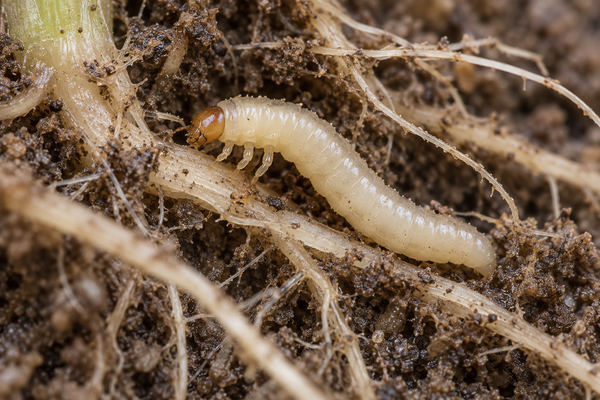

A root being chewed underground cannot move away. Some corn roots do something else: release a chemical that certain insect-parasitic nematodes can follow. The chewing insect supplies the damage. The plant supplies a clue to its location.
The chemical is (E)-β-caryophyllene, often shortened to EβC. Some maize varieties release it from roots attacked by western corn rootworm larvae. It can travel through soil air spaces, carrying information beyond the feeding site. Early research demonstrated recruitment of Heterorhabditis megidis, a relative of Hb.1
A signal needs a receiver
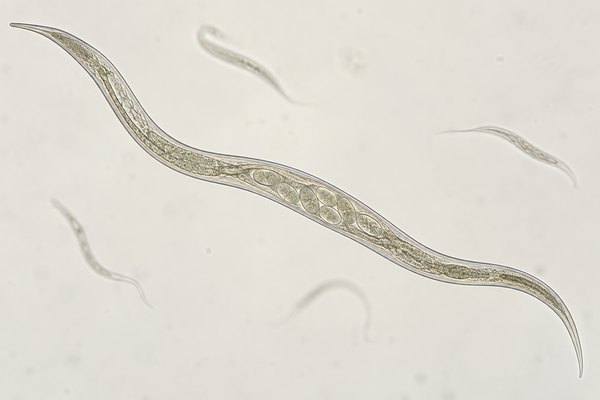
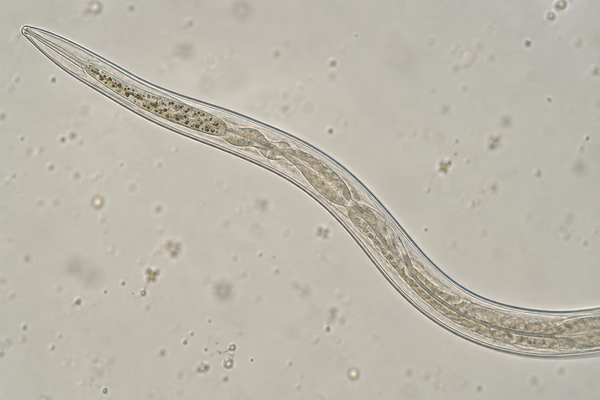
Hb, Heterorhabditis bacteriophora, also hunts insect hosts underground. Sharing that occupation does not give all nematodes identical odor preferences. Experiments comparing species found different responses to hosts and individual chemicals. Carbon dioxide is a widespread cue, but other odors can alter how attractive a potential host is to a particular nematode.2
A root can therefore release useful information without every nearby parasite following it. To improve that match, researchers tried selecting Hb for a stronger response to EβC.
Six routes through the sand
The 2010 experiment gave Hb six sand-filled routes toward EβC, other odors, or unscented controls. Researchers bred early EβC responders through insect hosts, then tested their offspring.3
After six selection rounds, the new line responded about twice as quickly. This was selective breeding: each test involved a new generation, not worms remembering an earlier route.3

The field comparison used maize varieties that either produced the signal or did not. Selected Hb improved rootworm control only with the signal-producing variety. The line also showed slightly reduced infectiveness in testing: a faster response had not improved every trait.3

This experiment concerns particular Hb populations and maize varieties, not every Hb product or damaged plant. It does, however, give the plant a more active role in the story. The root is being eaten, releasing a chemical, and changing the information available to a parasite that can attack its attacker.
We tend to picture biological control as a contest between a pest and its enemy. Here, the organism with no legs was contributing to the introductions.
Sources
- Rasmann et al. (2005), recruitment of nematodes by insect-damaged maize roots. Establishes the root-signal background; this earlier experiment used H. megidis, not Hb.
- Dillman et al. (2012), Olfaction shapes host–parasite interactions in parasitic nematodes.
- Hiltpold et al. (2010), selection for enhanced responsiveness to a volatile root signal. The Hb-specific experiment.
AI-generated editorial header and conceptual teaching illustrations; these are reconstructions, not microscopy or field photographs. Organisms and internal details are enlarged or simplified where noted.
