




Before you release a single predatory mite, here's a question worth sitting with: what are you actually trying to achieve?
Most growers don't think about this. There's a pest problem, they buy beneficials, they release them. The goal feels obvious — get rid of the pests. But "get rid of" can mean very different things, and which one you're after determines everything about how you deploy, what you buy, and whether you're satisfied with the result.
Are you trying to completely eliminate the current infestation — drive it to zero and be done with it? Or are you trying to keep pests suppressed over time, so your plants stay healthy without you constantly fighting outbreaks?
These are different goals. They require different species, different formats, different dosing strategies, and they produce different results. Understanding which one fits your situation is the thing that determines whether biocontrol satisfies you or disappoints you.
Here's how to think about it.
The two goals — and which is right for you
Most growers are operating from one of two distinct goals, even if they haven't articulated it:
Goal 1 — Eradication
I want this infestation gone.
A targeted campaign with a defined end. You release, the predators find and eliminate the current pest population, the crisis is resolved. Achievable in controlled environments. But once it works, your protection ends — so eradication is always phase one, not the whole strategy.
Goal 2 — Ongoing protection
I want my plants protected over time.
An open-ended program. You establish a resident predator population — through sachets, colony-building, or both — that keeps pests suppressed as a background condition. Pests may be present at low levels; the predators keep them there. The plants stay healthy without you constantly fighting outbreaks.
Most growers need both at different times — eradication to address an acute problem, ongoing protection to prevent the next one. The mistake is treating them as the same thing, or expecting one to do the job of the other.

What biocontrol actually does
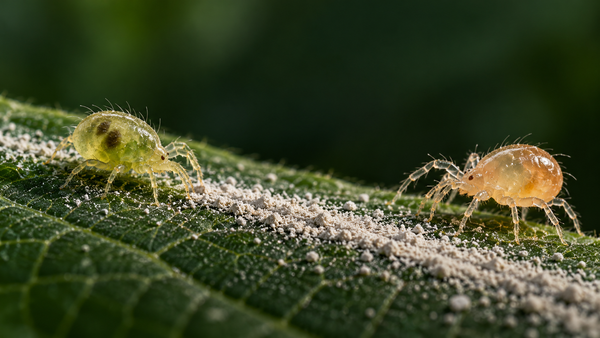
Biological control, by its nature, is a population management tool rather than an elimination tool. When you release predatory mites into a spider mite infestation, the predators track the prey population — they reproduce in proportion to available food, consume eggs and nymphs, and the pest population declines. But as the prey population falls, the predator population loses its food source and also declines. At some point the two populations reach a low-level equilibrium, or the predators disperse and die off as the prey collapses toward zero.
Which outcome you get depends on the environment. In a closed, controlled space with no reinfestation pressure, the prey can be driven to effectively zero and the predators die off naturally with no food left. In an open environment with ongoing reinfestation — from outdoors, from other plants, from a neighbouring collection — the prey never reaches zero because it keeps being replenished faster than the predators can consume it. The predators suppress it; they don't eliminate it.
The strategy you choose has to match the environment you're working in — not the outcome you're hoping for.
Eradication is achievable in the right conditions. Ongoing protection is achievable in almost any conditions. Knowing which you're in changes everything.
Goal 1: Complete eradication
Eradication — driving a pest population to effectively zero — is achievable under specific conditions. The key word is "controlled." The more sealed and stable your growing environment, the more likely a biocontrol release can eliminate the current infestation rather than just suppress it.
The conditions that make eradication achievable:
Enclosed environment
A sealed grow tent, grow room, or greenhouse with no open windows or vents through which pests can re-enter. If the pest source can be cut off, the predators have a finite population to work through.
Controlled conditions
Temperature and humidity are stable and within the beneficial's optimal range. Environmental variability doesn't interrupt the predator's lifecycle mid-campaign.
Identified pest source
You know where the infestation came from and that source has been removed or quarantined. A new plant brought in mid-treatment that carries the same pest will restart the cycle.
Correct dose and species
Enough predators proportionate to the pest load, with the right species for the pest and environment. Underdosing means suppression at best — the predators can't catch up.
Even in a controlled environment, eradication means the current infestation — not permanent protection. Once the predators have done their work and the pest population collapses, the predators decline too, leaving the space unprotected. Any pest that enters afterward — on a new plant, through an open window, on clothing — starts a fresh infestation with no predators to stop it. This is why eradication is an event, not a state. You eradicate, then you protect. Those are two separate phases requiring two separate strategies.
The correct sequence for an enclosed eradication program:
- Identify and quarantine the pest source
- Physically reduce the pest load — wipe heavily infested leaves with a damp cloth, or spray foliage down with water to knock off visible colonies. This is not glamorous, but it makes the predators' job significantly easier. You're not trying to eliminate the pest here — just reduce the number the predators have to chase.
- Optional compatible knockdown spray if infestation is severe (insecticidal soap, 5-day residue clearance minimum)
- Bottle release of appropriate specialist or semi-generalist at adequate dose
- Monitor weekly — new growth coming in clean and declining egg/nymph counts confirm the campaign is working
- Once pest population is eliminated, transition to sachet-based preventive program before the predators die off
The patience window
Expect 7–14 days before you see a visible decline in pest numbers. The predators are feeding on eggs and nymphs — the stages you can't see — before the adult population starts to visibly drop. Biology moves at its own pace. Releasing on Monday and checking for results on Wednesday is how growers talk themselves into unnecessary panic-sprays that undo everything. The signal that it's working is clean new growth and declining counts under a hand lens — not fewer adults on day three.

Step 6 is the one most growers skip. The space is clean, the crisis is over, and the sachets feel unnecessary. Three weeks later the infestation is back — a new plant brought it in, or a few eggs survived in a leaf axil. The preventive program is not a luxury; it's the thing that makes the eradication stick.
Goal 2: Ongoing protection
Suppression and equilibrium — keeping pests present but below the damage threshold — is the realistic target for the majority of home collectors who don't have a sealed, controlled environment. It is not a compromise or a failure of biocontrol. It is how predator-prey relationships work in nature, and it is a genuinely stable and protective state for your plants.
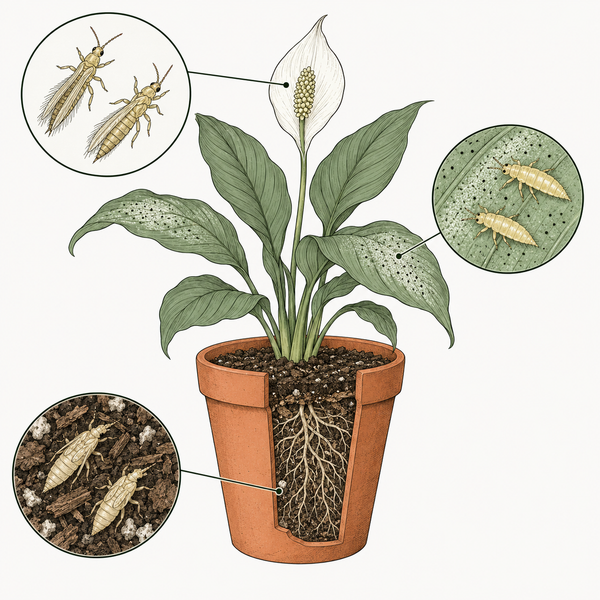
And it starts in the soil, not just on the leaves. A complete equilibrium program includes soil-dwelling beneficials — Stratiolaelaps scimitus for fungus gnat larvae and thrips pupae, nematodes (Steinernema feltiae) for deeper larval pressure — running alongside the foliar predators. Pests that spend part of their lifecycle underground will keep replenishing the foliar population if the soil layer isn't covered.
The two ways to maintain ongoing protection
How you sustain a predator population over time depends on your environment and how hands-on you want to be.
Scheduled sachet program — replace sachets every six to eight weeks regardless of pest pressure. This is the simplest approach: sachets maintain a breeding colony in the collection continuously, so there's always a resident predator population present when pest pressure arrives. It requires minimal monitoring and no decision-making about when to intervene.
Resident colony — establish a self-sustaining predator population that reproduces and persists between pest events without requiring replenishment. This is achievable with generalist species — Neoseiulus californicus, Amblyseius swirskii, Amblyseius andersoni — that can survive on pollen and alternative food when prey populations are low. In a collection with regularly flowering plants, or with supplemental feeding, these species can maintain themselves indefinitely. The initial investment is higher, but once established the colony runs at a fraction of the cost of repeated reactive treatments.
What a resident colony needs to survive between pest events
Alternative food: Pollen from flowering plants is the most natural source. A predatory mite diet supplement applied to sachet hooks or leaf surfaces can substitute when no flowering plants are present.
Stable environment: Temperature and humidity within the species' range, consistently. Sudden drops in humidity collapse predator populations faster than prey scarcity does.
No pesticide interference: A single spray of neem oil or insecticidal soap resets the colony to zero. If you want permanent predator presence, the biocontrol program is the pest management strategy — not a complement to chemical intervention.
Sachet top-ups: Even established colonies decline over extended periods without pest pressure. Replacing sachets every six to eight weeks maintains the population rather than waiting for it to collapse.
The monitoring tool that changes everything
Check affected plants regularly for live pests, fresh feeding injury, and changes in new growth. Record comparable observations over time so treatment decisions follow the pest trend rather than sightings of predators.
If your collection lives in a living room with open windows in summer, if you regularly bring new plants in, if your plants move between indoors and outdoors seasonally — your environment has continuous reinfestation pressure. Pests will always find their way back. The question isn't whether the pest will return; it's whether your resident predator population can intercept it before it builds into a damaging outbreak.
A well-maintained equilibrium program looks like this: sachets on every plant providing a continuous low-level predator presence, replaced every six to eight weeks, so there is always a resident population of beneficials in the collection. When a new plant arrives with a pest hitchhiker, or a few thrips blow in through a window, the predators are already there to catch it. The infestation never builds to a damaging level because it's always being suppressed at the early stage.
What a working equilibrium looks like
Healthy new growth and a stable or declining pest population are useful observations. Continue monitoring for fresh injury and changes in pest activity.
This is not a problem to solve. This is the program working. The moment you spray to eliminate the remaining pests, you also eliminate the predators — and the next infestation has nothing to stop it.
The hardest part — and the most important thing to understand
Seeing any pest on a plant feels like failure. It isn't.
A small background population of spider mites being actively suppressed by a resident population of californicus is not a crisis — it's a stable system. The damage threshold for most ornamental plants is far higher than zero pests. A few spider mites on a Monstera with a resident predator population is not a problem. A thousand spider mites on a Monstera with no predators is. The moment you spray to eliminate the remaining pests, you also eliminate the predators — and the next infestation has nothing to stop it.
Outdoor growers — a different conversation
For outdoor gardens, balcony collections, and plants that spend any part of the year outside, eradication is essentially never achievable. Pest populations in outdoor environments are driven by forces entirely outside your control — weather, neighbouring gardens, wild hosts, seasonal cycles. Spider mites build up during hot dry summers regardless of what you release. Thrips move between plants freely. Aphids arrive from anywhere.

The goal for outdoor and semi-outdoor growing is not to eliminate pests but to maintain a predator population large enough to prevent economic or aesthetic damage — to keep pest numbers below the point where your plants visibly suffer. This is classical IPM thinking and it works, but it requires accepting that some level of pest presence is the permanent baseline.
Practically, this means:
- Seasonal sachet programs timed to pest pressure — start before peak season, not after the infestation is established
- Generalist species that can handle variable conditions and multiple pest types (Neoseiulus californicus, Amblyseius andersoni) rather than narrow specialists that need stable controlled environments
- Monitoring to catch outbreaks early, when predators can intercept rather than chase
- Accepting that a bottle release into a heavy outdoor infestation in summer will suppress but not eliminate — and that's enough if it keeps the plants healthy
Outdoor growers who attempt total eradication with beneficials will spend significantly more than those who run a suppression program — and achieve the same result, because reinfestation is always coming. Calibrating the goal to the environment saves money and reduces disappointment.
Deploying for your situation
| Your situation | Realistic goal | Primary tool | Secondary tool | Key principle |
|---|---|---|---|---|
| Sealed grow tent or grow room, no new plants incoming | Eradication of current infestation | Bottle release at high dose | Sachets after eradication for prevention | Eliminate, then protect. Don't skip the preventive phase. |
| Indoor collection, occasional new plants, some air exchange | Equilibrium — keep pests below damage threshold | Continuous sachet program | Bottle release when infestation builds | Resident predator population is always present. Don't wait for visible damage. |
| Mixed indoor/outdoor collection, plants move seasonally | Equilibrium — suppress outbreaks as they arise | Seasonal sachets + reactive bottle releases | Monitoring to catch pressure early | Start sachets before outdoor season begins, not after first infestation. |
| Outdoor garden, balcony, or greenhouse with open vents | Suppression — prevent damage, not elimination | Generalist sachets (californicus, andersoni) | Bottle release for outbreak response | Reinfestation is constant. Continuous coverage beats periodic responses. |
Why eradication is never permanent
This is the most important thing to understand about a successful eradication campaign: the moment it works, your protection ends.
Specialist predators like Phytoseiulus persimilis disperse or die when prey is eliminated — they are not generalists that can sustain themselves on pollen or alternative food. The population that just cleared your spider mite infestation is gone. If a new plant arrives carrying two spider mite eggs, there is nothing in your collection to stop them. Within two weeks you have a new infestation in a space with no natural enemy present.
Generalist species like Neoseiulus californicus and Amblyseius swirskii persist longer on pollen and other food sources, but without ongoing prey or supplemental feeding they too decline over weeks. Sachets maintain a breeding colony, but they don't last indefinitely — they need to be replaced every six to eight weeks.
The growers who get the best long-term results from biocontrol are those who treat eradication and prevention as two phases of a single continuous program rather than a problem that, once solved, is finished. Eradication addresses the current crisis. Prevention determines whether you face the next one.
Goal 1 — Eradication — if
- You have a sealed, controlled growing space
- You can identify and remove the pest source
- Temperature and humidity are stable within the beneficial's range
- You're prepared to run a preventive program immediately after
- You have a confirmed infestation, not just background presence
Goal 2 — Ongoing protection — if
- Your space is open — windows, vents, traffic in and out
- You regularly bring in new plants
- Your plants move between indoors and outdoors
- You grow outdoors or in a ventilated greenhouse
- You want a low-maintenance program you don't have to actively manage
Common questions
Frequently asked
-
No — the treatment succeeded. The infestation was eliminated. What failed was the transition to a preventive program. When the spider mites were gone, the predators died off or dispersed with nothing to eat, leaving the space unprotected. Any spider mite that arrived afterward — on a new plant, on clothing, through a window — had no natural enemies to stop it. This is why eradication and prevention are two separate phases, not one. After a successful eradication, the next step is sachets — not waiting for the next infestation.
-
Almost certainly not. Check two things: the pest count and the new growth. If the pest count is low and stable, and new growth is coming in without damage, the program is working — you're in equilibrium, not failure. A small background population of pests alongside a resident predator population is the expected outcome of a suppression program, not a sign that it's broken. If you spray to eliminate the remaining pests, you'll also eliminate the predators and lose the protection entirely.
-
Ask yourself one question: can new pests get in? If your growing space is sealed — a grow tent, a controlled grow room — and you can quarantine new plants before they join the collection, eradication is achievable and worth attempting. If your space has open windows, your plants go outside, or new plants come in regularly, reinfestation pressure is constant and equilibrium is the only sustainable strategy. Most home collectors are in the second category and would be better served by accepting that and running a continuous sachet program rather than cycling through repeated reactive treatments.
-
Yes — this is actually the recommended approach for most growers with an active infestation. Phase one: bottle release to address the current pressure with high initial predator numbers. Phase two: once pest counts have dropped significantly, add sachets to maintain a resident predator population going forward. The bottle handles the crisis; the sachets prevent the next one. The key is not to wait until the infestation is completely gone before starting the sachets — overlap them so there's no gap in coverage.
-
Yes — but calibrate your expectations. Outdoors, eradication is not achievable, and attempting it is expensive and futile. What biocontrol can do outdoors is keep pest populations suppressed below the level that causes visible plant damage, which is exactly what you want. Use generalist species that handle variable outdoor conditions — Neoseiulus californicus and Amblyseius andersoni for spider mites, Amblyseius cucumeris for thrips. Start sachets before plants go outside, so the predator population is already established when outdoor pest pressure arrives. Reactive treatments after an outdoor infestation is established are harder and more expensive than prevention.
Bottles for the current infestation. Sachets for everything after. Ships Monday–Thursday.
