


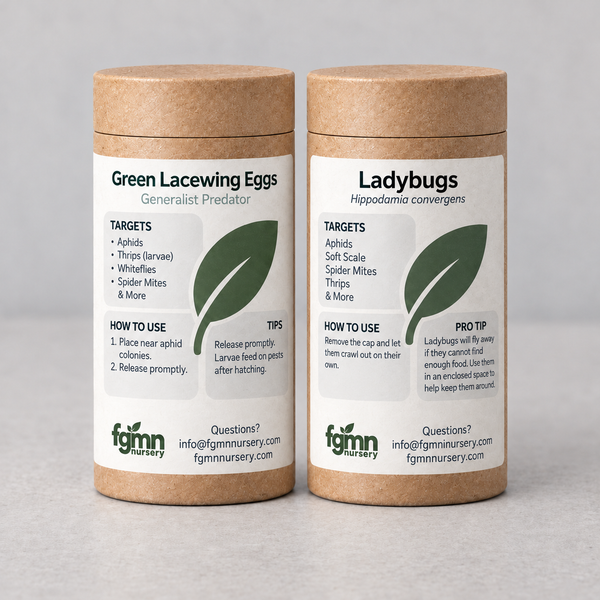


Mosquito Bits work through larval feeding. Sf nematodes find and infect larvae. Both can be stored for later use—and they can work together.
You have fungus gnats, and two recommendations keep coming up: water in Mosquito Bits, or water in beneficial nematodes. Both can work. Both go into the pot. Neither sounds particularly interested in the adult currently inspecting your coffee.
The choice gets clearer when you compare what you are getting. Mosquito Bits provide a treatment that larvae must eat. Sf nematodes are living organisms that move through suitable moist growing media to find and infect larvae. You can choose either approach or use both together.
For an occasional outbreak and a product you can keep on hand, Mosquito Bits are a sensible first choice. For an ongoing problem in plants or propagation trays that stay moist, Sf deserves a closer look. That is a practical distinction, not a rule that one works only on small infestations and the other only on large ones.
Same target, different approach
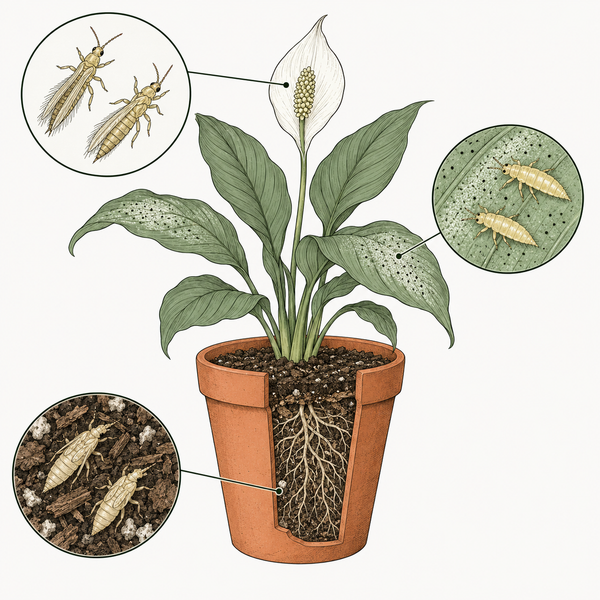
The flies you see are adult fungus gnats. Their young are slender, translucent larvae with black heads, living in the potting mix. These larvae eat fungi and decaying material, but can also damage roots—particularly in seedlings and fresh cuttings.2
Both treatments go after those larvae. The difference is how.
What are Mosquito Bits?
Mosquito Bits are small corn cob granules carrying Bacillus thuringiensis subsp. israelensis, usually called Bti—a naturally occurring bacterium used to control mosquito and fungus gnat larvae. The corn cob is the carrier; Bti is the active ingredient.3 · 14
When you soak the granules, the Bti treatment is released into the water. You then apply that water to the potting mix, putting the treatment where fungus gnat larvae feed. The larvae ingest insecticidal proteins produced by Bti, which act in their gut and kill them. Young larvae are especially susceptible.3 · 4 · 6
Sf nematodes go looking for the larva
Steinernema feltiae, or Sf nematodes, are microscopic roundworms that infect insects. They move through films of moisture in the potting mix, enter a suitable larva and release bacteria that help kill it. These are insect-killing nematodes, not the plant-parasitic kinds that damage roots.5

When Mosquito Bits win
Mosquito Bits are a good fit when you want a dry product to measure out for a repeat watering treatment. Store it according to its label, use what you need, and keep the rest for later. Sf can also be stored; the distinction is the treatment routine, not whether you can plan ahead.
That makes them a good fit for someone treating an occasional outbreak in a few pots, or anyone who wants a treatment ready when gnats appear. They can also treat larger collections; a small collection is an example of a convenient use, not a limit on what Bti can do.1 · 4
The tradeoff is follow-through. Bti does not establish a lasting population of larval hunters in the pot. You repeat the treatment so newly hatched larvae encounter it too. If your preferred approach is “mix, water, repeat on schedule,” Mosquito Bits fit that routine well.
What using them involves
The EPA-accepted residential label reviewed here gives this water-treatment method: soak 4 tablespoons in 1 gallon of water for 30 minutes, skim off the floating granules, stir or shake, and apply enough treated water to wet the growing-medium surface sufficiently. Repeat weekly for three weeks, and repeat treatment if gnats reappear. Follow your own package’s current directions.4
Use the fungus gnat instructions, not the mosquito directions for standing water. The label also allows direct granule application at specified rates; soaking is one option, not a requirement for every use.
When Sf nematodes have the advantage
Sf becomes especially useful when the growing medium stays moist enough to support a living treatment. Think propagation trays, moisture-loving plants, or a collection with a persistent larval problem. The nematodes can move through that habitat to find hosts and may reproduce inside infected larvae, potentially extending control beyond the initial application.1 · 5
There is comparative evidence behind this choice. In a study on organically grown potted herbs, Sf controlled fungus gnats more effectively than the Bti treatment tested. That supports choosing Sf for an established problem under suitable conditions. It does not prove that every nematode treatment beats every Bti product in every home.7
Our practical choice would be Sf for a persistent outbreak in consistently moist growing media, especially when a correctly applied Bti course has not brought numbers down. You do not need to try Bti first; Sf can be the starting treatment when it fits your growing conditions.
Nematodes can be stored for later treatments
Sf nematodes do not have to be used immediately on arrival. Suitable packaged formulations can be kept for up to one month at room temperature or about three months in the refrigerator. Storage life varies with the formulation, so follow the package’s storage directions and use-by date. Those windows apply to the stored product, not nematodes already mixed into application water.13
Once mixed, apply them promptly to already-moist potting mix at the supplied rate, gently stirring during application. Maintain the recommended moisture afterward. Heat, drying and direct sunlight can reduce their performance once you are preparing and applying the treatment.5
Reproduction is a useful possibility, not a reason to skip the recommended repeat applications. Sf can work beyond the first watering, but “living treatment” does not mean “one application forever.”
The choice in everyday terms
An occasional outbreak and a simple repeat-watering treatment: Mosquito Bits are a straightforward choice. Sf can also be kept on hand within its storage window.
A persistent problem in moist pots or propagation trays: Sf is our preferred option, provided you can handle and apply a live product properly.
Pots that regularly dry hard: Sf loses its habitat advantage. Bti may be easier to fit into an appropriate watering routine, but neither treatment is a reason to overwater a plant.
Two approaches to the same larval problem: Bti and Sf are compatible and can be used together.
Flying adults you want gone today: neither is an adult knockdown treatment. Yellow sticky cards address that part of the problem.
Which works faster?
There is no dependable household stopwatch that makes one the winner. Killing a larva and seeing fewer flying adults are different events. A pot can contain eggs, larvae and pupae at the same time, while adults are already flying around it.
 EggsLarvaPupaAdult
Keep following the treatment schedule and compare new catches on fresh sticky cards over the following weeks. An old card covered in gnats is a record of everything it has caught, not a current population count. Neither product should be judged by whether an adult crosses the room the next morning.2 · 8
You can use Mosquito Bits and nematodes together
This does not have to be an either-or decision. Bti and Sf are compatible: larvae can ingest Bti while nematodes find and infect hosts in the same potting mix. Using one does not mean you have to stop the other.8
Combining them is a reasonable option for an ongoing outbreak when you want both routes to the larvae. Follow each product’s application instructions, including any directions for mixing. The combination is not a guarantee of faster control, and either treatment can also work on its own.
Stratiolaelaps is the ongoing-suppression option
There is a third approach for a growing area that repeatedly supports gnats: put a predator where the larvae appear. Stratiolaelaps scimitus is a small tan mite that hunts fungus gnat larvae in the upper growing medium.

Compared with Bti or Sf drenches, its strongest role is early, ongoing suppression in a suitable moist habitat. That can make sense in propagation areas or collections where the conditions support resident predators. It can complement a drench used to bring an outbreak down.6
It is not automatically the best choice for a single houseplant. UC IPM cautions that these mites may perform poorly in individual pots, and repeated hard drying makes the habitat less suitable. Choose them for the growing conditions you can provide, not for a promise of permanent protection.1
Do peroxide or diatomaceous earth win anywhere?
For routine fungus gnat control in houseplant potting mix, neither would be our first choice over Bti or Sf. Their familiar names do not give them a better match to the job.
Hydrogen peroxide has a narrower case
Peroxide can affect fungus gnats. In a hydroponic lettuce study, treatment of foam growing blocks reduced flies and larval numbers and suppressed algae. It also affected seed germination. That is a specific production setting, not proof that a homemade peroxide drench is the best treatment for an established houseplant.9
Its effects on plants depend on concentration and conditions, so we would choose the more targeted Bti or Sf approach here. Do not improvise a peroxide mixture with live nematodes or use it as an automatic follow-up after releasing beneficials.10 The fizz is chemistry. It is not a body count.
Diatomaceous earth is a poor fit for this target
DE can damage insects’ protective outer coating and promote water loss, which can be useful in dry settings. But trials of DE layers over growing media generally failed to prevent fungus gnat emergence or egg laying. Cracks formed as the powder absorbed moisture, leaving openings the gnats could use.11 · 12
For larvae living inside moist potting mix, a treatment delivered into that habitat is the better-supported choice.
What matters whichever you choose
Treat the breeding sites, including affected propagation trays and nearby pots. Remove decaying leaves, empty standing water and correct poor drainage. Reduce unnecessary wetness without drying moisture-loving plants—or a fresh Sf treatment—to the point of failure.8 · 11
Mosquito Bits treat the larva’s feeding area; Sf searches for the larva. Use either—or both—and give the treatment the coverage, conditions and time it needs to stop the next generation.
Sources and reading
Research findings are distinguished from household recommendations above. Recommendations are a synthesis, not a claim that every treatment has been compared in the same home trial.
- UC IPM — Fungus Gnats. Household management, biological options and the limitation for predatory mites in individual houseplants.
- UMass Extension — Fungus Gnats and Shore Flies. Identification, larval damage, development and management.
- UC IPM — Bti active ingredient profile. Gut action; see also UConn below for young-larva targeting.
- EPA — Mosquito Bits accepted label, December 13, 2021. Residential fungus gnat directions, PDF page 6. Product-specific directions; use your package’s current label.
- Cornell IPM — Insect-killing nematodes. Shapiro-Ilan and Gaugler; infection, bacterial partnership and application constraints.
- UConn Extension — Managing Fungus Gnats and Shore Flies in Commercial Greenhouse Vegetable Transplant Production. Larval biological controls, moist media and early use of soil mites. Commercial guidance is not a promise of equivalent household persistence.
- Koller — Comparison of Sf, Bti and azadirachtin in organic potted herbs. Peer-reviewed study; repository abstract reviewed. Results apply to the treatments and conditions tested, not all consumer formulations.
- UC IPM — Fungus Gnats in Floriculture and Ornamental Nurseries. Treatment placement, sanitation, monitoring and Bti compatibility.
- Caixeta et al. (2018) — Hydrogen Peroxide for Insect and Algae Control in a Lettuce Hydroponic Environment. Journal of Agricultural Science 10(8), 221. Publisher abstract reviewed; not a houseplant drench trial.
- Effects of Hydrogen Peroxide Products on Basil, Lettuce, and Algae in an Ebb and Flow Hydroponic System (2022). Horticulturae 8, 569. Indexed discussion reviewed; full-page retrieval unavailable.
- Cloyd (2015) — Ecology of Fungus Gnats in Greenhouse Production Systems. Insects 6, 325–332. Review of moisture, sanitation and physical barriers.
- Cloyd, Dickinson & Kemp (2007) — Effect of Diatomaceous Earth and Trichoderma harzianum T-22 on the Fungus Gnat. Journal of Economic Entomology 100, 1353–1359. Abstract reviewed; dry and moist DE surface-layer experiments.
- Storage windows supplied by Karen Horn for the Sf product used in this comparison: up to one month at room temperature or about three months refrigerated. These are product-handling guidance, not universal shelf-life claims for every nematode formulation. UConn Extension explains why storage life depends on species and formulation.
- Mosquito Bits safety data sheet. Product-composition documentation identifying corn cob as the carrier and Bti as the active ingredient; used for composition, not comparative efficacy.
Illustrations are AI-generated educational reconstructions, not microscopy or experimental observations. Sizes are adjusted for teaching.
