



Follow the shape, the movement, and where you found them.
Mealybugs at a leaf joint. The white coating is wax; the insect is underneath.
The white specks on a houseplant can be insects, shed skins, or bits of potting mix. Even when something is moving, it may be eating fungi rather than your plant. A mealybug and a springtail can both look like a white dot from across the room. Their plans for your Monstera are quite different.
Start with where you found them: on the leaves and stems, moving through the potting mix, or attached to the roots. Then look at the shape and movement. Cottony ovals, winged insects, jumping specks, and little worms lead to different answers.

Compare the likely suspects
Use this comparison to choose the section that matches what you are seeing.
| Possible match | What you see | Where it is | Plant concern |
|---|---|---|---|
| Mealybugs | White waxy ovals or cottony clusters | Leaf joints, stems, leaf undersides | Feed on plant sap. |
| Whiteflies | White wings; adults flutter up | Mostly leaf undersides | Adults and feeding young take plant sap. |
| Aphids / shed skins | Pear-shaped insects; hollow white skins | New shoots, buds, leaf undersides | Living aphids feed; shed skins are empty. |
| Thrips larvae | Narrow cream-colored bodies; silver scars | Leaves, flowers, sheltered new growth | Can scar leaves and distort growth. |
| Springtails | Small pale bodies; sudden jumps | Damp potting mix and surface debris | Usually harmless in houseplant pots. |
| Soil mites | Rounded or oval crawling dots | Potting mix and decaying material | Often fungal feeders, decomposers, or predators. |
| Fungus gnat larvae | Clear-white worms with black heads | Moist potting mix | Can damage roots, especially on young plants. |
| Root mealybugs | Powdery white insects and wax | Roots and inside the pot | Feed on roots. |
More than one kind can occupy the same plant.
White bugs on leaves and stems
On the plant itself, the most useful distinction is what makes the insect look white. Mealybugs wear wax. Whiteflies have powdery wings. Aphids may leave white skins behind, while young thrips can simply have pale bodies.
Mealybug · waxy oval
Whitefly · powdery wings
Aphids · insects and empty skins
Thrips larva · narrow body
Mealybugs hide beneath white wax
A mealybug has an oval body covered in powdery white wax, often with short waxy threads around its edges. It may sit beside a cottony egg sac or tuck into the junction where a leaf meets the stem. That is why a small infestation can look like a few pieces of lint caught in awkward places.
Mealybugs take sap from the plant. As the population grows, feeding can weaken growth and yellow leaves. Many mealybugs also excrete honeydew, a sugary liquid that leaves foliage—and sometimes the shelf below it—sticky. Black sooty mold can grow on this deposit.1
Once you recognize the insects, check the other leaf joints and undersides for similar clusters. Those sheltered spots matter when managing mealybugs: the obvious white patch may be only part of the infestation.
Whiteflies have wings; their young do not
If tiny white insects flutter up when you handle the plant, whiteflies are a likely match. Adults look like miniature white moths and usually rest beneath the leaves.

The same leaf may also carry their young: small, flattened, oval bodies that remain attached once they settle to feed. These are easy to overlook because they bear little resemblance to the winged adults. Both take plant sap, and an infestation can produce honeydew and yellowing.2
This explains why whitefly control needs to account for the leaf-bound young as well as the adults that fly away.
White aphid skins can reveal a green colony
Aphids are soft, pear-shaped insects with visible legs and antennae. They often gather on tender shoots, buds, and leaf undersides. Some are pale, but a colony can also be green, yellow, pink, brown, or nearly black.
As young aphids grow, they shed their outer skins. The empty skins can remain on the plant as papery white shapes, complete with little legs. You may notice those before you notice the aphids that left them.3
Living aphid
Empty shed skin
Follow the white skins toward nearby shoots and leaf undersides to look for the living colony. Aphid feeding can leave sticky honeydew and curled or distorted growth. The discarded outfits are evidence; the insects still wearing theirs are the concern.
Thrips larvae look like moving dashes
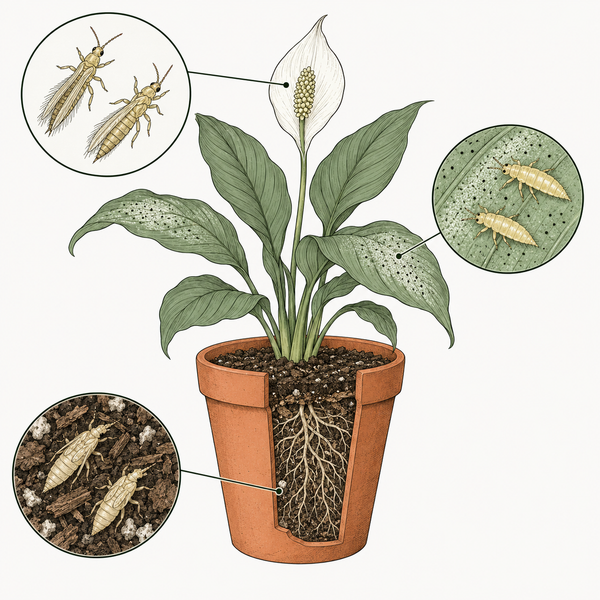
Young thrips, called larvae, are slender and often cream or pale yellow. Their narrow bodies have no cottony covering. They puncture plant cells and withdraw the contents, leaving silvery scars or streaks. Tiny dark fecal spots may appear nearby, and new growth or flowers can become distorted.4
That combination—narrow insects plus feeding scars—is more useful than color alone. It points toward a thrips problem, particularly when the insects are on the damaged tissue.
Tiny white bugs in the soil
Below the leaves, the food supply changes. Potting mix contains decomposing organic material and the fungi growing on it, along with small animals that eat one another. A moving speck here may be part of that food web without feeding on living roots.5, 6
Springtail · sudden jumps
Soil mite · rounded crawler
Fungus gnat larva · black head
Springtails jump when disturbed
Many houseplant springtails are small, white or gray, and elongated. A forked structure beneath the abdomen lets them spring away suddenly. You may notice them hopping across the mix after watering.
Springtails commonly feed on fungi, algae, and decaying organic matter. In houseplant pots, they are usually harmless. Damp conditions suit them, so a large gathering is a reason to review moisture and dead plant debris, rather than assume the roots are under attack.7
If you want to reduce their numbers, remove fallen leaves and let the mix surface dry between waterings where the plant tolerates it. A moisture-loving plant should not have to endure a drought because its decomposers became conspicuous.
Soil mites have several different diets
Soil mites often appear as rounded or oval crawling dots. Some are pale cream; others are tan or darker. Unlike the elongated springtails in the comparison above, mites have a more compact body and lack antennae.
“Soil mite” covers many species. Some eat fungi or decaying material, while others hunt small animals.5, 6 For example, Stratiolaelaps scimitus is a predatory soil mite that eats fungus gnat larvae.8
A mite's color or walking speed will not tell you which species it is or what it eats. If the plant is healthy, the presence of mites in its mix is not, by itself, a reason to treat. If the plant is declining, investigate the roots and growing conditions rather than assigning blame to the first moving dot.
Fungus gnat larvae are little worms with black heads
A fungus gnat larva has a translucent-to-whitish, legless body and a distinct shiny black head. It wriggles through moist potting mix. The adults it develops into are dark, delicate flies—the ones that tend to linger around pots.
This separates them from whiteflies: whitefly adults are white and their young feed on leaves; fungus gnat adults are dark and their larvae develop in the mix.
Fungus gnat larvae eat fungi and organic matter, but they can also damage roots, especially when numerous around seedlings and young plants. Sticky traps catch adults without reaching those larvae. Persistent infestations therefore need fungus gnat control directed at the potting mix, alongside attention to excess moisture and decaying debris.8
Root mealybugs leave wax around the roots
White insects attached to roots deserve a different response from springtails moving through loose mix. Root mealybugs withdraw sap from roots and sometimes the stem base. They have elongated oval bodies with a powdery white coating and may leave wax deposits on roots or against the inside of the pot.
They often gather around the outside of the root ball, although they can occur deeper within it. Root mealybugs in the genus Rhizoecus also lack the prominent fringe of wax threads seen on many foliage mealybugs.9
Root mealybugs · insects on roots
Perlite · porous mineral pieces
Affected plants can yellow or grow poorly, but those symptoms also have other causes. The stronger evidence is the combination of wax and recognizable insects on the roots. If root mealybugs are confirmed, avoid sharing drainage water or reusing the infested mix. Treatment must reach the roots; a foliage mealybug treatment cannot be assumed to do that.9
White material that is not a bug
Root mealybug wax is easy to confuse with other white material in a pot. Perlite is expanded volcanic rock, recognizable as separate, porous pieces.10 Mineral and fertilizer salts can form a chalky crust on the mix or pot rim.11 Fungi can grow as branching white threads or fuzz across organic material.
Perlite · porous pieces
Mineral salts · a crust
Fungal growth · fine threads
Stillness alone does not rule out a pest, though. Settled whitefly young and feeding mealybugs may barely move. Compare the structure as well as the behavior: a porous granule, a hollow aphid skin, and a wax-covered insect are different findings even when all three stay put.
Once you have a likely match
For a plant-feeding pest, separate the affected plant from neighboring foliage and follow the relevant treatment guidance. For springtails or likely decomposer mites around a healthy plant, leaving them alone is often appropriate.
If the match is still unclear, a plant diagnostic service or extension service can help. A photo of the suspect pest and the affected plant, with a note about where you found it and how it moves, gives them something useful to work with.
Sources and further reading
Identification and practical guidance draw on university and extension references below. The peer-reviewed soil-food-web review provides ecological context, not a diagnosis of an individual houseplant pot.
- UC IPM — Mealybugs. Wax, feeding injury, honeydew, and life stages.
- UC IPM — Whiteflies. Adult and immature identification, feeding, and management.
- University of Maryland Extension — Aphids in Home Gardens. Appearance, cast skins, and feeding signs.
- UC IPM — Thrips. Appearance and feeding damage. See also University of Minnesota — Managing insects on indoor plants.
- Cornell — Invertebrates of the Compost Pile. Mite and springtail feeding roles; ecological context, not a pot-specific species list.
- Soil Microarthropods and Soil Health: Intersection of Decomposition and Pest Suppression in Agroecosystems. Insects 10(12), 414 (2019). Peer-reviewed review; indexed abstract and excerpts checked, full-text retrieval unavailable.
- University of Wisconsin Extension — Springtails. Jumping mechanism, diet, and houseplant context; moisture advice also supported by the Minnesota indoor-plant guide.
- UC IPM — Fungus Gnats. Black-headed larvae, root injury, and larval control.
- UC IPM — Ground (Root) Mealybugs. Root feeding, wax, location, and spread.
- NC State Extension — Plants Grown in Containers. Perlite and growing-media components.
- University of Maryland Extension — Mineral and Fertilizer Salt Deposits on Indoor Plants. White crust and residue.
Illustrations are enlarged teaching comparisons, not photographs of a submitted specimen or a species-level identification key. Organisms are not shown at a shared scale.
