


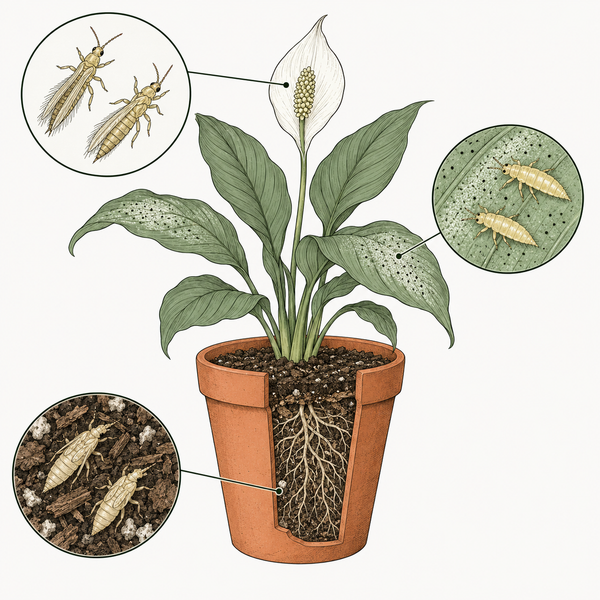


The mite you can’t see can leave damage you can’t miss. Understanding which russet mite you have—and which plant it is eating—makes treatment less of a guessing game.
Russet mites have managed to make being extremely small into a fairly effective business model. They feed on a plant’s surface, multiply out of sight, and leave the owner investigating the watering schedule.
By the time stems turn bronze or leaves begin to curl and dry, the mites may already be well established. There is no helpful webbing to announce them. There may not be a single moving speck you can see.
But “russet mites” is not one pest with one favorite plant. The tomato russet mite and the hemp russet mite are different species. That distinction matters before you decide what the damage means, which neighboring plants are at risk, or which treatment has evidence behind it.
What are russet mites?
Russet mites are plant-feeding mites in the eriophyid family. Under magnification, they look more like tiny tapered worms than the rounded spider mites many growers know. Their bodies have fine rings, and their four legs sit near the front. No legs at the back. Apparently the front office handles everything.
They are microscopic in the everyday gardening sense: you will not reliably identify one while watering. Hemp russet mites, for example, are roughly one-tenth to two-tenths of a millimeter long. Their pale bodies are easily lost against the surface of a leaf.

The mites pierce surface cells and withdraw their contents. Each feeding site is tiny; enough feeding across a leaf or stem produces visible injury. The bronze or rusty appearance is part of where the name comes from. It describes what happens to the plant, not a requirement that the mite itself be rust-colored.
Start with the plant it is eating
The tomato russet mite, Aculops lycopersici, is especially associated with tomatoes, though other plants can host it. The hemp russet mite, Aculops cannabicola, is associated with cannabis and hemp. A result from one crop is not automatically an answer for the other.
For a houseplant collector, this is a useful brake on internet diagnosis. A bronzed Hoya or a twisted Alocasia leaf does not become a hemp russet mite case because the symptoms resemble a photograph. Other mites, other pests, and non-pest injuries can produce overlapping damage. The host plant belongs in the diagnosis.
| Suspect | Useful context | What the symptoms cannot tell you |
|---|---|---|
| Tomato russet mite | Tomatoes and other hosts; bronzing often starts low and moves upward. | Brown lower leaves alone do not prove mites. |
| Hemp russet mite | Cannabis and hemp; curling, bronzing, smaller leaves and injured buds can occur. | A look-alike injury on an unrelated houseplant is not the same diagnosis. |
| Broad or cyclamen mites | Many ornamentals; distorted, thickened leaves and damaged buds. Different mite family. | Twisted new growth does not reliably separate these pests from one another. |
| Spider mites | Fine pale stippling; webbing may appear as colonies grow. | No visible webbing does not rule out an early infestation. |
| Growing conditions or spray injury | A change in light, nutrition, temperature or recent treatment may explain the pattern. | Color and leaf shape alone do not establish a pest. |
Broad, russet and cyclamen mites are often discussed together because their damage can overlap. Their biology—and the treatment that fits—can still differ.
Russet mite damage follows the feeding
On tomatoes, injury commonly begins on lower foliage and stems. The surface takes on a dull bronze appearance, lower leaves dry, and the damaged area progresses upward as the infestation spreads. Fruit can also become rough or russeted. A badly affected plant can decline severely or die.

Hemp russet mites can produce curled leaf edges, bronzing, reduced leaf size and damaged developing buds. Heavy populations spread beyond the leaf undersides onto stems and flower structures. Neither species needs to build a web to do this.
Those patterns help narrow the problem, but a photograph of damage is still a photograph of damage. Confirmation may require a diagnostic service to examine plant material under magnification. That is particularly useful when several possible causes would lead to different treatments.
A warm week is a lot of time to a mite
Once russet mites are present, the population is not politely waiting for the diagnosis. Eggs hatch into immature mites, which develop into adults; meanwhile, other adults are laying more eggs. These overlapping stages are one reason an infestation is not a single event you can address and forget.
In a laboratory study of tomato russet mites, development from egg to adult averaged about 17 days at 59°F, but only about five and a half days at 77°F. Those are measured development times, not a forecast for every greenhouse. They do show how much more quickly a new group of adults can appear in warm conditions.

The graph is not a suggestion to chill a tropical plant or heat the mites out. It explains why several weeks of treating an assumed nutrient problem can give the actual pest a substantial head start. Once a russet mite infestation is confirmed, containment and a treatment plan belong together.
Keep the infestation from getting a lift
These mites cannot fly, but that does not confine them to one plant. Infested plant material can carry them into a growing area, and air currents can move the tiny mites. Moving cuttings, tools and supplies between affected and unaffected plants creates further opportunities for spread.
Separate affected plants where practical, stop taking cuttings from them, and work on unaffected plants before handling the infested group. Clean tools between them and remove infested debris promptly. A badly damaged, replaceable plant may be better removed than maintained beside healthy hosts while treatments catch up.
Where predatory mites fit
Biological control introduces a predator to eat the pest. Amblyseius andersoni is one predatory mite with evidence of feeding on russet mites. The next question is whether it can reach enough of them, on that particular plant, to reduce injury.
Tomatoes make that question unusually interesting. Their stems and leaves carry plant hairs called trichomes, including glandular hairs that can obstruct larger predatory mites. A much smaller russet mite can feed in the spaces between them. The plant’s own defenses can end up providing the pest with cover.

In a greenhouse tomato study, andersoni was among the predators that reduced typical russet mite damage, but it survived poorly and did not eradicate the pest. Sustaining that approach required repeated introductions rather than relying on a lasting predator population. The researchers also identified the cost of repeated, high-number releases as a practical obstacle for commercial growers.
That makes andersoni a tool to consider within a plan, not a promise that one release will settle every infestation. The plant surface, pest pressure and timing all affect the result. Evidence from tomato also should not be presented as a measured success rate on hemp—or on your houseplant.
Likewise, do not choose a predator solely because its label says “mite.” Persimilis is a familiar spider-mite specialist; that reputation does not make it a russet mite treatment. Match the predator to the pest before matching it to the shopping cart.
What about sprays?
Predators are not the only approach with supporting evidence. Sulfur treatments have reduced hemp russet mite populations in field research, and sulfur is also included in university guidance for tomato russet mites. Those findings concern specific crops and treatments; they are not instructions to apply any sulfur product to any plant.
If you choose a pesticide, use a product permitted for the crop and intended use, following its current label. Crop sensitivity, application conditions and repeat-treatment instructions matter. If predators are already present—or planned—check compatibility and the appropriate release interval for the specific product. A spray plan and a biological-control plan need to work together.
For an established infestation, the useful question is not which single method sounds most reassuring. It is whether the approach can reduce the pest quickly enough, limit spread and protect the remaining healthy growth.
Recovery shows up in the next leaves
Dead leaf tissue does not turn green again when feeding stops. A scarred stem can remain scarred, and an old distorted leaf is a poor scorecard for a new treatment.

Follow the direction of the damage instead: whether bronzing is advancing, whether additional leaves are deteriorating, and how subsequent growth develops. Cleaner new growth is encouraging, but it is not proof that every mite has disappeared. If injury keeps expanding, reassess the diagnosis and treatment rather than waiting for the old leaves to look better.
The aim is to give the plant a future that looks better than its past. The old leaves are allowed to keep their records.
Sources and further reading
Research findings are distinguished from practical interpretation in the text. Illustrations are generated teaching reconstructions; they are not microscope photographs or diagnostic specimens.
-
Haque & Kawai (2003) · Temperature and development of tomato russet mite
Original study. Full paper and Table 1 reviewed; graph uses reported egg-to-adult means and standard errors, not modeled values.
-
Kawai & Haque (2004) · Population dynamics of tomato russet mite
Original research; abstract reviewed for upward movement and effects on tomato growth.
-
van Houten et al. (2013) · Tomato trichomes and biological control
Original experimental research; abstract and accessible text excerpts reviewed for the plant-hair barrier. The illustration simplifies this mechanism.
-
Pijnakker et al. (2022) · Evaluation of phytoseiid and iolinid predators
Peer-reviewed greenhouse experiments; abstract, results and discussion excerpts reviewed. Supports the qualified tomato-specific andersoni discussion, not universal control claims.
-
Hayes et al. (2023) · Biology and management of hemp russet mite
Original research; abstract reviewed for field sulfur results. No experimental rates or hot-water protocols are recommended here.
-
UC IPM · Tomato russet mite
Feeding, typical progression, injury and management context.
-
University of Kentucky · Hemp russet mite
Anatomy, host association and damage symptoms.
-
Colorado State University · Hemp russet mite
Dispersal, sanitation and predator context. No universal eradication or host-free interval is inferred.
-
Utah State University · Tomato russet mite
Hosts, damaged tissue and cultural management.
-
UC IPM · Broad and cyclamen mites
Comparison with tarsonemid mites and non-pest look-alikes.
-
UC IPM · Spider mites
Stippling, webbing and comparison with spider mites.
-
NC State Extension · Hemp russet mite
Distinguishes feeding reports from demonstrated field performance.
