



A moss pole and a coir pole can look like two versions of the same purchase. Both are tall. Both are brown. Both promise to stop your monstera from occupying the next room.
Then you watch someone water a pole full of roots, look at the coconut fiber wrapped around your own stake, and wonder whether you missed a step.
Possibly. Or you bought a different piece of equipment.
A typical coir pole mainly holds a climbing plant upright. A moss-filled pole does that too, but also gives its roots moist material to grow into. That extra job is the reason you water the moss itself.
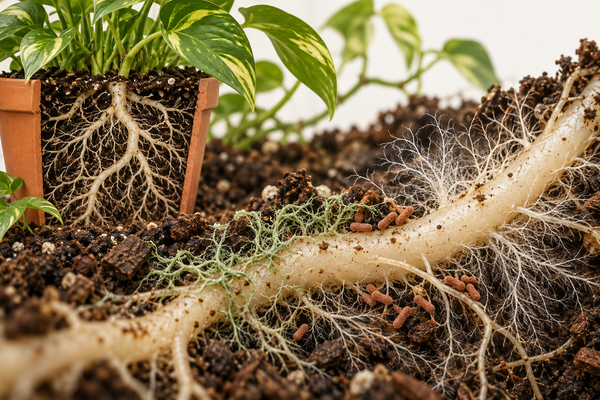
Those roots emerging from the stem above the pot are called aerial roots. Against a coir-wrapped stake, they may grip the outside. In a moss-filled pole, they can enter the filling and grow smaller branching roots inside it. Think of the moss as another place for roots to live, above the pot.

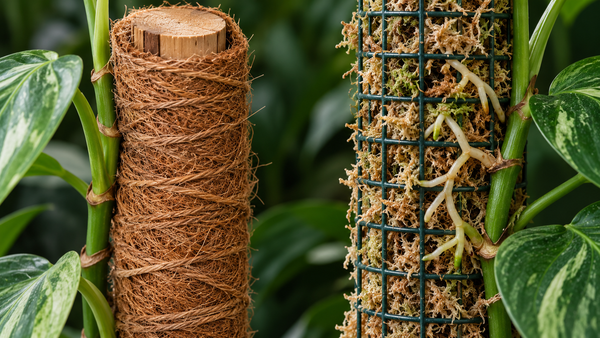
Coir, left: a solid stake wrapped in coconut fiber. It supports the plant; roots can grip the outside.
Moss, right: a mesh tube filled with sphagnum. It supports the plant and provides moist filling for roots to grow into.
Which pole is better for your plant?
A moss pole offers more space for roots, but that does not make it dramatically better for every plant or every home. If you mainly want your monstera to stop leaning across the floor, a sturdy coir pole and soft ties may do the job perfectly well. You do not need to maintain damp moss to justify owning a climbing plant.
Choose a moss-filled pole when you want aerial roots to grow into the support and you are willing to check and water the filling. If you would rather keep care focused on the pot, a coir stake is often the more practical choice. Neither guarantees bigger leaves.
| Your goal | Usually the better fit | What you take on |
|---|---|---|
| Hold a climbing plant upright with a simpler care routine | Sturdy coir-wrapped stake | Secure the main stem with soft ties; adjust as it grows. |
| Give aerial roots somewhere moist to grow and branch | Mesh pole filled with sphagnum moss | Check and water the moss as well as the pot. |
| Get larger leaves | No automatic winner | Provide suitable light, support, and root care. Changing poles alone is not a promise. |
Look inside the moss pole
“Moss pole” is used loosely enough that the name alone tells you very little. Look at the construction.
A common coir pole has a solid wooden or plastic core covered in coconut husk fiber. The rough outside gives roots something to grip, and you can tie the stem to the pole while the plant attaches. But beneath that thin layer of fiber is a solid stick. Roots can grow among the outer fibers; there is no deep filling for them to grow into.
A sphagnum-filled pole is built differently. Imagine a tube made of mesh, packed with the loose, stringy moss sold for propagation. The moss fills the tube rather than just covering a stick. A root can pass through a mesh opening and grow farther into that damp filling, producing smaller branching roots along the way. NYBG describes this construction for monstera support, and RHS guidance explains that the moss needs to stay moist for the plant to root into it.1, 2
This is why the material name can mislead you. Some poles are solid stakes with a thin covering of moss. Others are hollow tubes filled with coconut material instead of moss. Coconut husk can be processed into long fibers, chips, or much finer particles, and those forms hold water differently. Research on coir growing media confirms that particle size affects water retention. The useful question is: what is inside this particular pole, and can roots reach it?3
Plants that work well on coir poles
Golden pothos—the plant in these illustrations—is a useful example. If you want its long vines growing upward instead of trailing from a shelf, a coir pole can provide the support without adding a column of moss to your watering routine. RHS guidance specifically includes both moss- and coir-covered poles for pothos, as well as trellises and wires. You may need soft ties to keep the stems positioned.8
Heartleaf philodendron (Philodendron hederaceum) is another practical candidate when the goal is simply to support its climbing vines. Its aerial roots attach to supporting surfaces. A coir stake is one way to provide that surface; it is not evidence that the species grows better on coconut fiber than in moist moss.9
For either plant, a moss-filled pole becomes useful when you specifically want roots to develop inside the support. The choice follows what you want the pole to do, rather than a strict list of “coir plants” and “moss plants.” A large monstera also needs a support sturdy enough for its weight; a flimsy pole does not become adequate because it has the right covering.
And some climbers do not need either kind of pole. For a climbing hoya such as Hoya carnosa, a wire hoop or trellis can be a more convenient way to arrange the stems. RHS recommends loops, canes, or wires for training hoyas. A damp moss column is not a requirement for supporting one.10
Choose for the plant you actually have
For climbing aroids, aerial roots are part of the climbing system. Monstera roots can attach to supporting surfaces, and long roots can also reach and root into the ground. A tree is doing more than keeping the leaves tidy.4
Check whether your particular plant naturally climbs. Some philodendrons grow upward against a support; others grow a thick stem horizontally along the soil surface, sending roots downward as they go. Those creeping plants need room to travel across the pot. They will not become climbers because you have purchased the deluxe extension kit.
Aerial roots do not all have to enter a pole, either. Iowa State notes that philodendron aerial roots can be left alone, guided toward a support, or directed into the potting medium.5 Work with flexible roots and emerging growth; do not force an old, rigid root into a sharp bend.
Put the stem next to the support
The illustrations show golden pothos (Epipremnum aureum). To attach a climbing pothos, philodendron, or monstera, start by tracing one leaf back toward the pot. Its long stalk—the petiole—joins the thicker main stem. Follow that main stem and you will find the attachment points for other leaves, along with roots or small root bumps. Those points are called nodes. The main stem is what you secure to the pole; the individual leaf stalks stay free.

- Anchor the pole first. Repotting is a convenient opportunity because you can position the support without blindly driving it through the root ball. Keep the plant at the same soil level rather than burying more stem to make it stand up. Secure the pole firmly enough that it does not wobble when you gently move it.
- Put the pole behind the aerial roots. Look for roots or root bumps along the main stem and position those near the pole. On a monstera, these usually make the root-bearing side especially easy to identify. Bring that side close to the pole, with the roots facing its surface. A pole on the opposite side may hold the stem upright, but the roots have farther to travel to reach it.
- Secure the main stem. Loop a broad, soft plant tie around the pole and a clear section of main stem between leaf attachments. Leave it loose enough that it does not press into the stem. Keep leaf stalks and unfolding leaves outside the loop, and check periodically that the thickening stem has not outgrown the tie.
- Train new growth gradually. Guide flexible sections toward the support. Do not straighten an established sideways stem by force. If the old stem already bends sideways, support it in that shape and guide the newer, flexible growth toward the pole as it develops.
If several vines share one pot, follow each stem separately. They may face different directions. Gathering every leaf stalk into one tight bundle can make the plant look upright while leaving the actual climbing stems poorly positioned.
A rooted moss pole needs its own watering check
Once roots grow into the moss, they are living in that moss much as the lower roots live in the potting mix. Wisconsin Extension specifically recommends watering moss-covered supports so aerial roots can obtain water and nutrients.4 That is a different job from occasionally spraying a decorative wrap.

Feel the moss through an accessible opening without digging into the roots. When it is beginning to dry, add water slowly from the top or through the openings, wetting the section the roots occupy. Pause between small additions so the moss can absorb the water. You want damp moss with spaces for air, not filling sitting in trapped water. A quick mist can leave the outside wet while the moss inside is still dry.
Watch where the water goes. If it drains into the pot, that counts as watering the pot. Check the potting mix before adding its usual drink as well. If the pot is still wet, avoid pouring a large volume through the pole. Apply smaller amounts directly to the drying moss and watch the runoff. If that still keeps the pot wet, the arrangement needs changing—for example, to a pole with a covered back that exposes less moss to the room air.
Some poles have mesh all the way around. Others have a solid plastic back and openings only on the side facing the plant. The covered design leaves less wet moss exposed to the air. Neither comes with a universal watering schedule: the room and the plant affect drying too. Check frequently at first to learn what your setup needs.
For a solid-core coir pole used mainly as a support, there is no need to repeatedly soak it just to imitate someone else’s moss-pole routine. If roots are growing into the outer fibers, check those fibers for moisture. But repeatedly soaking a thin wrap will not give it the same space for roots as a tube full of moss.
Will a moss pole make bigger leaves?
Climbing can influence leaf development, but sphagnum is not a leaf-enlargement ingredient.
In a 2022 experiment with pothos, Epipremnum aureum, researchers tested light, contact with a support, and growth direction together. The strongest leaf expansion came from the combination of greater light, upward growth, and contact. The result helps explain why a supported vine in good growing conditions can develop very differently from a hanging vine.6
It does not show that moss beats coir, that every aroid responds identically, or that tying a plant upright guarantees the next leaf will double in size. Earlier experiments likewise found that several climbing aroids developed larger leaves and more aerial roots than hanging plants, although their stems did not all respond in the same way.7
Judge the setup by new growth over time. Are roots reaching the support? Is the stem growing in the intended direction? Are light and root conditions adequate? The pole cannot compensate for a plant spending its entire day in a dim corner.
Plan for the top before it gets there
An extendable pole is useful only if its joints and base can support the taller plant. Attach an extension before the top of the stem grows beyond the pole. As the leaves and stem get heavier, check that the pole’s base and extension joint remain firm. If the whole pot threatens to tip, placing it inside a heavier outer container can add stability without surrounding the roots with extra potting mix. Empty any collected water. A much larger planting pot can stay wet too long when the roots do not yet fill it.2
Before removing a plant from its pole, look at where its roots have gone. If they have grown through the mesh and branched inside the moss, pulling the stem away can tear them. The pole is now threaded through part of the root system. It cannot simply be pulled out like a loose garden stake.
When a rooted pole can help with propagation
This matters if the plant has reached the ceiling and you want to cut off the top to grow as a separate plant. That cutting needs a section of stem with a node, not just a leaf and its stalk. If its nodes have already produced branching roots inside a removable upper pole section, it may be possible to separate that section and keep the cutting attached to it. This depends on the pole’s design and where the roots run; do not pull apart a joint that roots cross. The detached plant still needs stable support and moisture around its roots. A single long aerial root is not the same as a network of smaller roots already growing in the moss.4
The right support is the one that fits both the plant and the care you intend to give it. Sometimes that is a moist column full of roots. Sometimes it is a sturdy coir pole and a few sensible ties. Your plant needs a workable arrangement. It has not read the pole reviews.
Sources and further reading
Research informs the biology in this article; the installation and watering sequence is practical horticultural guidance. These sources do not establish a controlled, universal moss-versus-coir winner.
- New York Botanical Garden — Can I clip off the aerial roots from my Monstera plant? Root guidance and a sphagnum-filled mesh support.
- Royal Horticultural Society — How to grow Swiss cheese plants. Support, moist moss, stability, and potting.
- Influence of Particle Size on Physical and Chemical Properties of Coconut Coir Dust as Container Medium (2003). Communications in Soil Science and Plant Analysis 34. Growing-medium research, not a pole comparison.
- Mahr, S. — Swiss-Cheese Plant, Monstera deliciosa. University of Wisconsin–Madison Extension. Climbing roots, support watering, and propagation.
- Steil, A. — What do I do with the aerial roots of a philodendron? Iowa State University Extension.
- Brito, C., Mantuano, D., De Toni, K. L. G., & Mantovani, A. (2022). Untangling leaf expansion triggers: A new experimental study with Epipremnum aureum (Araceae). Flora 295, 152139.
- Thigmomorphogenesis in Climbing Epipremnum aureum, Monstera obliqua expilata and Philodendron scandens (Araceae) (1987). Journal of Plant Physiology. Species-specific responses to climbing contact.
- Royal Horticultural Society — How to grow epipremnum. Moss and coir poles, trellises, and training pothos.
- NC State Extension — Philodendron. Climbing species, including heartleaf philodendron, and attachment to supports.
- Royal Horticultural Society — How to grow hoya. Training on loops, canes, and wires.
