



Mycorrhizal fungi. Trichoderma. Beneficial bacteria. Put the names next to one another and they can sound like three ways of saying “something good happens in the soil.”
That is roughly as helpful as describing everyone in a hospital as “someone with a badge.” The jobs matter.
Mycorrhizal fungi can extend a root system’s access to nutrients. Certain Trichoderma fungi can influence root growth and help suppress disease. Beneficial root-associated bacteria can change nutrient availability, plant signaling, and competition around roots. Their abilities overlap, but they are not interchangeable—and none is an automatic upgrade for every plant.

Three groups, different relationships with roots
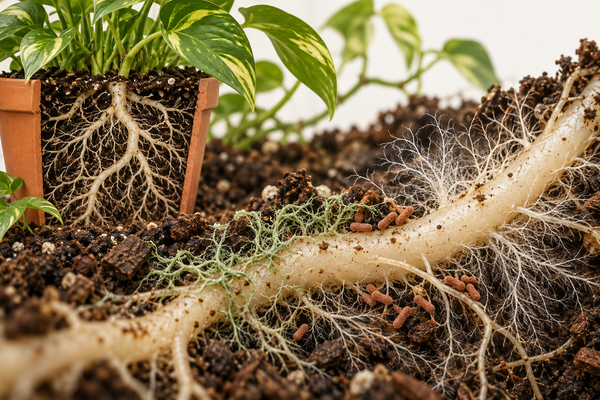
The soil immediately influenced by a root is called the rhizosphere. Roots release compounds into this area, including substances microbes can use. It is an active neighborhood, not empty space waiting for us to pour something into it. Adding living microorganisms—an inoculant—introduces organisms into conditions and communities already there. Establishment is part of the challenge.3

| Group | What makes it useful | What the name does not promise |
|---|---|---|
| Arbuscular mycorrhizal fungi | Form a partnership with compatible living roots; fungal threads explore beyond the root surface. | Every plant is a suitable host, or every colonized plant grows faster. |
| Trichoderma | Certain strains associate with roots, influence plant responses, and act against some pathogens. | Every strain has the same effects, or established root rot will disappear. |
| Beneficial root-associated bacteria | Depending on the strain, affect nutrients, root development, stress responses, or competing microbes. | Every bacterium performs all these jobs or replaces fertilizer. |
Mycorrhizal fungi extend the search
A root can absorb nutrients only where it has access to them. Phosphorus is a useful example: it can move slowly through soil, leaving a depleted area near an absorbing root. Fine fungal threads, called hyphae, can reach beyond that area and deliver nutrients to the plant. The plant supplies carbon compounds in return. The fungus is being paid.1, 2

Here we mean arbuscular mycorrhizal fungi, often shortened to AM fungi or AMF. They form specialized exchange structures inside compatible roots. That partnership distinguishes them from fungi merely living nearby. “Mycorrhizal” also covers other types of partnerships; an AM inoculant is not a universal match for every plant.2
The important distinction is access versus supply. These fungi do not manufacture phosphorus. They offer another route to resources already present. And a functioning fungal pathway does not always produce an obvious increase in plant size. A plant can be colonized without looking dramatically different.1
For more on that exchange, see Mycorrhizal Fungi Work for Dinner.
Trichoderma changes the neighborhood
Trichoderma is a group of fungi, not another name for mycorrhizae. Certain strains grow in association with roots and can influence their development and the plant’s defenses. Some also parasitize other fungi. Picture one fungal filament contacting another, growing around it, and attacking it with enzymes. Being a fungus does not require professional solidarity.4, 5

Direct attack is only one mechanism. Competition for resources and space, inhibitory compounds, and changes in plant defense responses can also contribute. A strain may affect growth even when a disease is not the main problem. But the organism, plant, pathogen, and conditions all matter; a result for one combination does not establish what every Trichoderma product will do.4, 5
This is where the letters and numbers after a microbial name earn their place on the label. A strain identifies a particular lineage within a species. Research on T22, for example, should not be treated as proof for every other Trichoderma strain. “Contains Trichoderma” starts the conversation. It does not finish it.
Beneficial bacteria are a varied group
You may see plant growth-promoting rhizobacteria, or PGPR. That describes bacteria associated with roots that can benefit plant growth. It is a functional category, not one organism with one standard set of abilities. Studied strains include members of groups such as Bacillus and Pseudomonas, but those names alone do not establish a benefit.3
Some bacteria release compounds that help make otherwise poorly available nutrients accessible. Others influence root development through plant signaling, compete with pathogens, or help prime defense responses. Certain bacteria can fix nitrogen, but that ability cannot be assumed for every bacterial inoculant—or translated into “you can stop fertilizing.”3, 6

Consider phosphorus again. One bacterial strain might help release it from a poorly soluble mineral compound. An AM fungus might help transport available phosphorus back to the root. Both can contribute to nutrition through different processes. Whether that combination helps in your pot depends partly on whether those processes are needed there.1, 6
Can they work together?
Yes, but “beneficial” is not a promise that every combination cooperates. Research on AM fungi and Trichoderma includes useful combinations as well as less favorable interactions. The particular organisms, growing conditions, and application matter. A longer ingredient list is not, by itself, evidence of a better result.7
That is why a tested combination is more informative than adding several products and assuming their benefits add together. More guests do not automatically improve a dinner party. Occasionally they just argue over the same chair.
What should you expect after applying them?
First, separate three questions: did you apply viable organisms, did they establish or remain active where needed, and did the plant benefit? Those are different outcomes. A packet reaching the pot confirms only the delivery.
Commercial inoculants have varied in their ability to establish and improve plant performance in research tests. That is one reason we cannot assign a universal “working by day seven” schedule. The formulation and its condition matter alongside the plant and growing environment.8
| What you notice | What you can reasonably conclude |
|---|---|
| New growth or better establishment | Encouraging plant performance; it does not isolate the cause if other care changed too. |
| No obvious change | Not proof of failure or success. Activity below ground and visible improvement are different questions. |
| White growth on the potting mix | Appearance alone cannot identify the organism or prove the intended partnership formed. |
| Continuing decline | Investigate the plant’s conditions and the cause of decline. Do not treat waiting longer as the only option. |
As a practical home comparison, photograph new growth and keep a simple record of watering, feeding, and changes in conditions. Similar plants receiving similar care—with some untreated—are more informative than a single before-and-after photo. There is no need to repeatedly unpot a plant to see whether its microscopic employees have clocked in.
Give the introduction a useful destination

AM fungi need compatible living roots for their normal partnership. Root-zone bacterial and Trichoderma products also need to reach the location specified for their use. Repotting can make placement convenient, but not every formulation is applied the same way. Follow the amount, method, storage conditions, and use-by guidance on the actual product.2, 3, 8
Keep ordinary plant care appropriate while the organisms establish. Do not turn an airy potting mix into a swamp in an effort to make it microbe-friendly. Nor should an inoculant be the reason to ignore poor light, damaged roots, or an unsuitable feeding routine.
If you use fungicides or disinfecting treatments, check compatibility with the specific inoculant. Different organisms and treatments behave differently; “safe with all beneficials” and “kills every beneficial” are both too broad. Likewise, use in a potting mix is not automatic evidence of suitability for a recirculating reservoir.
The useful expectation is a biological contribution under suitable conditions, not a substitute for understanding the plant. Roots have company. You are still responsible for the building.
Sources and further reading
These papers discuss microbial biology and research outcomes, not a trial of a particular nursery blend. Much of the evidence comes from crops and controlled experiments. Household application and observation advice is our practical synthesis. Illustrations are conceptual, not measured results. No fixed response time or growth increase is promised.
- Smith et al. (2011). Roles of Arbuscular Mycorrhizas in Plant Phosphorus Nutrition. Plant Physiology. Nutrient pathways and why colonization does not necessarily mean increased growth.
- The Costs and Benefits of Plant–Arbuscular Mycorrhizal Fungal Interactions (2022). Annual Review of Plant Biology. The partnership and its context-dependent costs and benefits; publisher abstract consulted.
- Backer et al. (2018). Plant Growth-Promoting Rhizobacteria: Context, Mechanisms of Action, and Roadmap to Commercialization. Frontiers in Plant Science. Root-associated bacteria, establishment, and formulation challenges.
- Harman et al. (2004). Trichoderma species—opportunistic, avirulent plant symbionts. Nature Reviews Microbiology. Root interactions and defense responses; USDA ARS technical abstract consulted.
- Trichoderma: a multipurpose, plant-beneficial microorganism for eco-sustainable agriculture (2023). Nature Reviews Microbiology. Growth and defense mechanisms; publisher abstract consulted.
- Wang & Xu (2026). PGPR-mediated enhancement of soil nutrients, rhizosphere microbial ecology, and plant growth. npj Biofilms and Microbiomes. Nutrient availability and the gap between laboratory mechanisms and reliable field effects.
- Szczałba et al. (2019). Comprehensive insight into arbuscular mycorrhizal fungi, Trichoderma spp. and plant multilevel interactions. Journal of Applied Microbiology. Benefits and limitations of combinations in horticultural crops.
- Salomon et al. (2022). Global evaluation of commercial arbuscular mycorrhizal inoculants under greenhouse and field conditions. Applied Soil Ecology. Commercial inoculant performance; study abstract and publication record consulted.
