

Specialist · Mealybugs
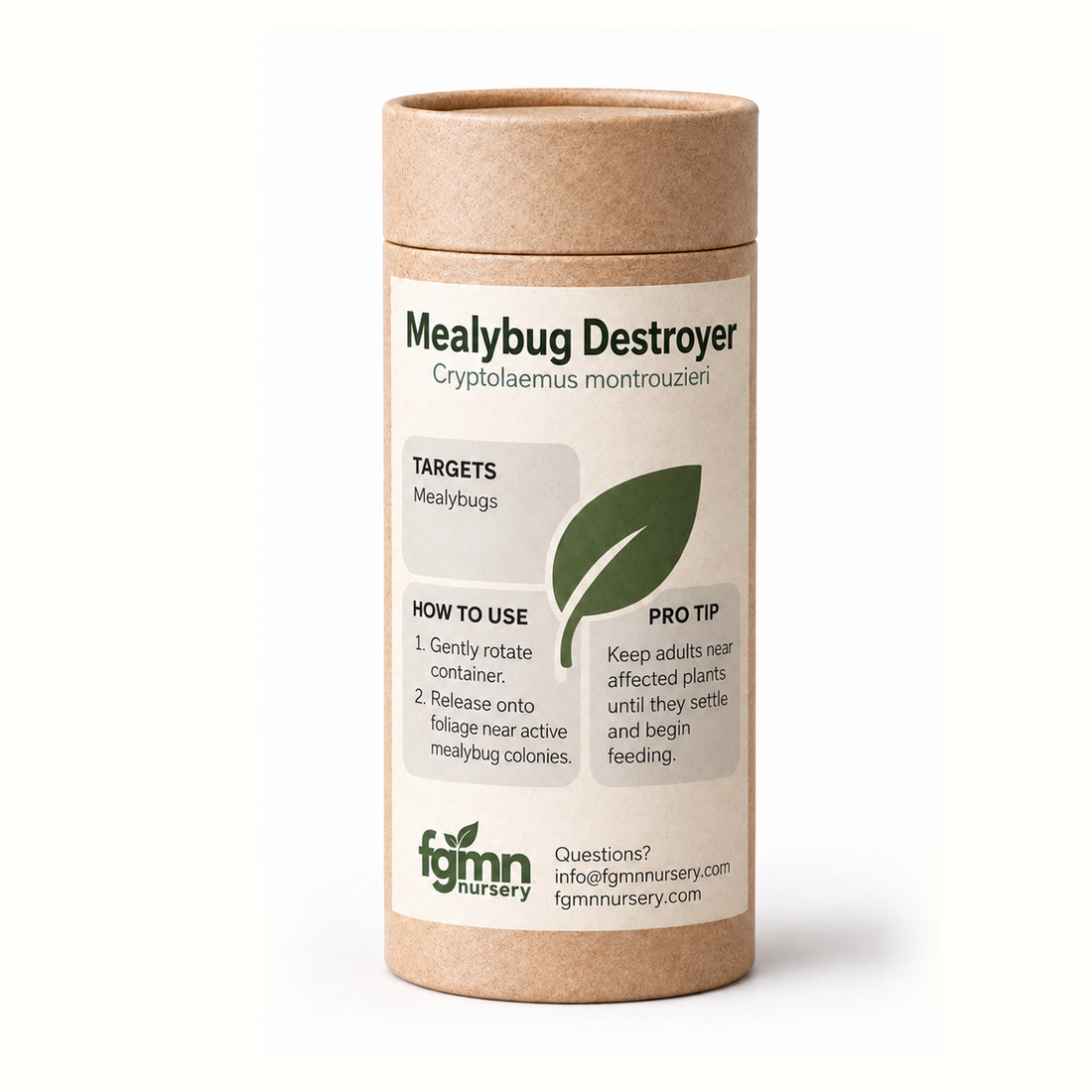
Cryptolaemus montrouzieri
Its larvae wear mealybug wax as a disguise, which is how they feed inside a colony the ants are guarding.
$25.00
Free Shipping for all orders over $30
If something's wrong when it arrives, file a report within 72 hours of delivery for a replacement or store credit.
By placing your order you agree to our Shipping Policy and Live Delivery Guarantee.

How much, and how often
Two questions — how bad it is, and how many plants. You get a size and the dates to put it out.
How bad is it?
Pick the one that sounds like your room. If you are between two, take the higher.
How many plants?
Six-inch pots. Count a large specimen with a dense canopy as three or four.
Your size and schedule
More about this dose
The three things people ask once they have their size. Open any of them.
Am I light, moderate or heavy?
Light
- A few white specks in one leaf axil
- No honeydew yet
- Nothing on the plants either side of it
Moderate
- Clusters in several axils and along stems
- Sticky honeydew on the leaves below
- White wax visible without looking hard
- A second plant affected
Heavy
- Wax along most of the stems and petioles
- Sooty mould on the honeydew
- Ants running the plant
- Growth stalling and leaves dropping
Every size comes two ways — larvae or adults — and the sizing below works from the plant count, so it will point you at the larvae option. Larvae are the surgical strike: they cannot fly, so they stay on the plant you put them on and eat until the colony is gone. Choose adults instead when the mealybugs are scattered across a collection and you want something that will go and find them. On a serious infestation, professionals run both: adults patrolling the room, larvae placed straight into the worst hot spots.
On a heavy infestation the aim is to overwhelm the colony — two to five per infested plant, and more where the wax is thick. Adults are the other risk of under-dosing: they are programmed to fly off and find food, so if the pest population in front of them is too thin, they leave. A generous release on a real colony keeps them where you put them.
Why more than one round?
Putting it out
- Control ants first. Baits or sticky barriers, two or three days before you release. Ants defend mealybugs and will kill your predators.
- Mist the plants lightly. The beetles are often thirsty after shipping.
- Releasing larvae: use a small paintbrush or the tip of a leaf to transfer them gently straight into the mealybug clusters. Do not squeeze them.
- Releasing adults: open the container near the infestation, in the evening or early morning.
- Do not wear a white shirt. Adults are drawn to light colours and will land on you instead of the plants. This sounds like a joke and is not.
Everything else is optional. Get these four and the release has done what it can.
A cleaner way
On a display plant, tip small piles into bio-boxes or paper cups hung in the branches instead of dusting the foliage. Same dose, nothing visible on the leaf.
The failure is forgetting. Very few programs fail because the mite underperformed. They fail in week five, when the plants look fine, the reorder does not happen, and the population holding the line ages out with nothing behind it.
A schedule is the same decision, made once. A container when it looks bad, then another when it looks bad again, is already a rhythm — just one you have to remember at the exact moment the plants look fine.
Change the size or the frequency, skip a box, pause or cancel from your account at any time.
Is this the right beneficial for your problem?
Five questions, in the order a grower actually asks them: what have you got, is this the answer to it, what will it eat, how does it do the killing, and will it survive your room.
Is this your pest?
The common name does its job here: mealybug destroyer. Get the identification right and this beetle is very hard to beat.
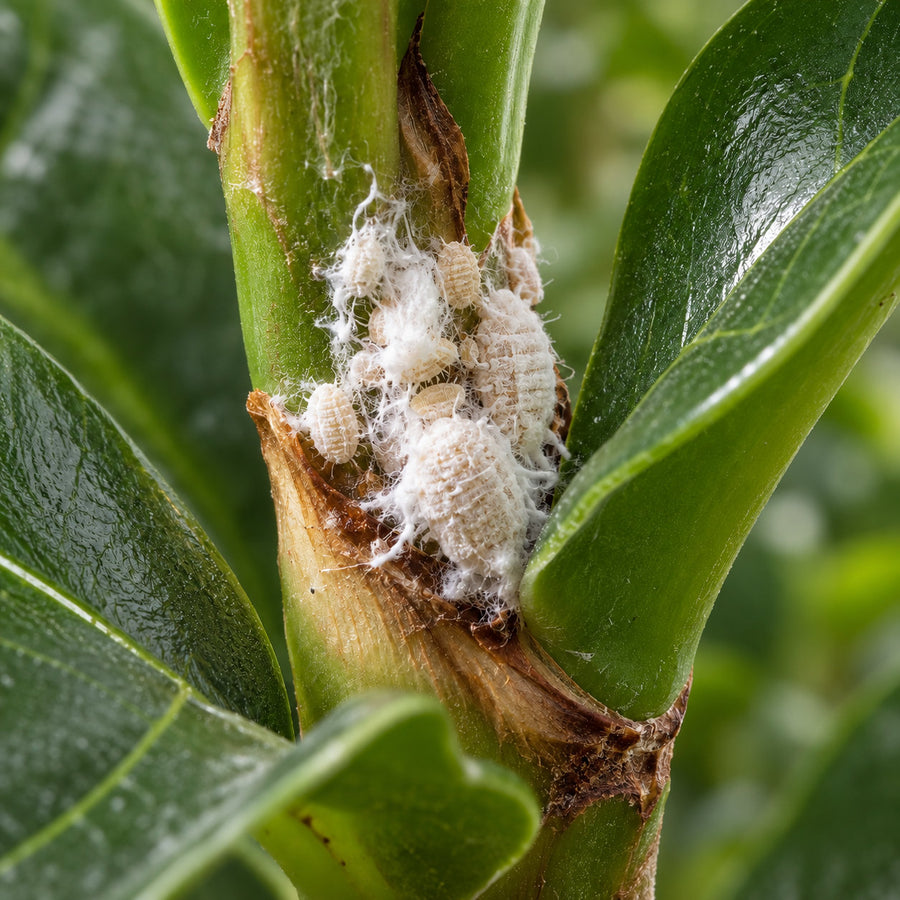
Mealybugs are the small soft insects wrapped in white wax, tucked into leaf axils, along stems and where a petiole meets the trunk. They leave sticky honeydew and sooty mould follows it. Citrus, long-tailed and obscure mealybug are all on the list.
The quick test is a fingernail: mealybug and soft scale squash wet and sticky. Armored scale — the hard little limpets — pops off dry, and that is a different beetle. One honest note on long-tailed mealybug: it bears live young and makes no egg sac, so the beetles will eat it but cannot reproduce on it. Expect repeat releases there rather than a self-sustaining population.
Then: is Cryptolaemus the right answer to it?
Choose this if
Choose Crypts when you can see mealybug colonies. The larvae are covered in white wax and look almost exactly like oversized mealybugs, which fools the ants guarding the colony and lets them feed inside it — a trick nothing else in the range has. Both stages are voracious, neither touches plant tissue, and there is nothing to mix or spray.
Choose something else if
They want warmth and a colony worth staying for: active between 64 and 90°F, and adults will fly off if pest numbers are too low, so this is for visible mealybugs rather than insurance. Armored scale needs Rhyzobius; root mealybugs need a soil predator. And ants have to be dealt with first, because the mimicry only gets a larva so far.
What it kills, and what it won't
Aphids get taken occasionally, but these are specialists: they may snack on aphids if starving, and they require mealybugs to reproduce. On a plant with three insects on it, they leave.
How it works
What it does to the pest, what it does on the plant, and what that leaves you looking at.
It eats them, wax and all
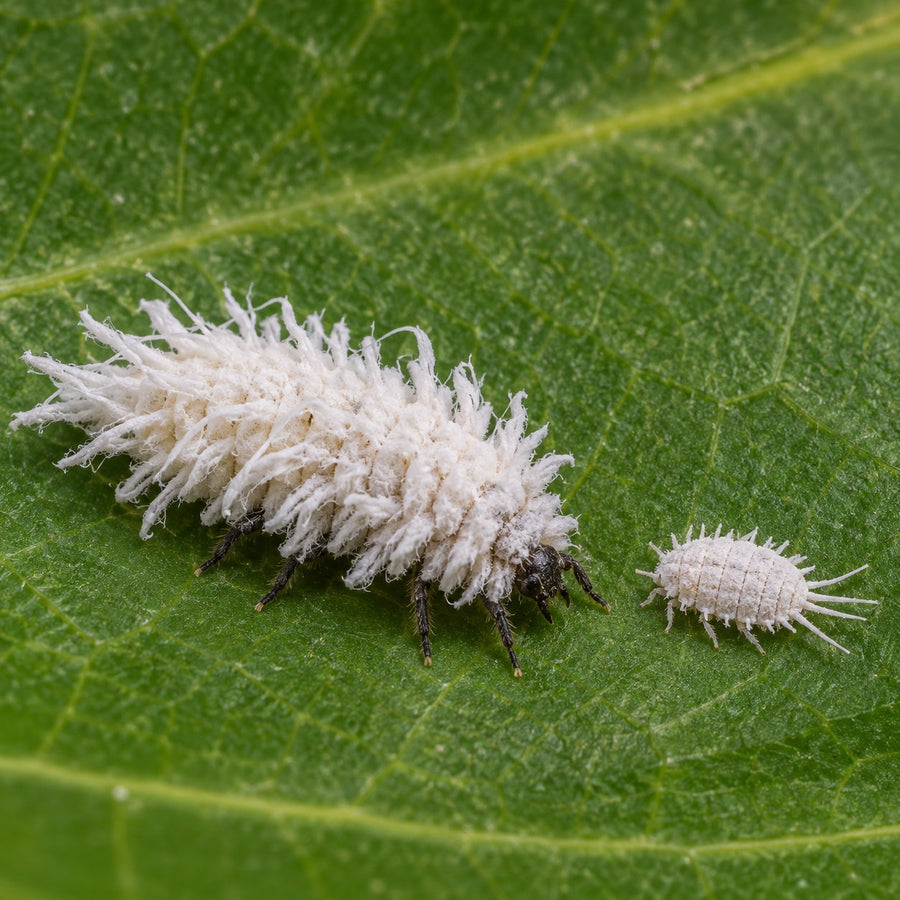
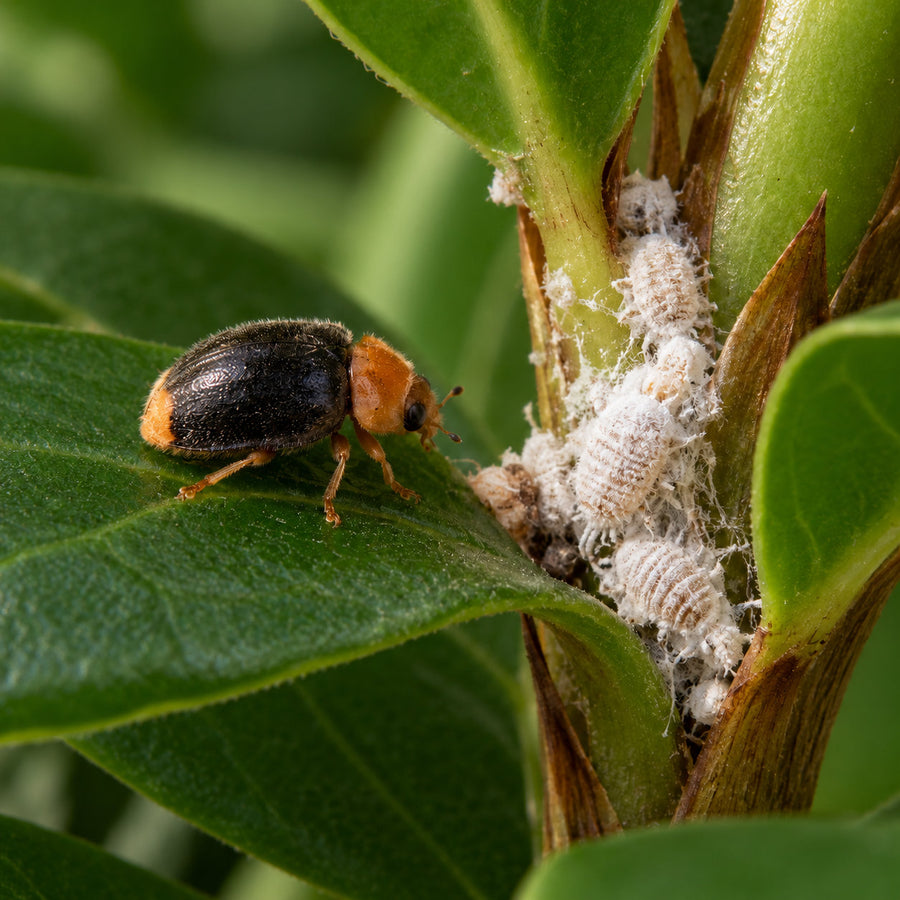
A small black lady beetle with an orange head and tail, and a larva that is white, waxy, and up to half an inch long. Both hunt mealybugs and both eat in volume. No poison, no residue on the leaves, and nothing for a pest to become resistant to.
It gets inside a guarded colony
The larva's wax coat is mimicry, and it works on ants. Ants farm mealybugs for the honeydew and defend them aggressively, and a larva that reads as a mealybug can feed inside a colony that would otherwise be closed to a predator.
Colonies visibly thinning
Starting with the cluster you released onto. The adults move on once the food runs out; larvae disappear into pupation on the stems before new beetles emerge. Both are the release working rather than failing.
Do not wipe the wax. White fluff on a treated plant may well be your own larvae. Poke it first — if it runs away quickly it is a predator; if it stays put it is the pest.
Will it work in your room?
Deal with ants first — two or three days ahead, with a bait or a sticky barrier. Ants defend mealybugs for the honeydew and will kill your predators, and the larva's disguise only gets it so far. And check the pest: if the insect pops off dry rather than squashing, that is armored scale and a different beetle.
About Cryptolaemus
The mealybug destroyer, which is a rare case of a common name doing its job. A small lady beetle that eats mealybugs and soft scale almost exclusively, and has no interest in your plants or in you.
New to beneficials?
Five things that catch almost everyone the first time.
After you release it
What actually changes, and the one thing not to scrub off.
How you'll know it's working
Mealybug colonies visibly thinning, starting with the cluster you released onto. This is one of the few beneficials where the result is legible on the plant.
Adults will move on once the food runs out. If you released larvae, expect them to disappear into pupation on the stems before beetles emerge. Neither is a failure — both are the normal end of a successful release.
Look closely before you go at anything with alcohol. White fluff on a treated plant may well be your own larvae. Poke it: a predator runs, a mealybug stays.
Getting it to you
What is in the container, how it travels, and what happens if it arrives wrong.
What arrives
Adults ship loose in a box with no carrier. Larvae come in buckwheat hulls, and the white waxy things in there are the predators, not an infestation.
Larvae arrive active and hungry, and may be huddled together. Adults can be sluggish at first and pick up once they warm to room temperature.
Release the day it arrives. Neither stage holds well in a container. Evening is best, onto foliage you have misted first — the beetles are often thirsty after shipping.
When it ships, and when it lands
Shipping
We ship when they're ready to travel. Live orders go out Monday to Thursday. If a colony needs a beat to peak, or we're propagating a fresh batch, yours might hold up to a week. All mites and insects ship 2-day or Overnight depending on what's best for them.
When it lands
Open it that evening, at the mealybugs. Mist the plants lightly first. For larvae, use a small paintbrush or the tip of a leaf to move them gently into the clusters — do not squeeze them. For adults, open the container near the infestation in the evening or early morning. And avoid wearing a white shirt: adults are drawn to light colours and will land on you instead of the plant.
About the ones that don't make it
Some of them die on the way. That is why we send more than you paid for.
A beetle with a high metabolism ships in a container, in a van, for two days.
Roughly 15% will not survive that. We cannot prevent it, so we price it in: the number on the label gets counted out, and then the cushion goes in on top of it.
Your 100-beetle container leaves here holding more than 100. The ones that do not make it are already paid for.
If you can see them
Ladybugs, lacewing larvae, Orius — the minute pirate bug — and the beetles. Tip a few onto white paper and give them twenty minutes at room temperature before you judge anybody.
Cold insects are genuinely good at playing dead. The deceased have been known to get up and walk off the counter.
Still more than about one in seven not moving? Photograph them and file a report.
The photo is not us doubting you. It is how we tell a bad batch from a bad courier day from a mailbox that hit 104°F.
If you can't see them
Mites, nematodes, eggs — most of what we sell. Not this one: both stages are visible, so the paper test above is the one that applies to you. Adults especially can be sluggish on arrival and need the twenty minutes before you judge them.
You file the report and our entomologist takes you through the diagnostic instead — the tap test on dark paper, where the box sat, what your room was doing, and then what the pest is doing about ten days later.
We spell the other half out here so you can see the policy is the same either way.
Seventy-two hours from delivery, either way, with your order number. Replacement or store credit, your pick.
What it does not reach
Three gaps this page has already named, and the beneficial that closes each one.
Armored scale is a different beetle
Press one with a fingernail. Soft scale and mealybug squash wet and sticky, with honeydew on the leaves below — that is this beetle's job. Armored scale is a hard little limpet whose cover pops off dry, and Rhyzobius lophanthae is the one that chews through it. Checking first is thirty seconds well spent.
Crypts hunt foliage. Root mealybugs are below them.
Cryptolaemus works the stems and leaf axils and does not forage below the soil line. Root mealybugs want a soil predator — Stratiolaelaps scimitus or beneficial nematodes — and the two run happily in the same pot. If you have both, run both.
Two cheap things that make the rest work harder. Blue cards give you the dated count this page keeps asking you to read. Breeder's Blend is pollen and Artemia; it keeps the population fed through the lull when prey gets scarce.
Questions
Wait, I see huge mealybugs on my plant! Are those the predators?
Likely, yes! Cryptolaemus larvae look just like mealybugs (white and fuzzy), but they are usually larger (up to 1/2 inch) and move much faster. If you poke it and it runs away quickly, it’s a predator. If it stays put, it’s a pest.
Will they eat my plants?
No. Cryptolaemus are strictly carnivorous. They do not eat leaves, roots, or fruit.
How many do I need?
For a heavy infestation, we recommend 2–5 larvae or 2–5 adults per infested plant. You want to overwhelm the pest population.
Why did the adults fly away?
Adults are programmed to fly to find food. If the mealybug population is too low, or if the temperature is too cold, they may disperse. This is why Larvae are often better for small, isolated infestations—they can't leave.
Can I use neem oil or sprays with them?
No. Neem oil kills on contact and leaves nothing behind once dry; insecticidal soap needs a day. Chemical pesticides run far longer — a synthetic pyrethroid is 8–12 weeks. Residues can kill the beetles or disguise the scent of the mealybugs.
Do they work on Root Mealybugs?
No. Cryptolaemus montrouzieri generally hunt on foliage. For Root Mealybugs, we recommend pairing them with soil predators like Stratiolaelaps scimitus or beneficial nematodes.