

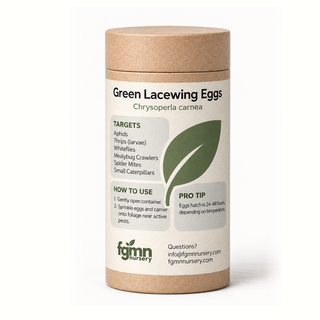


Generalist · Aphids
Green Lacewing Eggs
The cheapest aphid predator we sell per plant — with a hatch window that runs on your room's temperature rather than a calendar.
$21.00
Free Shipping for all orders over $30
If something's wrong when it arrives, file a report within 72 hours of delivery for a replacement or store credit.
By placing your order you agree to our Shipping Policy and Live Delivery Guarantee.

How much, and how often
Two questions — how bad it is, and how many plants. You get a size and the dates to put it out.
How bad is it?
Pick the one that sounds like your room. If you are between two, take the higher.
How many plants?
Six-inch pots. Count a large specimen with a dense canopy as three or four.
Your size and schedule
More about this dose
The three things people ask once they have their size. Open any of them.
Am I light, moderate or heavy?
Light
- Nothing visible yet — you are getting ahead of it
- A few aphids on one growing tip
- Aphids last season, and you would rather not repeat it
Moderate
- Clusters on several stems and leaf undersides
- Sticky honeydew on the leaves below
- New growth coming in curled
- Aphids turning up on a second plant
Heavy
- Stems crowded end to end
- Sooty mould on the honeydew
- Winged aphids, which means they are leaving to start colonies elsewhere
- Ants running the stems
Be honest with yourself about the heavy level here. At heavy pressure the hatch wait is the problem rather than the number of eggs — a colony doubles in under a week, and these can take a fortnight to hatch in a cool room. If that is where you are, the pre-incubated Larvae is the better buy even though it covers fewer plants.
There are two reasons the sizes look generous. Loose eggs roll off smooth foliage, so some of what you release starts on the soil rather than the leaf. And newly hatched larvae eat each other if they emerge in a pile, so spreading thin across many leaves is not optional. Both mean the useful number is lower than the number you bought — which the pack sizes already account for, and under-dosing does not.
Why more than one round?
Putting it out
- Let the container reach room temperature before you open it.
- Rotate it gently to distribute the eggs evenly through the carrier.
- Release at dusk, or after the grow lights dim. Eggs and newly hatched larvae dry out fast in direct sun and heat.
- Aim where they settle rather than slide: leaf axils, the crotch where the petiole meets the stem, textured new growth, flatter upper leaves. There is no adhesive on these, and leaf undersides hold nothing.
- Spread thin and wide, across as many plants and leaves as you can. Then leave them alone — seeing nothing for a week or more is the normal experience of this product.
Everything else is optional. Get these four and the release has done what it can.
A cleaner way
On a display plant, tip small piles into bio-boxes or paper cups hung in the branches instead of dusting the foliage. Same dose, nothing visible on the leaf.
The failure is forgetting. Very few programs fail because the mite underperformed. They fail in week five, when the plants look fine, the reorder does not happen, and the population holding the line ages out with nothing behind it.
A schedule is the same decision, made once. A container when it looks bad, then another when it looks bad again, is already a rhythm — just one you have to remember at the exact moment the plants look fine.
Change the size or the frequency, skip a box, pause or cancel from your account at any time.
Is this the right beneficial for your problem?
Five questions, in the order a grower actually asks them: what have you got, is this the answer to it, what will it eat, how does it do the killing, and will it survive your room.
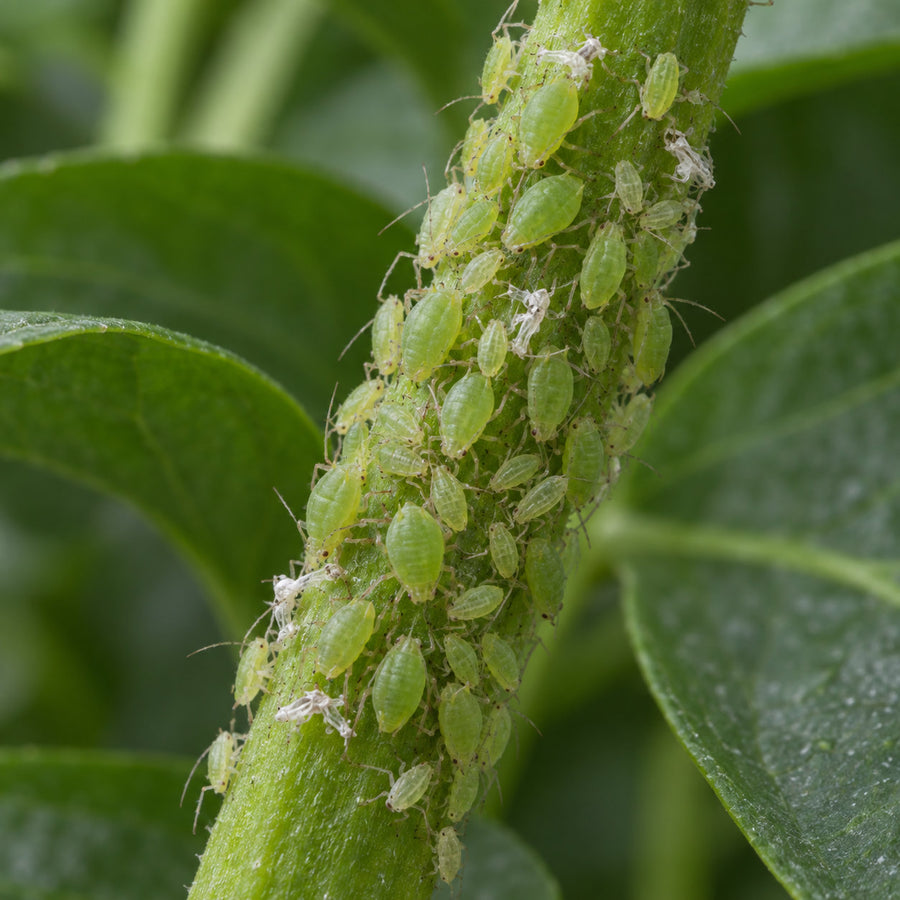
Is this your pest?
Aphids. That is the job, and we would rather say so plainly than take an order for something this will not fix.
Aphids cluster on stems and the undersides of new leaves, soft and pear-shaped, in greens and pinks and blacks. They leave sticky honeydew with sooty mould behind it, and new growth comes in curled and distorted. Every species is on the list — green peach, melon, potato and the rest.
Once they hatch, the larvae will also eat, on encounter: two-spotted spider mites, mealybug and scale crawlers, early instar thrips, whitefly eggs and nymphs, and small moth eggs. That second list is not a reason to buy them. Opportunistic feeding is not control, and a lacewing released where there is nothing to eat leaves rather than waiting.
Then: are lacewing eggs the right answer to it?
Choose this if
Choose eggs when time is not the constraint — getting ahead of a problem, covering many more plants for the money, or keeping pressure off something that is currently clean. Per plant this is the cheapest aphid predator we sell, and a hatched larva hunts for two to three weeks. Nothing to mix, no residue on the leaves, and nothing an aphid can develop resistance to.
Choose something else if
There is a real wait, and it runs on temperature rather than a fixed number of days: a few days in a warm room, up to two weeks when it is cool. If aphids are already climbing, buy the pre-incubated Larvae instead. And if the pest is thrips, mealybug or spider mites, buy the specialist — this is not a reliable treatment for any of them.
What it kills, and what it won't
Eggs need aphids on the plant, or arriving soon, to be worth releasing at all. A larva that hatches into an empty canopy walks off to find one that is not — which is the honest limit of a generalist predator.
How it works
What it does to the pest, what it does on the plant, and what that leaves you looking at.
The larva is the predator
What you are releasing is not yet hunting. The egg hatches into a translucent, alligator-shaped larva that grips an aphid, punctures it and drains it, then moves on. It feeds for two to three weeks, grows to about 8mm, then pupates and leaves.
It climbs toward the light
These ship loose with no adhesive, so on smooth aroid foliage a share of the eggs will roll off onto the soil. That is not waste: the larvae hatch and climb upward, which is where the aphids are. Placing them in leaf axils and stem crotches simply starts them closer to the job.
Days of nothing
Then aphid numbers falling without anything obvious doing it. A newly hatched larva is about a millimetre, translucent and effectively invisible — absence of sightings is not absence of larvae, and nothing at all will look like it is happening during the hatch wait.
Thin and wide. Lacewing larvae are cannibals, and a single generous pile becomes one very well-fed survivor. Cover more plants rather than fewer, and spread the eggs across as many leaves as you can reach.
Will it work in your room?
Two things. If your space runs cold, the hatch can take a fortnight, and the Larvae product removes that wait entirely. And deal with ants first — they farm aphids for the honeydew and will actively kill lacewing larvae to protect the colony.
About green lacewings
Eggs, not yet hatched, which is the part that surprises people. The larvae that emerge are what hunt. The adults that eventually fly off eat pollen and nectar and will not touch a pest.
New to beneficials?
Five things that catch almost everyone the first time.
After you release it
The wait, what ends it, and why you will never see a larva.
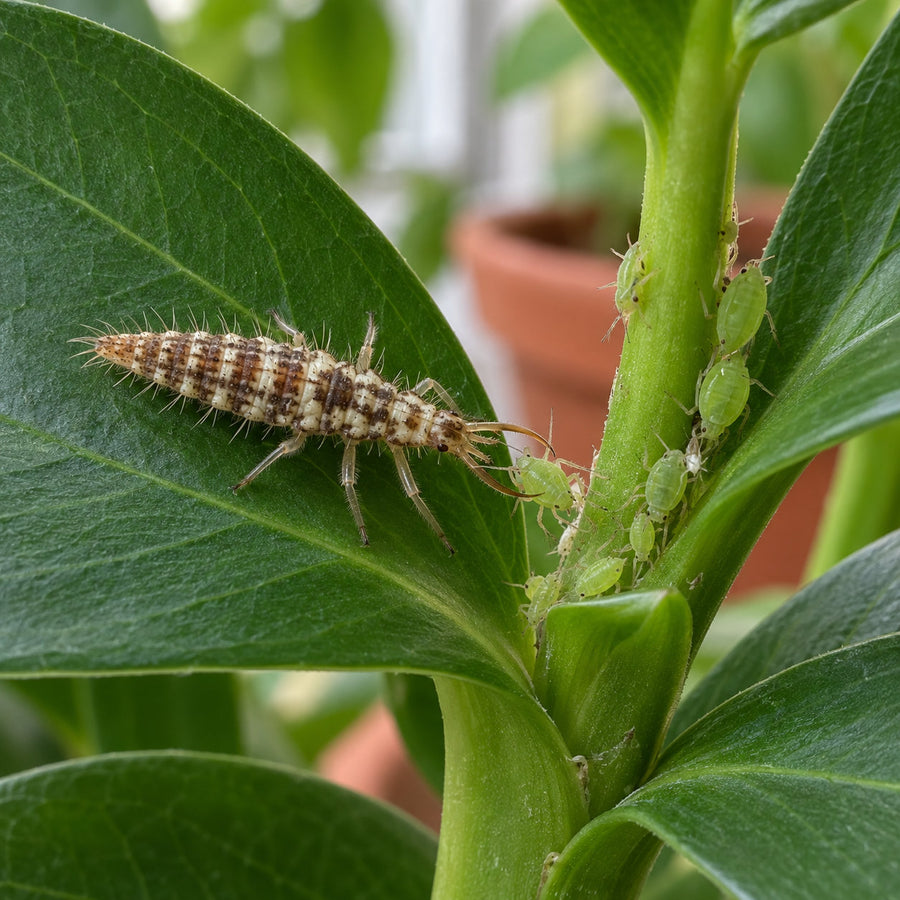
How you'll know it's working
Days of nothing first. The hatch runs on temperature rather than a calendar, and during that stretch there is genuinely nothing to see.
Then aphid numbers start falling without anything obvious doing it. A newly hatched larva is about a millimetre and translucent, and it favours leaf undersides and crevices — so absence of sightings really is not absence of larvae. After two to three weeks of feeding they pupate and go.
Pull yellow sticky cards before the adults emerge in a few weeks — cards catch them as efficiently as anything else with wings.
Getting it to you
What is in the container, how it travels, and what happens if it arrives wrong.
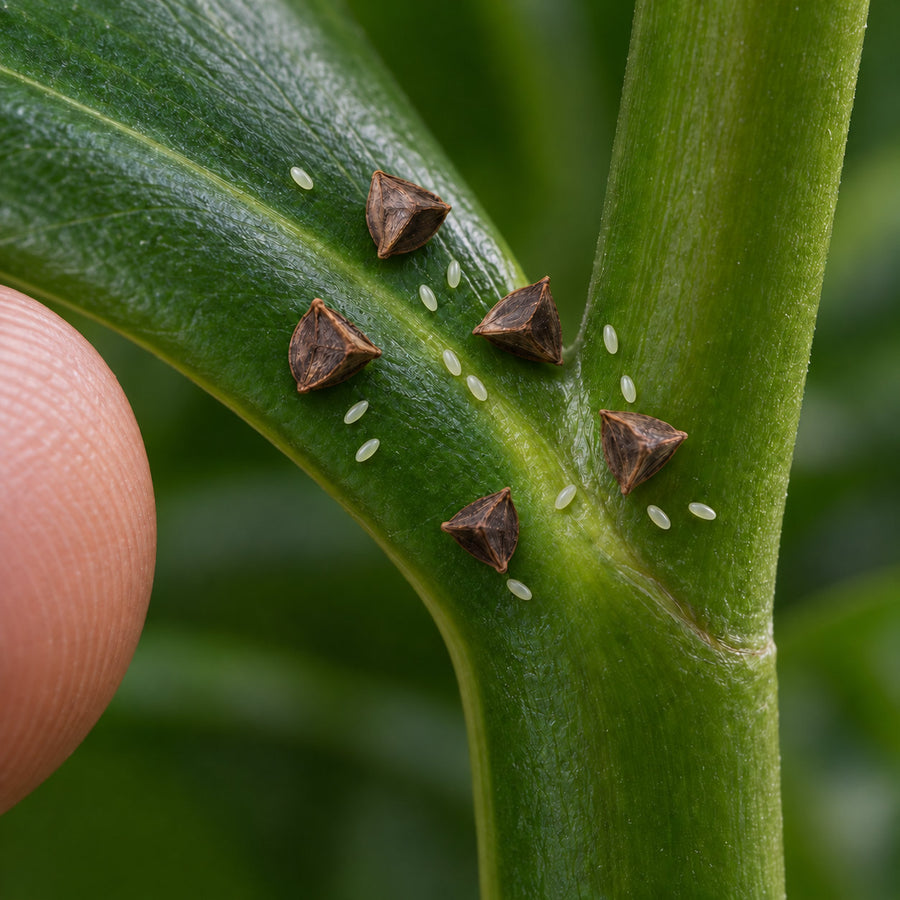
What arrives
Small pale eggs mixed through buckwheat hulls, in a breathable temperature-regulated container. The hulls keep the eggs separated and cushioned on the way, and they go out onto the plant with the eggs.
Nothing is moving, and nothing is wrong. There is no adhesive on these, which is why placement matters more here than on most things we sell.
Release the day it arrives. The hatch clock starts at your end and runs on temperature. If storage is genuinely unavoidable, keep the container horizontal at 46–50°F for no more than 24 hours — below 41°F kills the developing embryos.
When it ships, and when it lands
Shipping
We ship when they're ready to travel. Live orders go out Monday to Thursday. If a colony needs a beat to peak, or we're propagating a fresh batch, yours might hold up to a week. All mites and insects ship 2-day or Overnight depending on what's best for them.
When it lands
Let it reach room temperature, then release at dusk. Rotate the container gently to distribute the eggs through the carrier, then sprinkle onto foliage — leaf axils, the crotch where the petiole meets the stem, textured new growth and flatter upper leaves, where it settles rather than rolls off. Leaf undersides sound right and hold nothing. Then leave them alone.
About the ones that don't make it
Some of them die on the way. That is why we send more than you paid for.
A lacewing egg is smaller than a grain of sand, and it ships in a container, in a van, for two days.
Roughly 15% will not survive that. We cannot prevent it, so we price it in: the number on the label gets counted out, and then the cushion goes in on top of it.
Your 2,500-egg container leaves here holding more than 2,500. The ones that do not make it are already paid for.
If you can see them
Ladybugs, lacewing larvae, Orius — the minute pirate bug — and the beetles. Tip a few onto white paper and give them twenty minutes at room temperature before you judge anybody.
Cold insects are genuinely good at playing dead. The deceased have been known to get up and walk off the counter.
Still more than about one in seven not moving? Photograph them and file a report.
The photo is not us doubting you. It is how we tell a bad batch from a bad courier day from a mailbox that hit 104°F.
If you can't see them
Mites, nematodes, eggs — and this one is eggs, so there is nothing moving in the carrier and no test you can do on a sheet of paper. The eggs are minute and pale and read as part of the buckwheat hulls. So we don't ask you for a photograph.
You file the report and our entomologist takes you through the diagnostic instead — the tap test on dark paper, where the box sat, what your room was doing, and then what the pest is doing about ten days later.
Give this one its hatch window first. A cool room can take a fortnight, and that stretch of nothing catches people out more than any other product we sell.
Seventy-two hours from delivery, either way, with your order number. Replacement or store credit, your pick.
What it does not reach
Three gaps this page has already named, and the beneficial that closes each one.
The same insect, hatching a day after it lands
These eggs hatch on your room's schedule — a few days when it is warm, up to two weeks when it is cool — and that is the trade you are making for the lower price. The Larvae product ships pre-incubated and hatches about a day after delivery, near enough whatever the weather is doing. If aphids are already climbing, that difference is the whole decision.
The larva hunts; the adult eats pollen
Once a larva pupates and emerges as the iconic green winged insect, it switches to nectar and pollen and will not touch a pest again. What it will do, if there is something to feed on, is stay and lay a second generation of eggs in your space. Breeder's Blend or flowering plants nearby is what makes that happen rather than hoping.
Lacewing larvae climb toward the light, never down
That habit is useful here — eggs that roll onto the soil are not wasted, because the larvae hatch and climb to where the aphids are. It also means they will never go looking downward. Fungus gnat larvae and root mealybugs want a soil predator, and the two run happily in the same pot.
Two cheap things that make the rest work harder. Blue cards give you the dated count this page keeps asking you to read. Breeder's Blend is pollen and Artemia; it keeps the population fed through the lull when prey gets scarce.
Questions
Will the eggs stay on the leaves?
Not on their own. These ship loose through a dry carrier with no adhesive, and on smooth foliage — which is most aroids — a share of them will roll off and end up on the soil.
So put them where they settle rather than slide: leaf axils, the crotch where the petiole meets the stem, textured or crumpled new growth, and flatter upper leaves. Leaf undersides sound right, and hold nothing.
Eggs that reach the soil are not wasted. The larvae hatch and climb toward the light, which is where the aphids are. Placing them on foliage just starts them closer to the job.
How soon will I see results after releasing the eggs?
These are eggs, so there is a wait — and it runs on temperature rather than on a fixed number of days. In a warm room they hatch in a few days. In cooler conditions it can be up to two weeks. That is normal and it is not a fault; nothing will look like it is happening in the meantime.
Once they hatch the larvae hunt straight away and feed for two to three weeks. Aphid numbers falling quietly is how you know it worked — you are unlikely to ever see a larva.
If the wait is the problem — aphids already climbing, a plant you are worried about — buy the Larvae instead. Those ship pre-incubated and hatch about a day after they reach you, whatever the weather is doing.
Can I use Lacewings alongside other beneficial insects?
Yes. Lacewings are excellent team players in an Integrated Pest Management (IPM) program. They work well alongside soil-dwelling predators like Hypoaspis miles and can be used in the same canopy as Aphidius wasps. However, because they are generalists, they may occasionally snack on other beneficial larvae, so we recommend spacing out releases by 24–48 hours.
Will the adult lacewings stay in my garden?
The larvae are the "workhorses" that eat the pests. Once they mature into adults (the iconic green winged insects), they shift their diet to nectar and pollen. To encourage them to stay and lay a second generation of eggs in your garden, we recommend providing a food source like our Breeder’s Blend or having flowering plants nearby.
What should I do if I can't release them immediately?
Beneficial insects are live organisms and are happiest when released the day they arrive. If you must wait, store the container horizontally in a cool, dark place (46°F – 50°F) for no more than 24 hours. Do not refrigerate below 41°F, as this can kill the developing embryos.
How many eggs do I need per 6" plant?
Preventative: roughly 5–10 eggs per 6" plant, to have something on patrol before a colony forms.
Active aphids: increase to 25–50 eggs per 6" plant — and spread them across as many leaves as you can. Newly hatched larvae eat each other before they find aphids if they come out in a pile.
Pro Tip: these ship without an adhesive, so expect some roll-off on smooth leaves. Aim for leaf axils and stem crotches rather than flat surfaces, and count what lands on the soil as still in play — the larvae climb.