


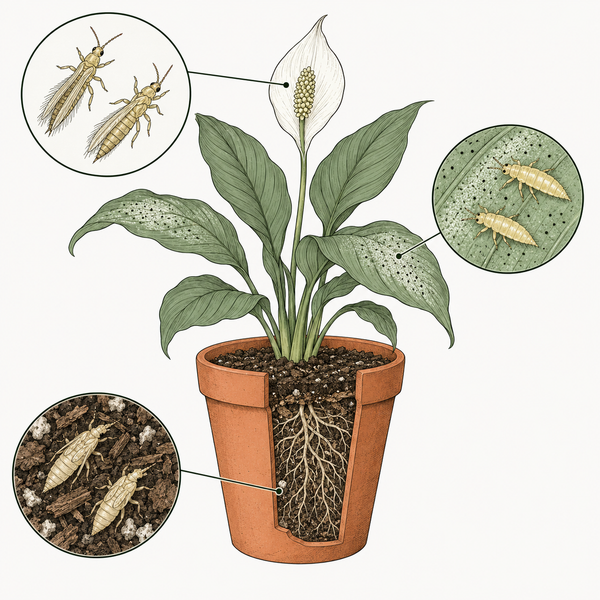


The leaf has a scar. The next leaf opens smaller than you expected. You have found the thrips, which explains the marks, but it leaves another question: why does the whole plant seem to be having a worse month?
Because a leaf is doing a job. Damage can change how much working leaf area the plant has, how a developing leaf expands, and how much carbon it can gain from light. The mark you see is only the visible part of that story.
Start with one feeding puncture
A thrips pierces plant tissue and takes up cell contents. Researchers studying western flower thrips matched electrical recordings with observed feeding behavior, distinguishing penetration from the ingestion that follows.1 This is not a stain sitting on top of an otherwise untouched leaf.
Feeding in a small area can leave silvered or dead patches. If you are still deciding whether those marks belong to thrips, Those Might Be Thrips walks through the insects and clues to look for. Here, we are following what happens to the plant after the injury.
The leaf was still under construction
Damage to a fully expanded leaf leaves a mark on an existing surface. Damage inside a developing bud can affect the leaf before it has finished unfolding. Western flower thrips feed in those protected spaces, and that feeding can lead to deformed leaves or flowers.2
That is why the next leaf can emerge looking as though it has already been through something. It has. Its grand opening was not its first day.
The distinction matters when you look at a plant after treatment. A newly opened leaf may reveal an older injury. It also explains why damage can affect more than appearance: a leaf that expands poorly may give the plant less surface to work with.
Less leaf can mean less work gets done
In an experiment on sugar maple, researchers introduced pear thrips before the leaves expanded. The affected trees developed less total leaf area, and measurements also showed lower net photosynthesis in expanded leaves.3 There were two effects to consider: how much leaf the tree produced, and how that foliage performed.
| What changed | Reported change | What it tells us |
|---|---|---|
| Whole-tree leaf area | About 23% lower | The trees had less leaf surface. |
| Net photosynthesis in fully expanded leaves | About 20% lower | The remaining foliage also performed differently. |
These are separate measurements, not percentages to add together. They describe pear thrips on sugar maple under the study conditions—not a forecast for your philodendron. The useful lesson is that counting visible scars cannot tell you exactly how much the plant's performance has changed.

Recovery can happen somewhere else
Now consider the plant after feeding pressure subsides. It does not have to make an old scar disappear to regain leaf area.
Researchers followed thrips-damaged cotton seedlings and found that recovery involved changes in leaf development: smaller, damaged lower leaves finished expanding sooner, while larger leaves farther up the shoot unfolded more quickly.4 The plant regained ground through its developing canopy.
Cotton's response is not a promise that every houseplant will recover at the same pace. But together, these studies explain why we look beyond the worst leaf. Our practical interpretation is to follow the plant's capacity to grow as well as the insects: what is opening, how does it compare with the growth before it, and is feeding still occurring?
You do not need to turn the windowsill into a research station. A photograph of the whole plant, followed by another from the same position as growth develops, can help you see changes that disappear when your attention stays fixed on one ugly patch. For deciding whether the treatment itself is working, use the progress guide; it brings those observations together with repeated insect checks.
The damaged leaf can remain part of a recovering plant. It is simply unlikely to be the leaf you photograph for Instagram.
Sources and further reading
- Kindt, F., Joosten, N. N., Peters, D., & Tjallingii, W. F. (2003). Characterisation of the feeding behaviour of western flower thrips in terms of electrical penetration graph (EPG) waveforms. Journal of Insect Physiology, 49, 183–191.
- Reitz, S. R. (2009). Biology and ecology of the western flower thrips: The making of a pest. Florida Entomologist, 92, 7–13.
- Ellsworth, D. S., Tyree, M. T., Parker, B. L., & Skinner, M. (1994). Photosynthesis and water-use efficiency of sugar maple (Acer saccharum) in relation to pear thrips defoliation. Tree Physiology, 14, 619–632. Read the abstract.
- Lei, T. T., & Wilson, L. J. (2004). Recovery of leaf area through accelerated shoot ontogeny in thrips-damaged cotton seedlings. Annals of Botany, 94, 179–186. Full text.
