


Specialist · Thrips
Neoseiulus cucumeris Slow-Release Prevention Sachets
The cheapest way to have something already on the plant when thrips arrive — and it keeps working when the room runs cool.
$2.25
Free Shipping for all orders over $30
If something's wrong when it arrives, file a report within 72 hours of delivery for a replacement or store credit.
By placing your order you agree to our Shipping Policy and Live Delivery Guarantee.
How many, and how often
One sachet per large plant, or one every three to five feet through a dense canopy — two or three on a big specimen, hung at different heights. Replace every four to six weeks.
More about this dose
The three things people ask once they have their size. Open any of them.
Why more than one round?
Putting it out
- Shade, not sun. Direct light dries the sachet out and the colony inside stops producing well before the four to six weeks are up.
- Hang it, do not lay it. On a branch or stem in the middle of the canopy, above the soil line.
- Do not open it. Every sachet has a pre-drilled exit hole. The mites emerge through it at their own pace.
- Give them the canopy to themselves. Other loose generalists take cucumeris juveniles, so let this one own the plant rather than layering a second species on top.
- Replace every four to six weeks while the season is running, and water at the soil line in the meantime.
Everything else is optional. Get these four and the release has done what it can.
A cleaner way
On a display plant, tip small piles into bio-boxes or paper cups hung in the branches instead of dusting the foliage. Same dose, nothing visible on the leaf.
Is this the right beneficial for your problem?
Five questions, in the order a grower actually asks them: what have you got, is this the answer to it, what will it eat, how does it do the killing, and will it survive your room.
Is this your pest?
A sachet is prevention, so the honest question is what you are guarding against. This is the thrips sachet, and it is the most cost-effective one we sell.
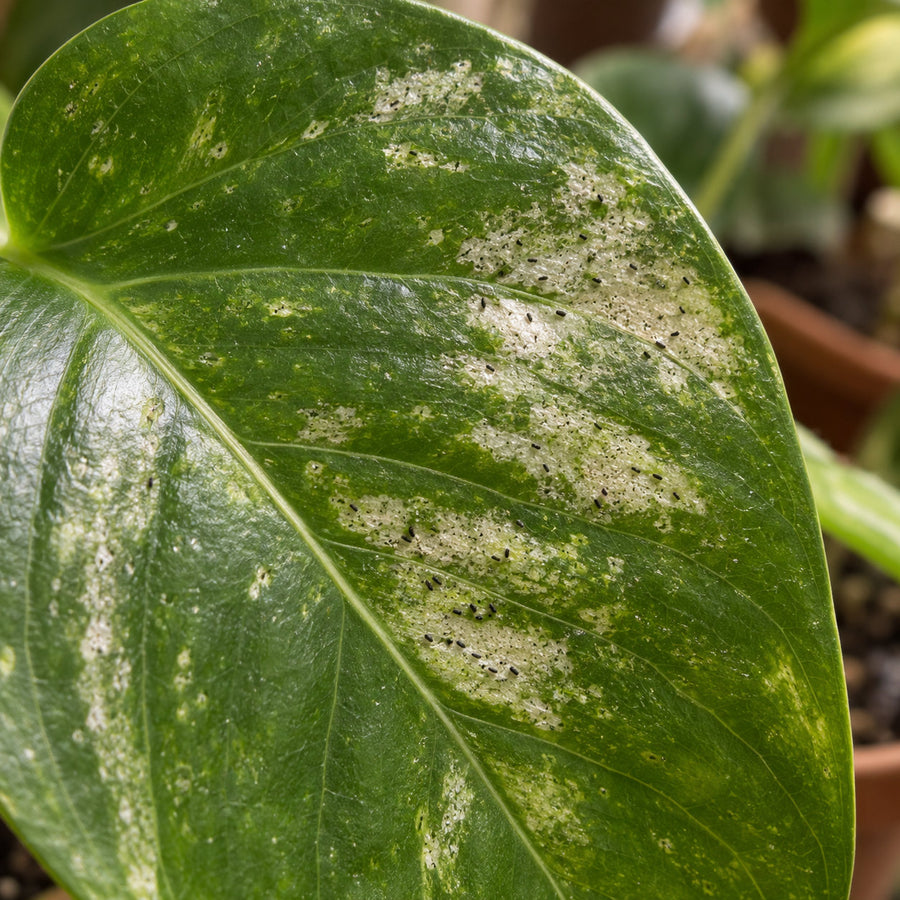
Thrips rasp the leaf surface and leave silvery scarring with black frass specks, worst on the newest tissue. The adults fly; the larvae sit on the leaf. Broad and cyclamen mites leave nothing visible at all — you read those from new growth that comes in small, hardened and twisted while the older leaves look fine.
Cucumeris works by breaking the life cycle before it becomes a problem: it hunts the tiny, immobile thrips larvae as they hatch. It does not eat adult thrips — no predatory mite does. Broad and cyclamen mites are its other real job, and it is the species with the record against both.
Then: is a cucumeris sachet the right answer to it?
Choose this if
Choose cucumeris when thrips are the thing you keep having to deal with, and you want something on the plant before they arrive. It is the most cost-effective way to do that, it keeps working when the room is on the cool side — where the warm-weather species start slowing — and it is an excellent pollen feeder, so the colony survives and reproduces on a plant with no pests on it at all. And nothing is left on your foliage: the mites walk out and the medium stays in the paper.
Choose something else if
If you already have flying adults, these sachets are too slow to stop the damage. If the room runs consistently hot, above about 80°F, swirskii is the stronger pick and adds whitefly to the list. And do not run another loose generalist in the same canopy — they take cucumeris juveniles, so let this one own the plant.
What it kills, and what it won't
Excellent pollen feeders, which is the quality that actually makes prevention work. The colony survives and reproduces on plants with pollen even when no pests are present, so what you are buying is something already in place when thrips turn up — not something that has starved out waiting.
How a sachet works
What is actually inside it, how the mites get out, and what that buys you over a bottle.
A breeding colony, not packaging
The sachet is a nursery. Inside is a bran medium, a founding population of predators and a food source that keeps them laying for weeks. It is not a bag of mites waiting to be tipped out, which is why the one instruction that matters is do not open it.
Through a vent already built in
Every sachet has an exit hole in the seam. The mites leave through it at their own pace, a few at a time, day after day. That trickle is the whole point: a bottle gives you one wave and a sachet gives you a standing population.
A clean leaf, and nothing else
Because the mites walk out and the medium stays in the paper, there is no bran or vermiculite left on your foliage or in your flowers. If you have ever picked carrier out of a leaf sheath, that difference is worth something on its own.
Prevention, not rescue. A sachet releases over weeks, which is exactly the wrong speed for an infestation that is already running. Bottles are the knockdown; sachets are what holds the line afterwards.
Will it work in your room?
Two checks. Shade, not sun — direct light dries a sachet out and the colony stops producing well before the four to six weeks are up. And if there are already adult thrips flying, hang these but run bottles or Orius at the hot spots as well; a sachet on its own will not catch that.
About cucumeris sachets
A breeding colony on a bran medium, releasing predators gradually for weeks. Prevention done properly is mostly this: something already on the plant.
New to sachets?
Five things that catch almost everyone the first time.
After you hang it
What changes, how you would know, and when to replace it.
How you'll know it's working
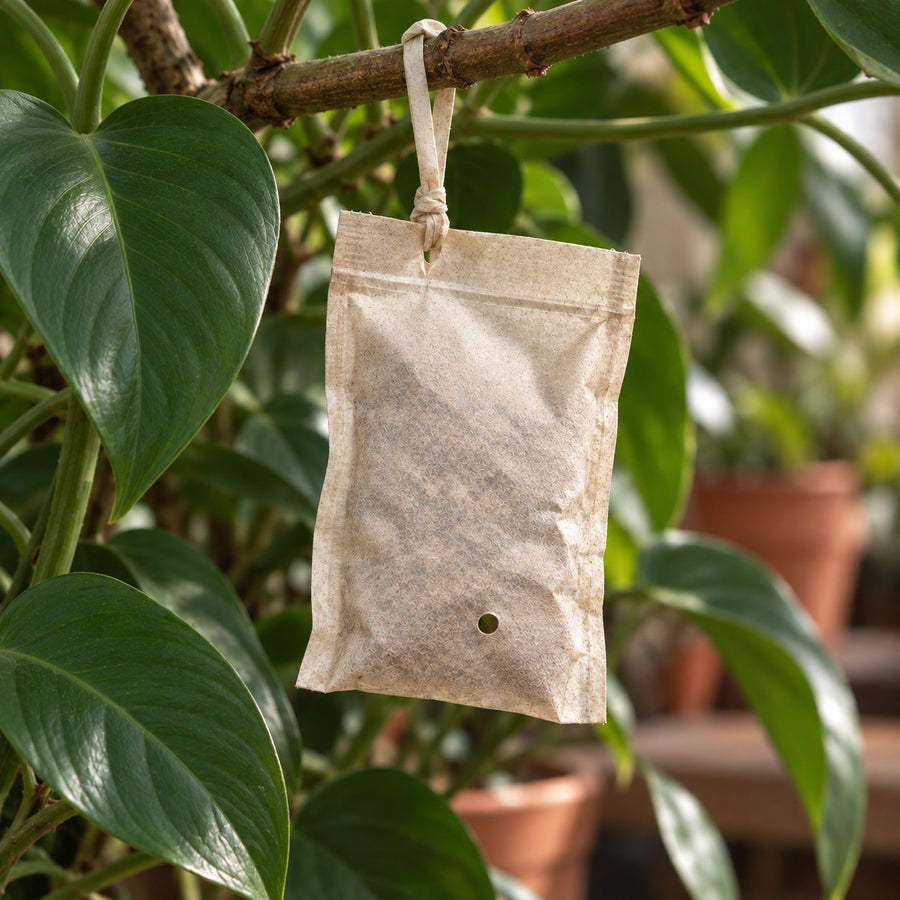
Nothing visible, which is the point. New thrips scarring stops appearing on new leaves, and the undersides stay clean.
Judge it on new damage rather than on mites you can spot. Existing silvering is scar tissue and will still be there when every thrips on the plant is dead — and at half a millimetre against a green leaf, these are not a thing you find by looking.
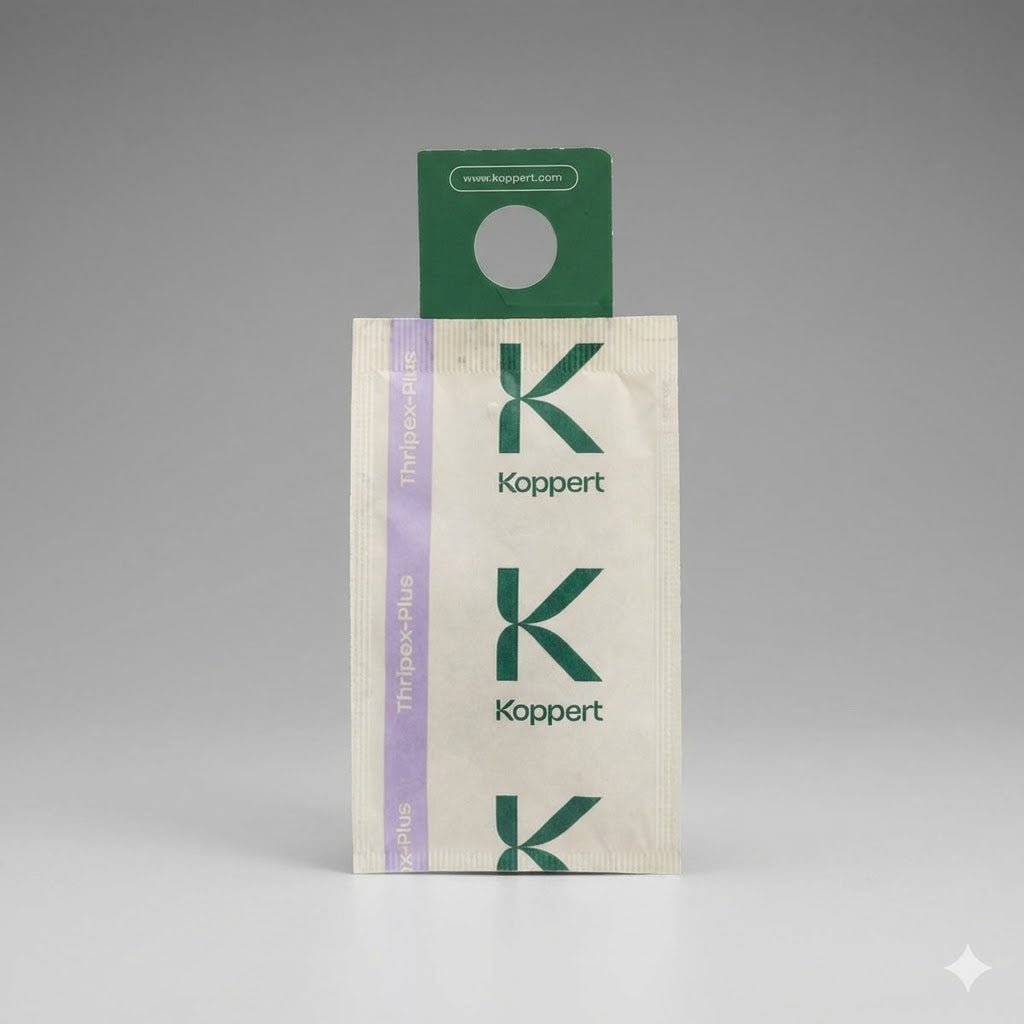
Note the photograph: a spent sachet looks almost exactly like a fresh one. That is why the discipline here is a calendar rather than an inspection — mark four weeks when you hang them.
Getting it to you
What is in the packet, how it travels, and what happens if it arrives wrong.
What arrives
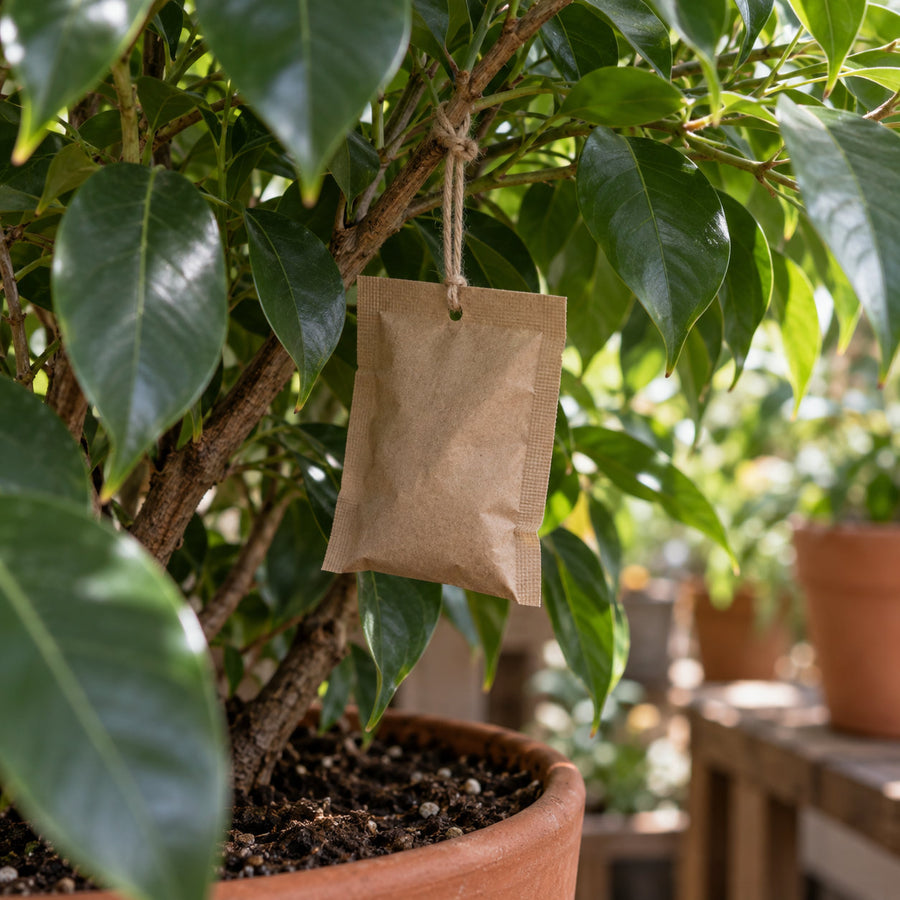
Sachets of paper, each one a live breeding colony on a bran medium with a food source sealed in beside it.
Nothing about the outside tells you anything. There is no window, no movement to look for, and no test you can run — the mites are half a millimetre and they are inside.
Hang them the day they arrive. These are living colonies rather than shelf stock, and every day in the box is a day off the release window you paid for.
When it ships, and when it lands
Shipping
We ship when they're ready to travel. Live orders go out Monday to Thursday. If a colony needs a beat to peak, or we're propagating a fresh batch, yours might hold up to a week. All mites and insects ship 2-day or Overnight depending on what's best for them.
When it lands
Unpack and hang the same day. One per large plant, or one every three to five feet through a canopy. On a stem in the middle of the foliage, in shade, above the soil line — not in a hot spot of direct light, and not where watering will soak it. Then leave it alone for four to six weeks.
About the ones that don't make it
Some of them die on the way. That is why we send more than you paid for.
A predatory mite is the size of a grain of table salt, and a sachet is a breeding colony in a paper packet, in a van, for two days.
Roughly 15% will not survive that. We cannot prevent it, so we price it in: the founding population gets counted out, and then the cushion goes in on top of it.
Your sachet leaves here holding more than the label says — and unlike a bottle, the survivors breed, so the number that matters is the one a week from now.
If you can see them
Ladybugs, lacewing larvae, Orius — the minute pirate bug — and the beetles. Tip a few onto white paper and give them twenty minutes at room temperature before you judge anybody.
Cold insects are genuinely good at playing dead. The deceased have been known to get up and walk off the counter.
Still more than about one in seven not moving? Photograph them and file a report.
The photo is not us doubting you. It is how we tell a bad batch from a bad courier day from a mailbox that hit 104°F.
If you can't see them
Mites, nematodes, eggs — and sachets more than any of them. A sealed paper packet looks identical whether the colony inside is thriving or gone, and no photograph settles that. So we don't ask you to take one.
You file the report and our entomologist takes you through the diagnostic instead — where the box sat, what your room was doing, whether the paper arrived damp, and then what the pest is doing about ten days later.
Please do not open a sachet to check. It is the one thing that guarantees the outcome you were worried about, and we cannot replace it afterwards.
Seventy-two hours from delivery, either way, with your order number. Replacement or store credit, your pick.
What it does not reach
Three gaps this page has already named, and the beneficial that closes each one.
Adult thrips need a predator that takes adults
Cucumeris is a larval specialist, and that is the stage worth killing — larvae are what become next month's adults. But it does not take the adults themselves, so a room where thrips are already flying wants something that does. Orius insidiosus, the minute pirate bug, hunts adult thrips on the wing and on the leaf. Run Orius to clear what is flying now and leave the sachets hanging to stop the next generation from ever getting there.
Above 80°F swirskii is the stronger sachet
Cucumeris is the cool-and-moderate workhorse and it covers a genuinely wide band, but a room held consistently in the eighties is swirskii's home ground rather than its own. Amblyseius swirskii gets faster as the room warms, carries the same thrips-larvae job, and adds whitefly eggs and crawlers to it — which is usually the other thing a hot, humid room is fighting.
Four species in one sachet, covering each other's gaps
Choosing a single species means matching it to your room and your pest. The Special Blend sidesteps that: andersoni, californicus, swirskii and cucumeris hung together, so mites, whitefly and thrips are covered at once and whichever species suits the week takes over. It is the broad-spectrum answer when you would rather not pick.
Two cheap things that make the rest work harder. Blue cards give you the dated count this page keeps asking you to read. Breeder's Blend is pollen and Artemia; it keeps the population fed through the lull when prey gets scarce.
Questions
I already have Thrips damage. Will this fix it?
No. Sachets are too slow to stop an active outbreak. If you see flying thrips or silvering on leaves, you need a Knockdown strategy first (like sprays or loose mites in a bottle). Once the plants are clean, then you hang sachets to keep them that way.
Will they kill adult Thrips?
No. Cucumeris feeds on the immature larvae only. They cannot kill the flying adults.
Why use sachets instead of a bottle?
Sachets = Fireproofing. They stop the fire from starting.
Bottles = Fire Extinguisher. They put the fire out.
Use sachets for long-term peace of mind on clean plants.
How do I know they are working?
Success looks like "nothing happening." If your new growth remains clean and green without thrips damage, the sachets are doing their job.
Do I need to feed them?
The sachets come with food inside (feeder mites) to last 4–6 weeks. However, if you want you can use our Breeder's Blend to help them live longer once they leave the sachet.
What about the Thrips in the soil?
Cucumeris strictly patrols the leaves and stems. However, Thrips larvae often drop to the soil to pupate (transform into adults). For complete protection, we recommend pairing these sachets with Stratiolaelaps scimitus (Soil Mites). The Soil Mites hunt the pupae in the dirt, while the Cucumeris hunt the larvae on the plant—attacking the pest population from both ends.
These sachets are so handy! Definitely working, my plants are pest free!
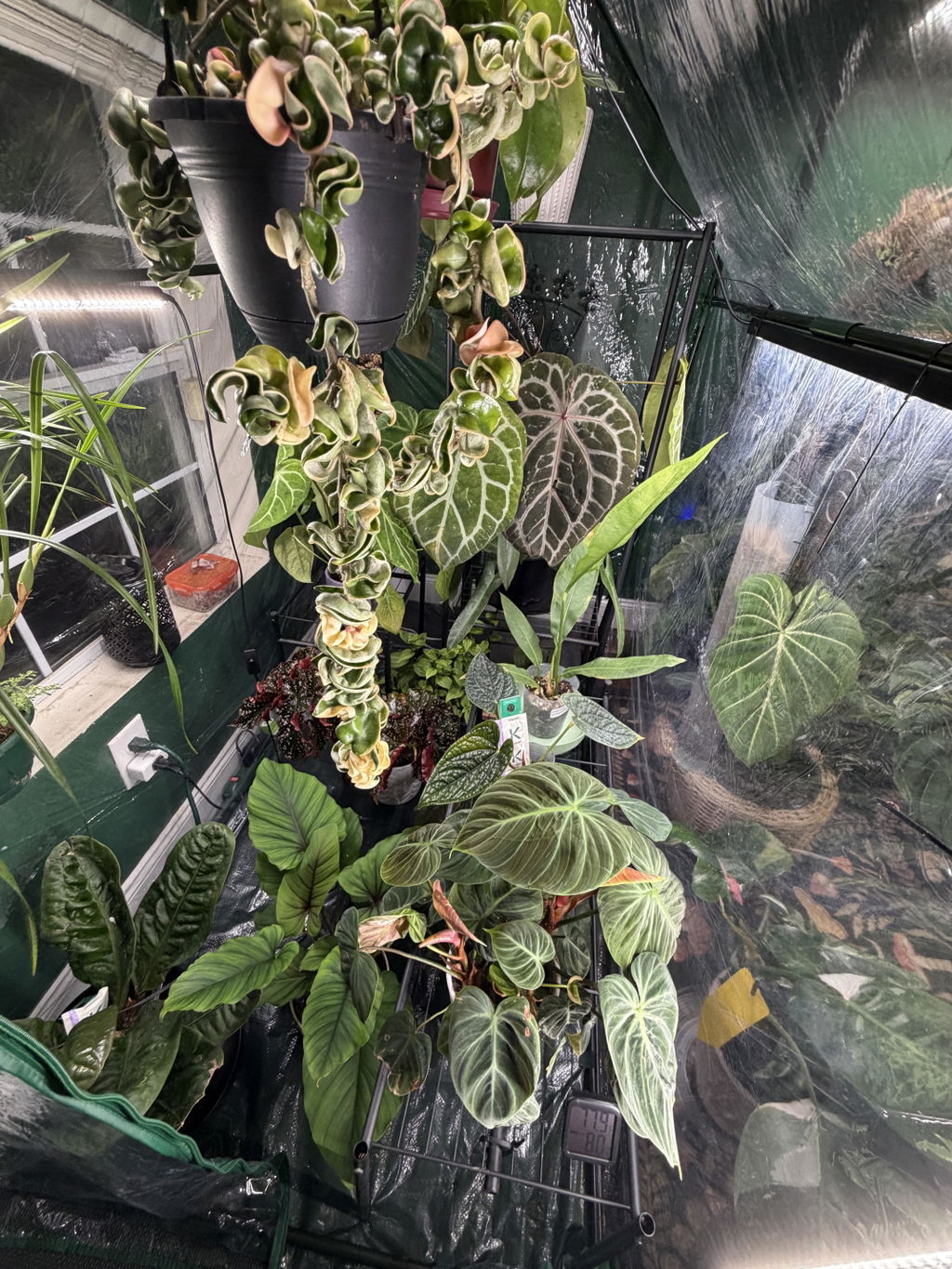
Absolutely amazing I'm so grateful for FGMN these satchets are amazing and so well price.
Arrived when expected. Very happy with my purchase. Priced right. Will buy from again
They showed up alive and full of vigor
I never saw them but the Cucumeris did their job and did it well!
Thank you!!
I'm not really sure if they are doing anything. About 5 days after I hung them on my plantwe got rain. I emailed and asked what I should do with the sachets, if they would be ruined in the rain. They responded with not knowing what rain looks like in my state(???) And could not help me with what to do. I asked again and said a storm was coming. Again they acted like they have no idea what a storm would entail in my state. So for all I know they got ruined. I left them hanging but I've seen critters on my plant the entire time. Might not do this again in the future. And for clarification, rain is when water comes down from the sky. That should help any future people asking for the same help I did.
Hi Alex,
Thank you for the thoughtful review. I’m sorry we didn’t do a better job of communicating that we didn’t have enough detail from your messages to fully answer your questions. I took a look back through the emails, and it seems like there was some miscommunication on both sides about what was being asked.
One thing I can help clarify: in your review, you mentioned already seeing pests. In that case, sachets aren’t going to be very effective. They just don’t contain enough adult mites to tackle an existing infestation—they’re really designed for prevention, not treatment.
That said, definitely let us know how the sachets held up in the rain. We get all kinds of feedback: sometimes they’re fine, other times not so much. The mites themselves can usually survive, but the sachet material isn’t designed for every type of storm. A standard NJ rainstorm is usually fine, but torrential downpours in Maine are often too much. We've heard from folks in Florida who said they held up during a hurricane, and others in Nevada whose sachets fell apart in a regular rain (possibly due to the dry heat making the material brittle). We love hearing those stories—it helps us think through improvements.
Looking forward to hearing how yours did.
Will be getting more because these definitely worked
Arrived quickly and packaged great can’t wait for the thrips to be gone
These sachets are huge! Great price too.
Always a pleasure to buy from! Shipping is fast and bug are active!
Thrilled that they arrived alive and rearing to go. Can't wait for them to get the job done.
Product arrived quickly and as described.
Thank you for ordering from us!
I have heard of combating insects with insects and I am all about not using pesticides that harm the good bugs or the environment. I just put out the sachets 3 days ago and haven't noticed and thing yet, but I am hopeful.
Great news! I'm so glad everything got to you safely. You know where we are if you need anything and anyone on the team will be happy to help. :)