

Specialist · Leafminers
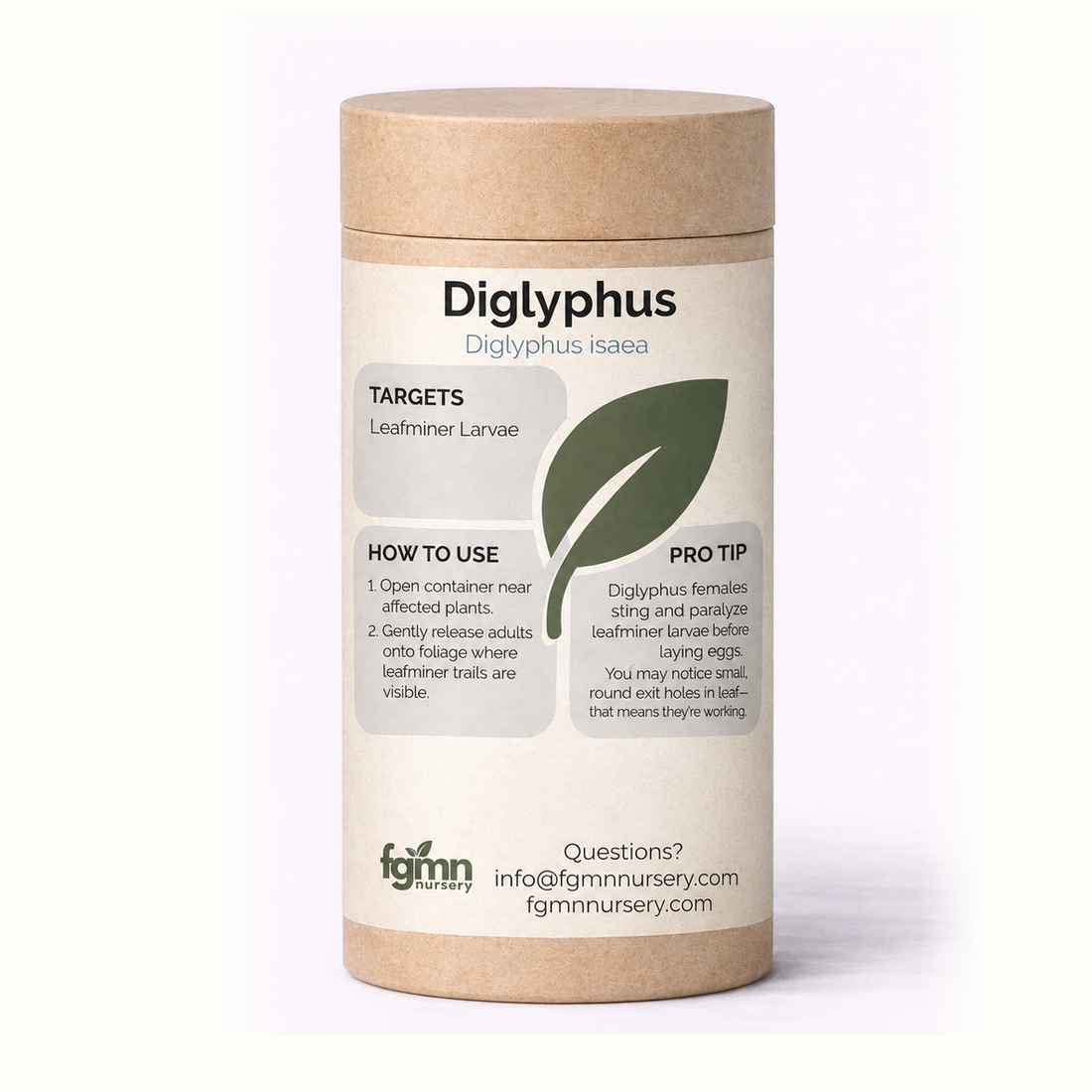
Diglyphus isaea
The only thing we sell that reaches a pest inside the leaf — and the mine stops lengthening the day it does.
$80.00
Free Shipping for all orders over $30
If something's wrong when it arrives, file a report within 72 hours of delivery for a replacement or store credit.
By placing your order you agree to our Shipping Policy and Live Delivery Guarantee.
How much, and how often
Two questions — how bad it is, and how many plants. You get a size and the dates to put it out.
How bad is it?
Pick the one that sounds like your room. If you are between two, take the higher.
How many plants?
Six-inch pots. Count a large specimen with a dense canopy as three or four.
Your size and schedule
More about this dose
The three things people ask once they have their size. Open any of them.
Am I light, moderate or heavy?
Light
- One or two trails on a single plant
- Mines still short and narrow
- No new trails on the newest leaves
Moderate
- Trails on several leaves, visibly lengthening
- Pale pinprick punctures where adults have fed
- New leaves opening already mined
Heavy
- Mines across most of the foliage
- Leaves collapsing where trails have joined up
- Small flies lifting off the plants when you move
- More than one plant affected
With this one the stage matters as much as the number. Look for mines that are visibly lengthening — that is a second or third instar larva, which is what the wasp needs. A fresh pinprick is too early, and an empty mine with a slit at the end has already been vacated.
Every mine that keeps going is permanent damage to a leaf you cannot replace. On a collectible aroid that is the whole cost of the pest, and it accrues daily. Taking the higher level costs a little more once; taking the lower one is paid for in foliage.
Why more than one round?
Putting it out
- Take yellow sticky cards down first. The wasps are drawn to the colour. About a week, then hang them back at canopy height.
- Release in the morning, in daylight. They will not search in the dark. Avoid the heat of the day, and avoid releasing while exhaust fans are at full speed.
- Go to the hot spots — the plants where the trails are most visible. They find hosts by detecting the mines.
- Open the tube gently in the canopy and let them fly out. Walking through the area and tapping the tube lightly spreads them evenly.
- Repeat weekly while new mines are still appearing.
Everything else is optional. Get these four and the release has done what it can.
A cleaner way
On a display plant, tip small piles into bio-boxes or paper cups hung in the branches instead of dusting the foliage. Same dose, nothing visible on the leaf.
The failure is forgetting. Very few programs fail because the mite underperformed. They fail in week five, when the plants look fine, the reorder does not happen, and the population holding the line ages out with nothing behind it.
A schedule is the same decision, made once. A tube when it looks bad, then another when it looks bad again, is already a rhythm — just one you have to remember at the exact moment the plants look fine.
Change the size or the frequency, skip a box, pause or cancel from your account at any time.
Is this the right beneficial for your problem?
Five questions, in the order a grower actually asks them: what have you got, is this the answer to it, what will it eat, how does it do the killing, and will it survive your room.
Is this your pest?
Leafminers are unmistakable once you know them, and they are the only thing this wasp is interested in. If the damage is on the leaf rather than inside it, the product you want is a different one.
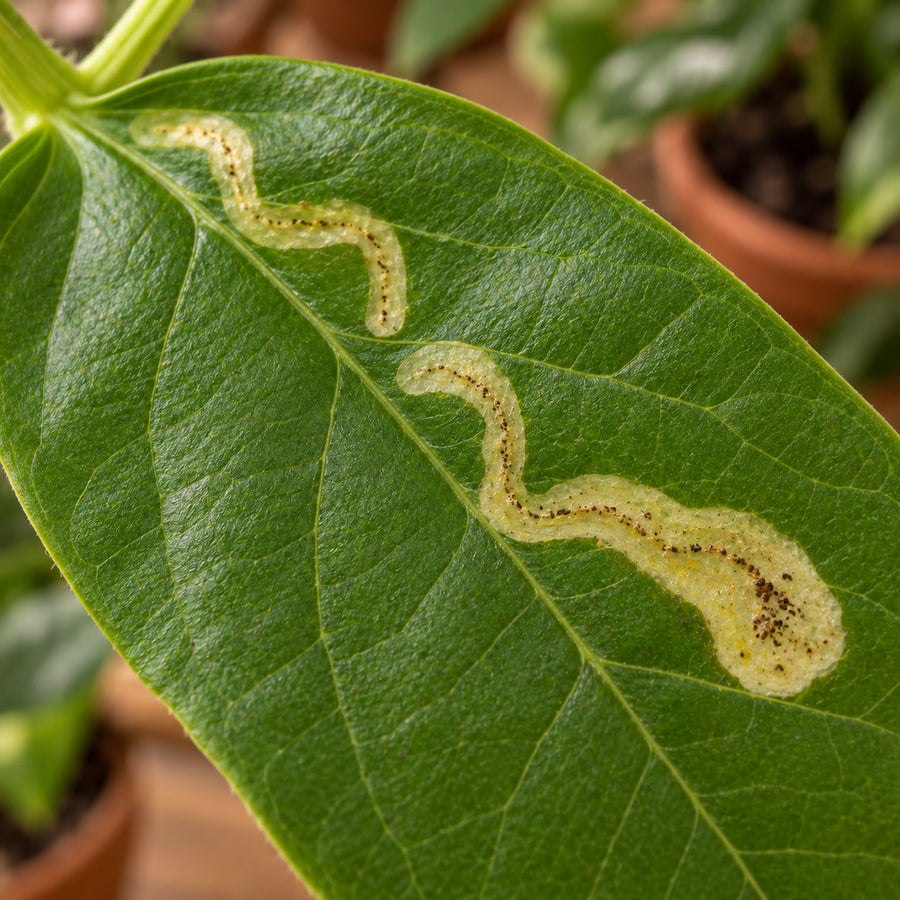
A leafminer larva lives between the upper and lower surfaces of the leaf and eats its way along, leaving a pale winding trail that widens as it grows. The trails are the giveaway: white or silvery, serpentine, and lengthening a little each day.
On an aroid — a Monstera, an Alocasia, a Philodendron — that trail is permanent. The leaf does not repair itself, so the only thing that matters is stopping the mine from getting any longer. That is precisely what this wasp does.
Then: is Diglyphus the right answer to it?
Choose this if
Choose Diglyphus when you can see mines and you care what the foliage looks like. No generalist predator can reach a pest that is inside the leaf — lacewings and predatory mites hunt the surface, and the larva is simply not there. Diglyphus reaches into the mine itself, and the mining stops the moment it stings. In a warm room it out-breeds the leafminers, which is how an outbreak gets closed down rather than managed.
Choose something else if
Timing is the real constraint: it needs second and third instar larvae, so fresh pinprick mines are too early and empty mines are too late. It also needs daylight to search, and it slows down below 60°F. And it eats nothing else — leafminers only, so it is not a general-purpose insurance policy.
What it kills, and what it won't
There is a bonus kill on top of the parasitism. Adult females also host-feed — they puncture leafminer larvae and drink the fluids — so a pest dies even where no egg gets laid.
How it works
What it does to the pest, what it does on the plant, and what that leaves you looking at.
It reaches inside the leaf
The female detects the mine, stings the larva through the leaf tissue, paralyses it, and lays an egg beside it. Her larva then feeds on the paralysed host and pupates inside the mine. No poison, no residue, no re-entry interval, and nothing to become resistant to.
The mine stops that day
This is the part that matters on a collectible plant. A paralysed larva does not eat, so the trail stops lengthening within a day or two of a successful sting — usually long before anything else about the plant looks different.
Trails that end abruptly
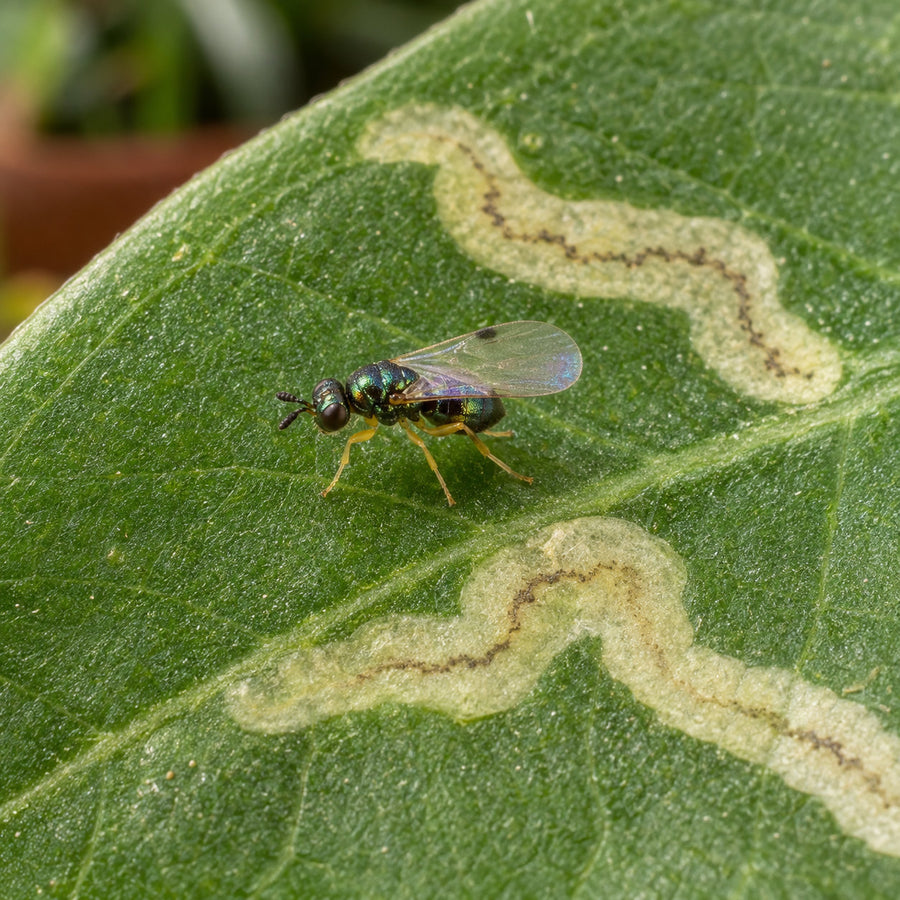
A mine that stops short and stays pale is a paralysed larva, and that is the product working. Under a hand lens you may see the larva itself, and later a small dark object where the wasp has pupated inside the mine.
Existing squiggles are permanent. The leaf does not repair. What you are watching for is the absence of new trails on new leaves, not the disappearance of old ones.
Will it work in your room?
Check the mines first. Diglyphus needs second and third instar larvae — a mine that is still a pinprick is too early, and an empty mine with a slit at the end has already been vacated. The sweet spot is a trail that is visibly lengthening. And take yellow sticky cards down for about a week: the wasps are drawn to the colour.
About Diglyphus isaea
A 2 to 3mm wasp that deals with leafminers where they live — inside the leaf. It has no defensive sting, no interest in people or pets, and nothing else in your collection is on its list.
New to beneficials?
Five things that catch almost everyone the first time.
After you release it
What actually changes, how fast, and what the old trails will and will not do.
How you'll know it's working
Mines stop lengthening within a day or two of a successful sting. That is the first and clearest signal, and on a collectible plant it is the one that matters.
Look for trails that end abruptly and stay pale. Under a hand lens you may see the paralysed larva, and later a small dark object where the wasp has pupated inside the mine. Existing squiggles are permanent — what you are watching for is the absence of new trails on new leaves.
If leafminers are present the wasps reproduce, with a new generation every ten to fourteen days. Once the leafminers are gone, the wasps die off or move on — they cannot become residents.
Getting it to you
What is in the tube, how it travels, and what happens if it arrives wrong.

What arrives
Live adult wasps, ready to hunt the moment the lid comes off, in a tube designed to keep them calm and viable in transit.
Small, black and quick. Expect movement when you open it, and expect to lose sight of them within seconds. Both are exactly right.
Release on arrival, in the morning. They need daylight to search and will not work in the dark, and they are too active to store. Avoid the heat of the day, and avoid releasing while exhaust fans are at full speed.
When it ships, and when it lands
Shipping
We ship when they're ready to travel. Live orders go out Monday to Thursday. If a colony needs a beat to peak, or we're propagating a fresh batch, yours might hold up to a week. All mites and insects ship 2-day or Overnight depending on what's best for them.
When it lands
Open it that morning, in the canopy. Take yellow sticky cards down first. Carry the tube to the hot spots where the trails are most visible, open it gently and let the wasps fly toward the plants — walking through the area and tapping the tube lightly spreads them evenly.
About the ones that don't make it
Some of them die on the way. That is why we send more than you paid for.
A 2mm wasp with a two-week adult life ships in a tube, in a van, for two days.
Roughly 15% will not survive that. We cannot prevent it, so we price it in: the number on the label gets counted out, and then the cushion goes in on top of it.
Your 100-wasp tube leaves here holding more than 100. The ones that do not make it are already paid for.
If you can see them
Ladybugs, lacewing larvae, Orius — the minute pirate bug — and the beetles. Tip a few onto white paper and give them twenty minutes at room temperature before you judge anybody.
Cold insects are genuinely good at playing dead. The deceased have been known to get up and walk off the counter.
Still more than about one in seven not moving? Photograph them and file a report.
The photo is not us doubting you. It is how we tell a bad batch from a bad courier day from a mailbox that hit 104°F.
If you can't see them
Mites, nematodes, eggs — most of what we sell. Not this one: Diglyphus ships as live adults, so the paper test above is the one that applies to you, and they will be moving.
You file the report and our entomologist takes you through the diagnostic instead — the tap test on dark paper, where the box sat, what your room was doing, and then what the pest is doing about ten days later.
We spell the other half out here so you can see the policy is the same either way.
Seventy-two hours from delivery, either way, with your order number. Replacement or store credit, your pick.
What it does not reach
Three gaps this page has already named, and the beneficial that closes each one.
Inside the leaf and on it are two different jobs
Diglyphus works inside the leaf; lacewing larvae and predatory mites work on it. They occupy different niches entirely, so running both costs you nothing in interference and covers the whole canopy rather than one pest in it.
Down for a week, then back at canopy height
Yellow cards catch these wasps as readily as they catch the leafminer flies, so take yours down for about a week around a release. Once the wasps have settled into the canopy the cards go back — adult leafminers on a yellow card are how you catch the next wave before it has drawn on anything.
Two cheap things that make the rest work harder. Blue cards give you the dated count this page keeps asking you to read. Breeder's Blend is pollen and Artemia; it keeps the population fed through the lull when prey gets scarce.
Questions
Do these wasps sting humans or pets?
No. Diglyphus isaea is a "micro-wasp." They are biologically programmed to only seek out leafminer larvae and have no interest in humans or animals. They do not have a defensive sting.
How do I know if they are working?
The most immediate sign is that the leafminer "mines" stop growing. If you look closely at a mine under a hand lens, you may see the paralyzed leafminer larva. Eventually, the Diglyphus pupates inside the mine, appearing as a small dark object.
Can I use these with yellow sticky traps?
We recommend removing yellow sticky traps for about a week when you release, as the wasps are attracted to the color. Once they have settled into the canopy, you can replace the traps, but hang them back at canopy height.
How long does a release last?
If leafminers are present, Diglyphus will reproduce. A new generation of wasps emerges every 10–14 days. If the food source (leafminers) is completely eliminated, the wasps will eventually die off or move on.
Why are these more expensive than generalist predators?
Diglyphus is a highly specialized, lab-reared predator. Because they provide a unique "surgical" service that generalists cannot (killing pests inside the leaf), they are a premium tool for saving the aesthetic value of rare plants.
Can I use these alongside Lacewings or Mites?
Absolutely. Since Diglyphus works inside the leaf and Lacewings/Mites work on the leaf surface, they occupy different niches. Combining them provides a "Total Canopy Defense" against multiple pest types.