



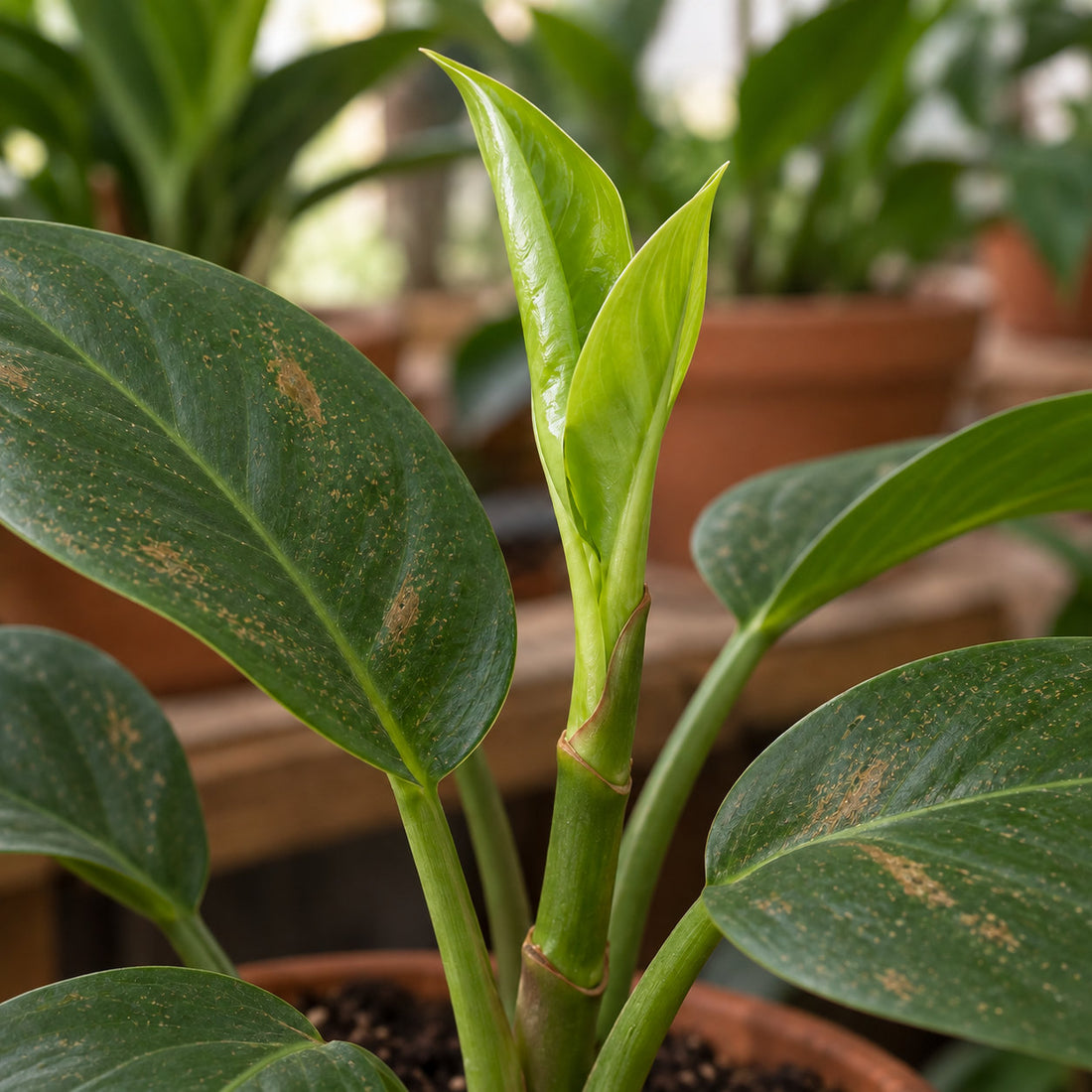
Amblyseius swirskii for Thrips and Whitefly Control
Swirskii mite · Amblyseius swirskii
4.4 · 9 reviewsLive Amblyseius swirskii predatory mites in a bottle: a mixed-stage population with food mites in a vermiculite carrier, sprinkled straight onto the foliage. They hunt thrips larvae, whitefly eggs and crawlers, and broad mites, and they work best in a warm, humid room. They don't take adult thrips or adult whitefly.
- Best for
- Broad mites, thrips, whiteflies
- Conditions
- 60–95°F, Best at 60% RH and up
- Good to know
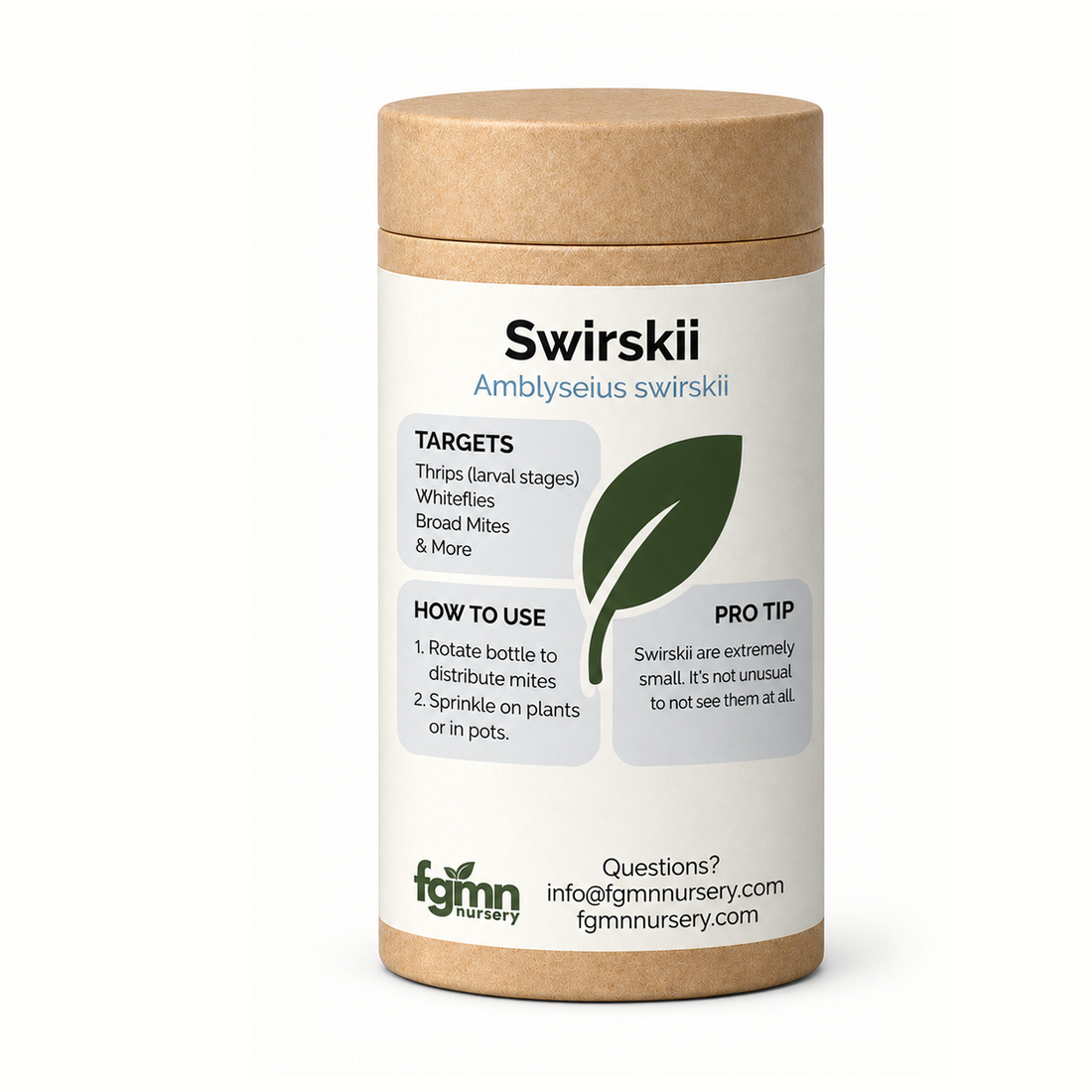
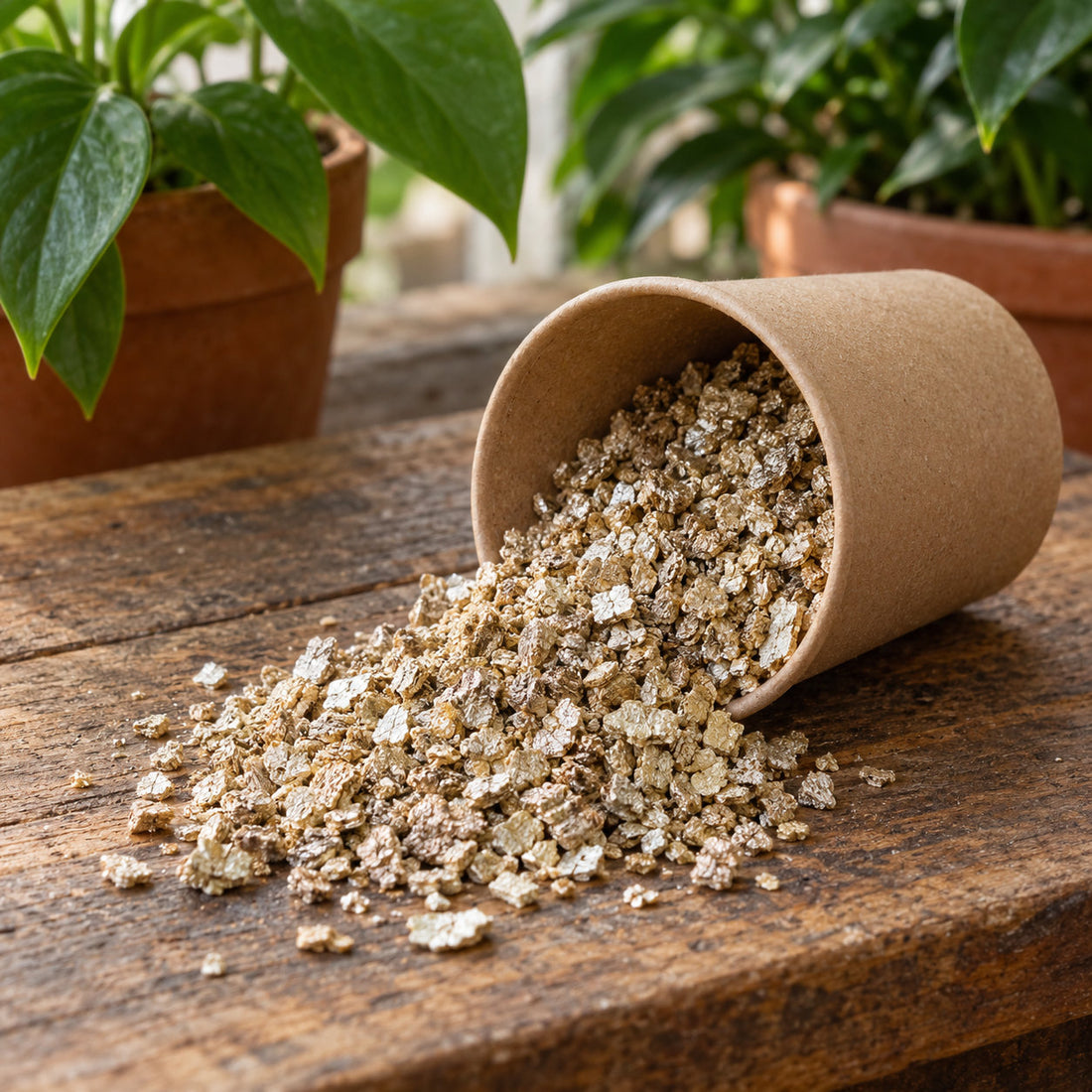
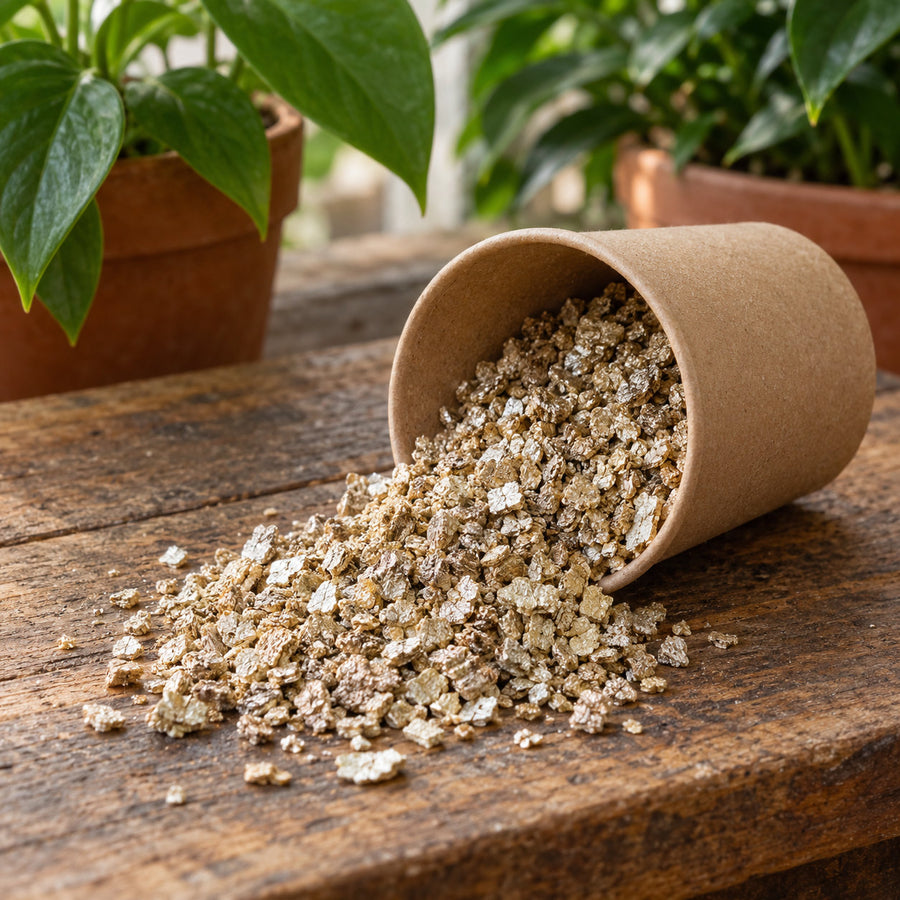
- Pale grains, no visible bugs. Swirskii are half a millimeter and carrier colored, packed with food mites to keep them fed. All of it goes on the plant. What to expect
When to choose something else
Not for adult thrips, adult whitefly, russet & rust mites.
Shipping details
Shipping
| Est. ships | Est. arrives | |
|---|---|---|
| Standard | ||
| Overnight |
Raising a fresh batch for you? Add up to 7 days to both dates.
Estimates. Overnight speeds up the trip, not the packing: its one day on the truck starts once it ships.
- Monday to Thursday only. Nobody spends the weekend in a warehouse.
- Check your address at checkout. Bugs are brilliant at finding aphids and hopeless at finding a new front door.
Ordering with friends? Get group pricing
Everyone picks their own. It ships to you in one box.
Buying for a greenhouse, farm or shop? Ask about wholesale
Right for you?
Your pest, your growing space, how many you need
What it treats, and what else it eats
Treat. It goes after broad mites, thrips and whiteflies.
| Pest | Treats or prevents | Why |
|---|---|---|
| Broad mites | Treats | Main prey. It goes looking for these first. |
| Thrips | Treats | Main prey. It goes looking for these first. |
| Whiteflies | Treats | Main prey. It goes looking for these first. |
Not for adult thrips, adult whitefly, russet & rust mites.
How many amblyseius swirskii do I need?
Count the plants you want to cover.
Size guide
| Size | In the bottle |
|---|---|
| X-Small | 500 Mites |
| Small | 1,000 Mites |
| Medium | 2,500 Mites |
| Large | 5,000 Mites |
| X-Large | 10,000 Mites |
| 2X-Large | 15,000 Mites |
| 3X-Large | 20,000 Mites |
| 4X-Large | 25,000 Mites |
- Each size is one release. The treatment plan below says when to check again.
- Count the plants you want to cover.
- Heavy pressure, go one size up; light, one size down. A large plant with a dense canopy counts as three or four plants.
Conditions for releasing amblyseius swirskii
Amblyseius swirskii work best when the growing space stays 60–95°F, Best at 60% RH and up. These are preferred conditions, not hard limits.
Best temperature60–95°F
A tropical predator. A cool night won't hurt it; metabolism and breeding speed rise as the room goes above 75°F, which is the opposite of most of the catalog.
Best humidityBest at 60% RH and up
Short dry spells are fine. The eggs need moisture, so only a room that stays dry for days costs you the next generation, and never this one.
RefrigerateBest not
If you need to wait, they're best kept at 55–60°F in the dark, bottle on its side. Best kept from freezing.
Releasing
What to do, and what you'll see
What to expect
- Pale grains, no visible bugs. Swirskii are half a millimeter and carrier colored, packed with food mites to keep them fed. All of it goes on the plant.
- They get to work fast. Swirskii hunt rather than wait, heading for the newest leaves and the undersides. Warm, humid rooms make them even quicker.
- Old damage stays, new leaves improve. Existing scars won't fade. Over two to three weeks, new growth comes in clean while the old marks stay as they were.
- Some adults may still fly. Swirskii take young thrips and whitefly eggs, not the flying adults. Adults thinning out over time means the next generation is being stopped.
How to release amblyseius swirskii
You may need to retreat
Eggs and young pests you can't see yet keep hatching after the first release. A second round catches that next wave.
You're done when you're seeing fewer pests and new growth comes in clean. Still seeing them, or fresh damage on new growth, at the check? That's your cue for another round.
Put it on a schedule and the next bottle arrives on its own, 10% off the first and 15% off every one after. If it turns out you don't need it, pause or cancel anytime from your account.
Reviews
What growers say
What people say
4.4 out of 5, from 9 reviews.
Seems helpful… some of my plants are doing better. I’m still seeing new thrips. I think I will try another round…
Hi!! You’re on the right track. Thrips are extremely difficult to treat. While it is theoretically possible that you can treat them with just one round, most of the time it takes several rounds usually timed about 30-45 days apart. You’re fighting is the predatory mites eating all of the larva, then dying off because there’s no food, but then more of the eggs start to hatch. Those eggs can incubate for 45 to 60 days. Hence the cycle or at least feeling like it’s hit or miss. Ideally what you want is that each cycle is less than the previous. The last round is usually safely around 45 days after the last adult died….. although those eggs can incubate for years, it’s unusual. Do feel free to reach out to us if you have any questions! We are more than happy to help.
The mites arrived alive and well. The media comes in a little tube with a cap; of which is made of cardboard and is sturdy. I was able the see the mites.
First time trying beneficials and was a great experience. Customer service is top notch, even if just have questions.
Well, I haven’t seen any thrips or new damage since introducing the swirskiis so 10/10 no notes! Thanks!
I can't see them, but I know they're working. My plants are showing loads less damage from thrips andthe spider mite webbing also seems to have decreased.I'msuper excited to have these on my plants and will absolutely be purchasing again in spring to prevent them earlier in the season.
So far so good! Spotted thrips on my indoor strawberry garden and did a knock down using sprays while I waited to receive these little guys. They shipped pretty fast and then I let them loose. It's been a couple weeks now... and no thrips (that I can find)! These swirskii guys are def. small and hard to see... but I've seen 1 or 2 now over the last 2 weeks so I know they were in there. Seems to be working!
I don't know that there were any mites in the box. I used the entire box, but it didn't prevent thrips and it didn't control them. I never saw any mites after two weeks.
Hi John,
Thank you for taking the time to share your feedback. Predatory mites are very small—often microscopic—so it’s completely normal not to see them even right after release. Their impact is usually observed indirectly through reduced pest damage rather than by spotting the mites themselves.
It’s also important to note that thrips control typically requires more than one release, since thrips reproduce quickly and at multiple life stages. One application may not be enough to keep them in check, especially if there’s already an established population.
We’d be happy to look into your order and help troubleshoot the setup so you can get better results going forward. Please reach out to us directly so we can support you with the right next steps.
10k mite bottle with maybe 1k alive if that. Opened package just a few hours after delivery.
Oh no! I’m sorry to hear you’re disappointed with how your order arrived. If your shipment was delivered within the last few days, please email us at info@fgmnnursery.com so we can review it together and figure out the best next step.
For future reference, we do have strict timelines for reporting possible issues. This isn’t about doubting customers—it’s just that, in the past few months, we’ve had a surprising number of requests for extra bottles (they went so far as to brag about online), so the window helps us keep our live arrival guarantee fair and sustainable for everyone.
If you’re still within that window, we’ll be happy to help.
They are great. Simple directions. Fast shipping. great customer service.
Pairs well with
Small things that help them work
-
Add alongside
Orius insidiosus
The adults already flying.
from $68
-
Add alongside
Sf Nematodes
The stage in the soil.
from $15
-
Add alongside
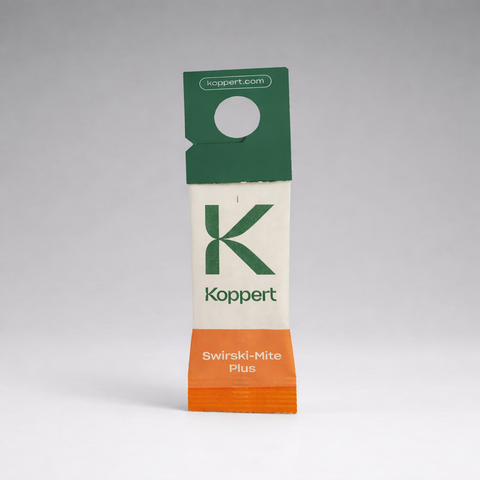
Amblyseius swirskii Slow-Release Prevention Sachets
The weeks after the course.
$4.75
-
Add alongside
Root Network
For the roots: mycorrhizae and microbes that help roots take up water and nutrients. Use at repotting, then a monthly drench.
from $15



More to know
Ways to buy, questions and reading
Ways to buy
Once, on a schedule, with friends, or mixed with other predators.
- One time
- A single bottle, this once. Free shipping on orders of $30 or more, $15 under that.
- On a schedule
- 10% off your first box, 15% off every box after. Skip, move, pause or cancel from your account.
- Group order
- Friends each pick what they want, and it ships to you in one box.
- Mix and match
- Buy several predators together and they get cheaper.
For the curious
Everything else we know about them. Tap a topic to open it.
Is this your pest?
Swirskii treats three, and the stages it takes are the ones doing the multiplying. If none of these looks like your plant, the product you want is a different one.
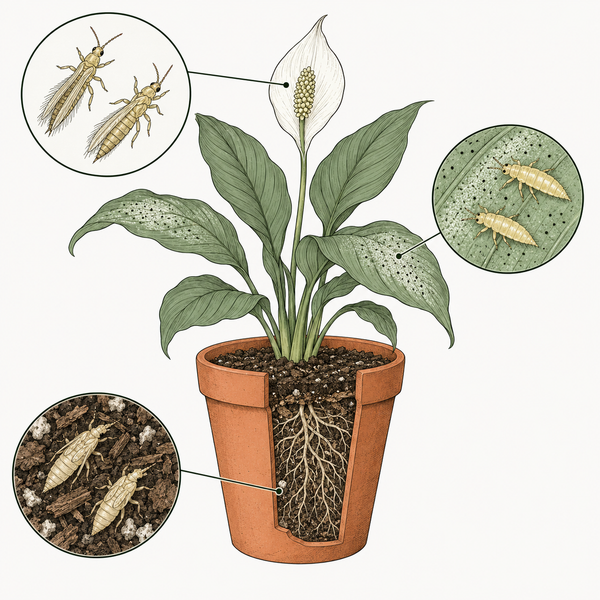
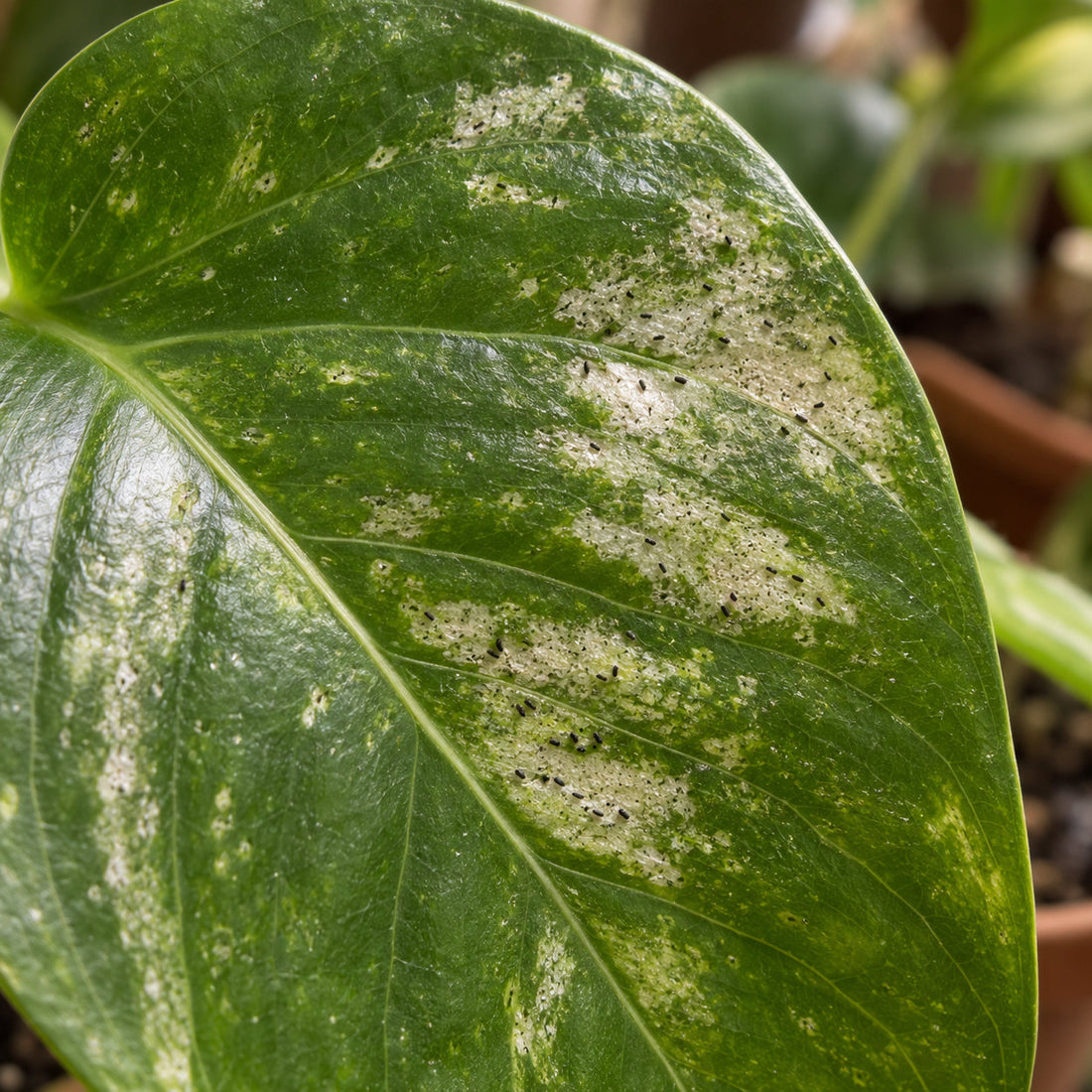
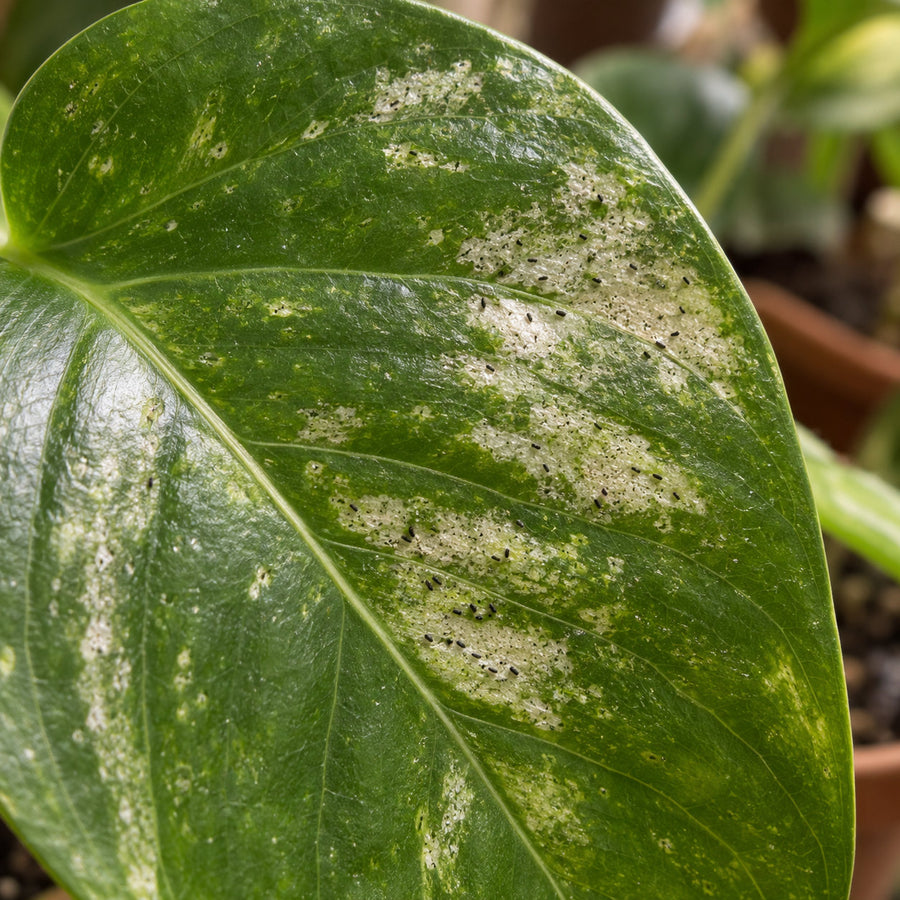
Thrips rasp the leaf surface and leave silvery scarring with black frass specks, worst on the newest tissue. Whitefly leave sticky honeydew and sooty mold on the leaves below, and a cloud of small white adults when you disturb the plant — the eggs and crawlers sit on the undersides. Broad mites leave nothing visible at all; you read them from new growth that comes in small, hardened and twisted.
Swirskii takes thrips first-stage larvae, whitefly eggs and crawlers, and broad mites in the tight new growth where they breed. It does not take adult thrips or adult whitefly: that is Orius and your cards, and the soil stages are Sf nematodes.
Then: is swirskii the right answer to it?
Choose this if
Choose swirskii for a room that runs warm and humid, and for a mixed problem — thrips and whitefly together is the case it is built for. It is one of the few predatory mites that keeps hunting when a room gets genuinely hot, and it gets faster above 75°F rather than slower.
Choose something else if
Cold and dry rooms slow it down. If the room stays below about 60°F, cucumeris is the lower-cost answer for thrips alone, and eggs hatch best with moisture, so a room that stays dry costs you the next generation. Once spider mite webbing is up this is not the one — that is persimilis. It works alongside cucumeris and the other predatory mites, so you can run them together.
What it kills, and what it won't
It also feeds on pollen, which is not a pest — it is how the population holds on a clean plant between outbreaks instead of starving out. Spider mite eggs get taken on encounter rather than hunted; once webbing is up, it is not the right one.
How it works
What it does to the pest, what it does on the plant, and what that leaves you looking at.
It hunts rather than waits
Swirskii is a predator — not a poison, not a repellent, nothing systemic. It is a high-metabolism generalist that goes looking, rather than sitting on a leaf waiting for prey to arrive. It finds a thrips larva or a whitefly egg and feeds on it directly. There is no residue on the plant afterwards, and there is nothing here for a pest to become resistant to.
It breeds where it lands
What you release is the start of the population, not the whole of it. In a warm, humid canopy they lay on the leaf and the next generation does a large part of the work — and it speeds up as the room gets hotter. Air that stays dry for days slows it: the adults keep eating, but fewer eggs hatch to replace them.
Pest numbers, not mites
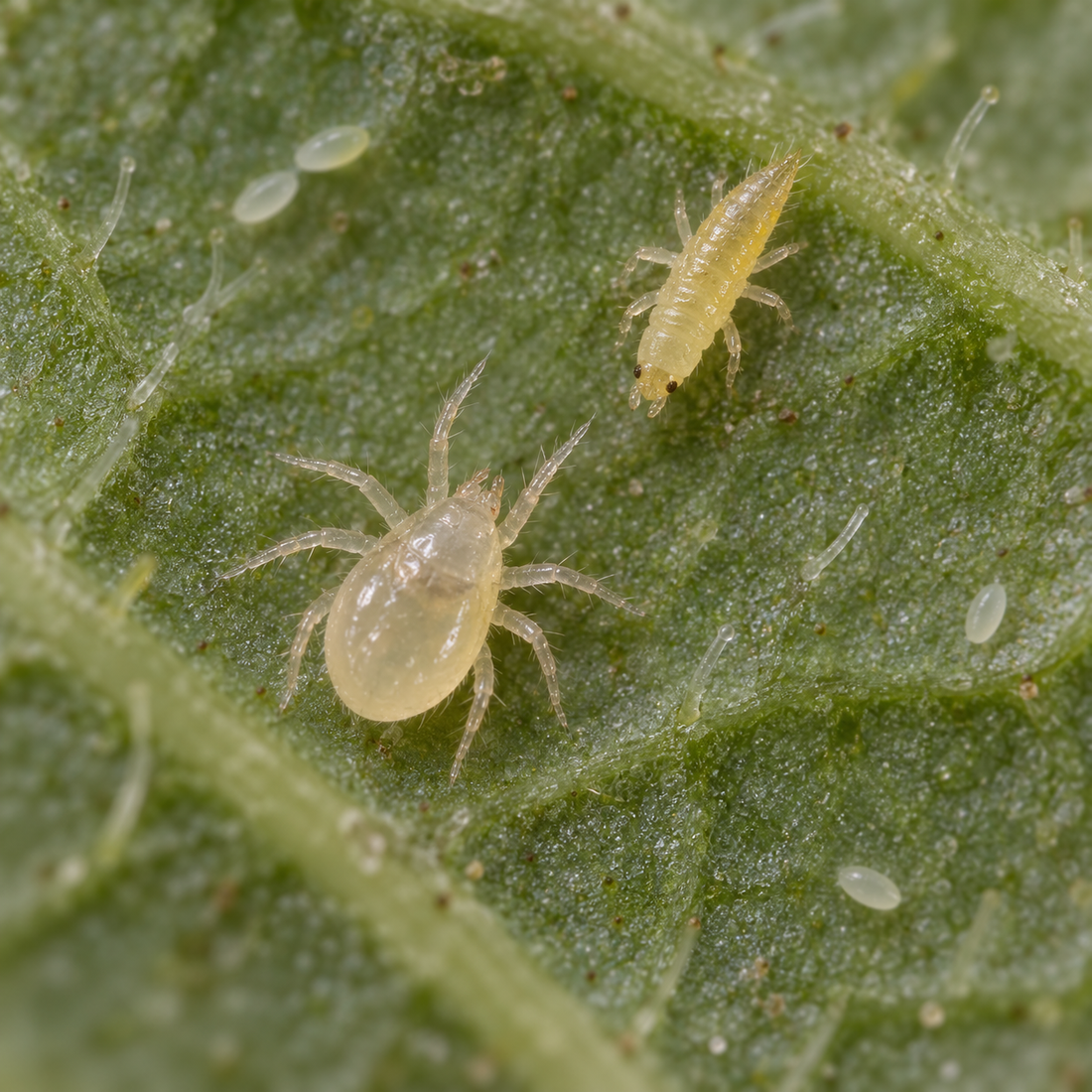
You will rarely watch this happen. They are about half a millimeter, pear-shaped, tan to pale orange, and quick. Judge it the way a grower does — new growth coming in clean, card counts flattening week to week — rather than by how many predators you can find.
It is not a knockdown. The silvering already on a leaf is scar tissue and it stays there whatever happens next. The first thing that actually changes is the growth that comes after.
About swirskii
A predatory mite about half a millimeter long that hunts on leaves. It has no interest in your plant and no interest in you — it eats other arthropods, and when there are none left it eats pollen until there are.
New to beneficials?
Five things that catch almost everyone the first time.
What arrives
A mixed-stage population with food mites in a vermiculite carrier. The food mites are deliberate: they keep the predators fed on the way and for a while after you release them. Everything in the bottle goes onto the canopy.
You are unlikely to see movement, and that is normal at this size against a pale carrier. It is not a sign that anything is wrong.
Release on arrival. Swirskii has a very high metabolism and does best released rather than kept in the bottle — if you need to wait, 55–60°F in the dark for a few hours, away from the freezer.
When it ships, and when it lands
Shipping
We ship when they're ready to travel. Live orders go out Monday to Thursday. If a colony needs a beat to peak, or we're propagating a fresh batch, yours might hold up to a week. All mites and insects ship 2-day or Overnight depending on what's best for them.
When it lands
Open it that day. Rotate the bottle gently, then sprinkle onto the foliage, concentrating on the upper third and any hot spot where damage is already visible.
Why we pack extra
Two days in a van is a long trip for something this small, so we send more than you paid for.
A predatory mite is the size of a grain of table salt. It ships in a bottle, in a van, for two days.
A trip like that is hard on anything this small, so we price it in: the number on the label gets counted out, and then roughly 15% more goes in on top as a cushion.
Your 500-mite bottle leaves here holding more than 500. The cushion is on us.
If you can see them
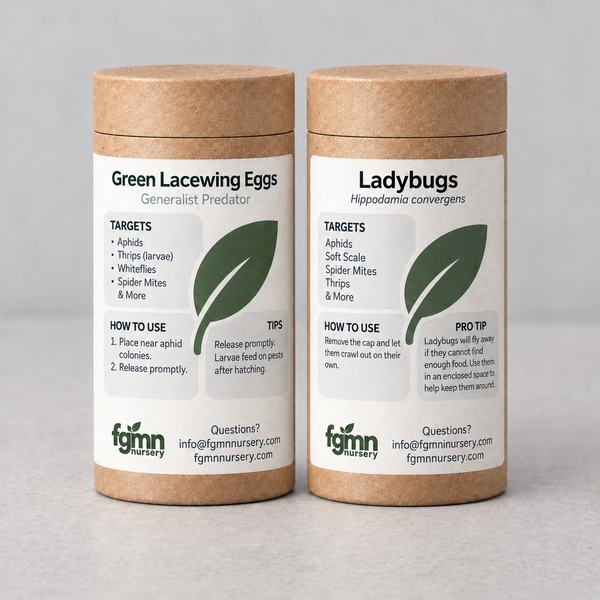
Ladybugs, lacewing larvae, Orius — the minute pirate bug — and the beetles. These are the ones big enough to see.
Cold insects are very good at sitting still. That's normal. Release them as this page says, and watch the pest instead.
Something look wrong? Email info@fgmnnursery.com with your order number.
If you can't see them
Mites, nematodes, eggs — most of what we sell, this one included. A bottle of carrier looks the same whether it holds 500 live mites or none, and no photograph settles that. So we don't ask you to take one.
Email info@fgmnnursery.com and our entomologist takes you through the diagnostic instead — where the box sat, what your room was doing, and then what the pest is doing about ten days later.
Seventy-two hours from delivery, either way, with your order number. Replacement or store credit, your pick.
Questions about amblyseius swirskii
Will I have bugs flying around my house?
No. They stay on the plants, where their food is.
Why is Swirskii more expensive than other mites?
Swirskii is a premium predator with a broad diet: thrips larvae, whitefly eggs and crawlers, and broad mites, all from one mite.
Will they eat my plants?
No. They are strictly predators. If no pests are present, they can survive on pollen, but they will never damage plant tissue.
Can I use them with Neem Oil?
Yes, once the spray is dry. Neem oil and horticultural oil kill on contact and leave nothing behind once dry; insecticidal soap needs a day before release. Products sold as azadirachtin, the concentrated active in neem, are different and need a week, and the label wins wherever it says longer.
Do they work on Root Aphids?
No. Swirskii only hunts on the foliage, and root aphids feed below the soil line. Of the soil biologicals, the mite Stratiolaelaps scimitus is the one with a published field trial against a root aphid — one significant season out of two, so worth trying rather than a cure. For fungus gnats and thrips pupae in the soil, nematodes and Stratiolaelaps are both well evidenced.
How long do they stay on the plant?
As long as there is food (pests or pollen), they can stay, breed and establish a colony.
Is it safe for my pets?
Yes. These mites are harmless to humans, dogs, cats, and other animals.
How many swirskii do I need?
Size it by plant count. Every size is built at roughly 100 mites per six-inch plant, so:
- Count the plants in the space, not just the ones with damage. Sizes are named in six-inch plants, so count bigger plants generously.
- Heavy pressure (silvering across whole leaves, a cloud of whitefly when you brush the plant): go one size up.
- Light pressure (a streak or two, new growth still clean): one size down.
- One bottle is one release. All of it goes onto the plants the day it arrives.
- Plan on more than one round. Release again every 7–14 days while thrips or whitefly are active; two or three rounds is normal. Check at about 14 days: new leaves coming in clean is the sign it's working.
Keep reading
Field Notes from the FGMN Nursery team.
 Swirskii Wants the Warm Room
Why a living swirskii mite is not the same as a growing colony, and how to interpret cool…
Swirskii Wants the Warm Room
Why a living swirskii mite is not the same as a growing colony, and how to interpret cool…
 Roll Your Swirskii Bottle Before You Open It
The bottle needs rolling before you open it, because the mites settle in transit and the top third…
Roll Your Swirskii Bottle Before You Open It
The bottle needs rolling before you open it, because the mites settle in transit and the top third…
 Swirskii Per Plant Or Per Square Foot?
Every commercial rate for this animal is written per unit of area, because a greenhouse bench is one…
Swirskii Per Plant Or Per Square Foot?
Every commercial rate for this animal is written per unit of area, because a greenhouse bench is one…
Sources
Published guidance from university extension services. The release tips on this page also draw on what we see shipping these every week.