




Limonicus was described in 1956 and became commercially available in 2012. The useful question is what took so long. Finding a mite that eats pests and producing enough of it to help growers turned out to be very different jobs.
Its history explains both the interest in this predator and the conditions that still matter after it reaches a plant. Being commercially available did not make it independent of food, humidity, or plant structure.
If you are choosing limonicus for thrips, read this profile alongside the comparison of foliage predators. The thrips treatment guide explains how that choice fits into the larger plan.
What Is Amblydromalus limonicus?
Limonicus is a phytoseiid predatory mite in the family Phytoseiidae — the same family that includes swirskii, cucumeris, and persimilis. It was first described by Garman and McGregor, and has been studied under its former name Amblyseius limonicus for decades before a reclassification placed it in the genus Amblydromalus. You'll see both names in the literature.
What makes limonicus interesting isn't that it does one thing exceptionally well — it's that it does many things well, across a wide temperature range, and with the kind of flexibility that generalist growers actually need. Scientifically, it's classified as a Type III-c generalist predator. In plain terms: it's opportunistic, adaptable, and hungry.
| Family | Phytoseiidae | Optimal Temp | 55–77°F |
| Classification | Type III-c Generalist | Min. Humidity | >70% RH |
| Also Known As | Limonica, Amblyseius limonicus | Primary Targets | Thrips, whitefly, mites |
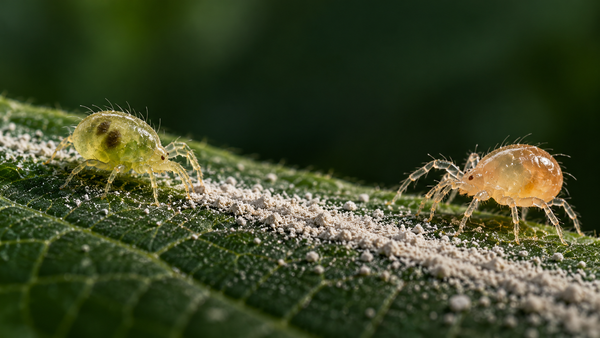
| Appearance | Beige, fast-moving | Egg → Adult (77°F) | ~5 days |

A Longer History Than You'd Expect
Limonicus is being called "new" in the home grower market, and it is — but the mite itself is not new at all. Amblydromalus limonicus was first formally described in 1956 from citrus orchards in California, where it was found occurring naturally alongside spider mite pest populations. Its native range spans North and South America, Australia, and New Zealand. It's been living on plants and hunting pest mites for a long time. What's new is the ability to produce it at scale.
After its initial description, limonicus caught the attention of biocontrol researchers in the 1960s as a natural enemy of avocado-damaging spider mites — specifically Oligonychus punicae and Tetranychus cinnabarinus. Early lab work showed it could develop and lay eggs on a surprisingly wide range of prey: mites, thrips, whiteflies, scale insects, and pollen. That breadth was noticed. And then, more or less, the work stalled for a few decades while other species were prioritized.
The story picks up again in the early 1990s, and it has a villain: Frankliniella occidentalis, western flower thrips. WFT had spread across most of the world by that point and was devastating greenhouse crops with few reliable biological control options. Researchers in New Zealand, Australia, and the Netherlands began systematic surveys to find natural enemies that could fill the gap. Limonicus turned up in those surveys — an already-known species suddenly relevant to an urgent new problem.
Lab and semi-field trials in the Netherlands and Australia confirmed limonicus was a strong candidate for WFT biocontrol. The results were promising. There was just one problem: nobody could figure out how to mass-produce it. Commercially viable rearing systems for predatory mites require very specific conditions, and limonicus resisted them for years. A closely related species collected during concurrent surveys in South America — initially also thought to be limonicus — turned out to be an entirely new, undescribed species. It was named Amblydromalus manihoti in 1994, and the confusion set the research back further.
"The mite was found in 1956. It took until 2012 to figure out how to breed enough of them to sell. That's not slow science — that's just how hard mass rearing living organisms actually is."
The breakthrough came in the early 2010s. Koppert Biological Systems — the Dutch biocontrol company responsible for commercializing swirskii and many other predatory mite products — finally developed a viable mass production system for limonicus. The product, branded as "Limonica," became commercially available in January 2012. That's less than 15 years ago. The first wave of field trials followed quickly, confirming its effectiveness not just against thrips but also greenhouse whiteflies across multiple crops — roses, cucumbers, strawberries.
Since then, research has expanded rapidly. The 2013 literature review by Knapp, van Houten, Hoogerbrugge, and Bolckmans effectively reintroduced limonicus to the scientific community and laid out its full prey range. Studies through the 2010s and 2020s have documented its performance on psyllids, Scirtothrips, chilli thrips, and most recently six-spotted spider mites. Each study has expanded the known profile of a mite that, at its core, has been sitting quietly in California citrus groves since before most of us were born.
What Does It Eat?
The honest answer: a lot. Limonicus has been demonstrated effective against multiple pest categories in research settings, which is unusual for a single predatory mite species. Most are specialists. This one isn't.
Thrips
Thrips control is where limonicus has the most documented commercial success. Research has shown it performs comparably to Amblyseius swirskii against chilli thrips (Scirtothrips dorsalis), with both species consuming larvae at similar rates. Larval stages are strongly preferred — both limonicus and swirskii consumed thrips larvae at a rate of roughly 5–6 individuals per day, compared to just 1.6–1.7 adults per day. In strawberry greenhouse trials against Scirtothrips species, swirskii and limonicus were the most voracious predators tested, achieving the highest prey consumption and oviposition rates.
Whitefly
Limonicus is commercially sold specifically for whitefly control alongside thrips — an unusual combination for a single predatory mite. It targets both Trialeurodes vaporariorum (greenhouse whitefly) and Bemisia tabaci (tobacco whitefly). The important nuance: limonicus is highly effective against whitefly eggs and first-instar larvae (the mobile "crawlers" that have just hatched). It will not meaningfully attack older nymphal scales or flying adults — those stages have protective waxy coatings and mobility that make them poor targets.
The practical implication: if you release limonicus into an active adult whitefly infestation, don't expect the flying insects to disappear immediately. What you'll see — and this is the correct outcome — is that the next generation fails to establish. Adult whiteflies lay eggs; limonicus eats those eggs and the crawlers that hatch from them. Population decline takes one to two generations to become visually obvious. That's the mechanism working correctly.
Spider Mites
More recent research has expanded limonicus's documented prey range into spider mites. A 2025 study found that limonicus and Amblyseius herbicolus fed and reproduced on all life stages of the six-spotted spider mite (Eotetranychus sexmaculatus), with limonicus showing significantly higher predation rates across experiments. This is an emerging application rather than its primary use case — but it signals that limonicus may be more broadly applicable than previously understood.
Psyllids
Less commonly discussed in houseplant contexts, but limonicus has also shown effectiveness against psyllids, including the tomato/potato psyllid (Bactericera cockerelli) — an invasive pest with real economic impact in commercial crops.
The four-mite comparison explains how these traits compare with other foliage predators. Here, the next question is what keeps limonicus on the plant between pest arrivals.

The Pollen Trick: Why This Matters
One of the most practically important traits of limonicus is its ability to survive and reproduce on pollen when pest populations are low. This is what separates it — and swirskii — from purely specialist predators like Phytoseiulus persimilis, which starve quickly when spider mite populations crash.
For a home grower, this means you can release limonicus preventively, before a pest infestation takes hold. The mites establish on the plant, feed on ambient pollen, and remain present as a standing patrol. When a pest arrives, the population is already in place to intercept it. Research has confirmed this — when given pollen supplementation alongside thread as oviposition substrate, limonicus successfully established and persisted at high population levels, making it well-suited to preventive programs.
The catch for indoor aroid growers: most aroids don't flower on a regular cycle, and many collector-grade plants rarely flower at all. If your shelves are wall-to-wall Monstera and Philodendron with nothing blooming, limonicus has no ambient pollen to fall back on between pest events.
The solution is simple: supplement manually. Commercial pollen products like Nutrimite (typha/cattail pollen) are designed exactly for this use case — dust a small amount directly onto leaves every one to two weeks to keep a background limonicus population simmering. Cattail pollen (Typha spp.) has been specifically validated in research as a high-quality food source for limonicus reproduction and development. A light dusting — visible as a faint yellow coating — is sufficient. The goal is bridging the population across pest-free gaps, not feeding them to saturation.
Where Limonicus Falls Short
No predatory mite is universal. Limonicus has real limitations worth knowing.
Humidity is non-negotiable. Limonicus is sensitive to relative humidity below 70%. If your growing environment runs dry — less than 60–65% RH consistently — limonicus will struggle to establish and reproduce. Swirskii is more forgiving in drier conditions. For aroid collectors running tropical humidity levels, this isn't a problem. For anyone growing in a dry apartment, this is a dealbreaker.
Some plant surfaces are hostile. Research has shown limonicus struggles to establish on plants with dense glandular trichomes — the sticky, hair-like structures found on tomatoes and some other crops. Aroids don't have this issue. Monstera, Philodendron, Alocasia — smooth, cooperative leaf surfaces. You're fine.
It's not for soil pests. Limonicus operates on plant surfaces. For fungus gnats, you still want Stratiolaelaps scimitus (Entomite-M) in the soil. They serve different niches.
That brings the story back to the original challenge: a promising predator still needs somewhere it can live and reproduce. For your collection, the useful decision is whether those conditions match the plants and pest you have. The foliage-predator comparison puts limonicus beside the other candidates.
The hard part was never persuading it to be hungry.
Peer-Reviewed Sources
- 1.Knapp, M., van Houten, Y., Hoogerbrugge, H., & Bolckmans, K. (2013). Amblydromalus limonicus (Acari: Phytoseiidae) as a biocontrol agent: literature review and new findings. Acarologia, 53(2), 191–202. doi:10.1051/acarologia/20132088
- 2.Yang, Y., Zhang, K., & Zhang, Z.-Q. (2025). Predatory mites Amblydromalus limonicus and Amblyseius herbicolus as potential biocontrol agents of Eotetranychus sexmaculatus in avocado. Journal of Economic Entomology, 118(3), 1335–1343. doi:10.1093/jee/toaf036
- 3.Schoeller, E.N., McKenzie, C.L., & Osborne, L.S. (2020). Comparison of the phytoseiid mites Amblyseius swirskii and Amblydromalus limonicus for biological control of chilli thrips, Scirtothrips dorsalis. Experimental and Applied Acarology. doi:10.1007/s10493-020-00556-5
- 4.Mouratidis, P., Labbé, R., & Shipp, L. (2023). Preventive releases of phytoseiid and anthocorid predators provided with supplemental food successfully control Scirtothrips in strawberry. BioControl. doi:10.1007/s10526-023-10232-3
- 5.Samaras, K., Pappas, M.L., Fytas, E., et al. (2015). Pollen suitability for the development and reproduction of Amblydromalus limonicus (Acari: Phytoseiidae). BioControl, 60, 773–782. doi:10.1007/s10526-015-9680-5
- 6.Vangansbeke, D., Nguyen, D.T., Audenaert, J., et al. (2014). Performance of the predatory mite Amblydromalus limonicus on factitious foods. BioControl, 59, 67–77. doi:10.1007/s10526-013-9548-5
- 7.Lee, M.-H. & Zhang, Z.-Q. (2018). Assessing the augmentation of Amblydromalus limonicus with the supplementation of pollen, thread, and substrates to combat greenhouse whitefly populations. Scientific Reports. doi:10.1038/s41598-018-30018-3
- 8.McMurtry, J.A. & Scriven, G.T. (1965). Life-history studies of Amblyseius limonicus, with comparative observations on Amblyseius hibisci (Acarina: Phytoseiidae). Annals of the Entomological Society of America, 58, 106–111.
