


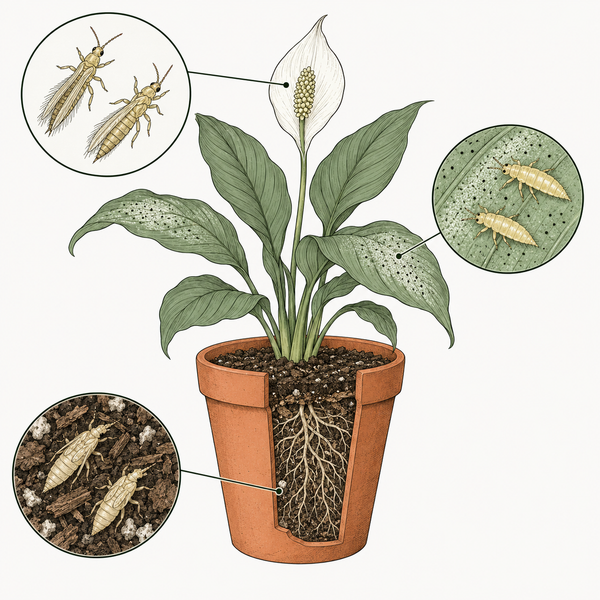
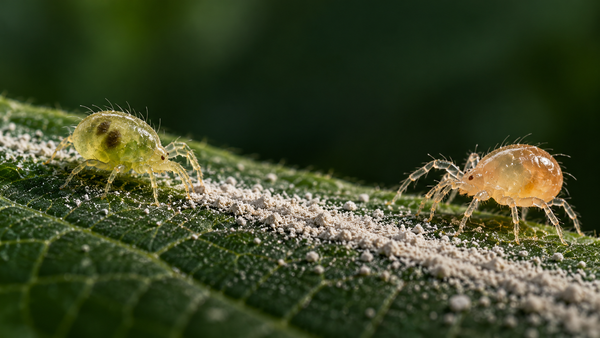


You have thrips, and four different mites appear to have applied for the job: cucumeris, swirskii, limonicus, and andersoni. Their descriptions overlap enough to make the choice seem like a question of which one eats the most.
That would be convenient. It is also where the comparison starts to go wrong.
A predator has to find prey on your plants, survive the conditions there, and keep contributing to control. A feeding rate tells you something about its appetite. Your plant shelf is a considerably longer interview.
The same appetite, a different result
In a study on chilli thrips, cucumeris and swirskii each ate about 2.7 larvae a day in leaf-disc tests. On pepper plants, however, swirskii kept thrips numbers much lower.1
A feeding-rate table would have called them a tie. The plants would not.
That difference changes the question worth asking. Instead of looking only for the mite that eats the most in a small arena, look for evidence that it can establish and suppress the pest on plants. Establishment means surviving and reproducing well enough to maintain a population there.
This is where limonicus enters the comparison. In a greenhouse cucumber trial comparing ten predatory mite species, it provided the best western flower thrips control. Swirskii also established substantially better than cucumeris.2 These are useful reasons to consider both species for thrips. They are not a promise that either will perform identically on every houseplant.
The practical interpretation is that a predator's success belongs to a combination: predator, pest, plant, and growing conditions. Changing one can change the result. Before choosing between those promising candidates, look at where you expect them to live.

Your room becomes part of the treatment
Imagine moving that successful greenhouse predator to a shelf beside a cold window. It may still be alive. That does not mean its population is keeping up.
A temperature study of swirskii makes this distinction especially clear. Its estimated lower threshold for population growth was about 60°F, while its fastest population growth was around 86°F. The researchers also estimated a lower threshold for individual development near 52°F.3 Those describe different things: developing is not the same as producing a growing colony.
These were controlled laboratory conditions, not thermostat instructions. Their value is in explaining why “survives at this temperature” is a poor substitute for “works well here.” Check conditions near the plants, including the cooler part of the day, before expecting a release to build the population seen in a warm trial.
Temperature is only half of that move from greenhouse to shelf. The eggs also need to survive the air around them.
Limonicus illustrates the tradeoff. The same research that made it interesting as a thrips predator also found its eggs particularly sensitive to dry conditions. In a laboratory screen, its eggs required more humid conditions than cucumeris eggs.4 A strong feeding result does not cancel that requirement.
If your plants live in dry air, that belongs in the choice from the beginning. Simply switching to the predator with the more impressive appetite leaves the original problem waiting for its eggs.
Then ask which pest gets eaten
So far, the comparison has been between mites tested for thrips suppression. Andersoni adds another question: what happens when a generalist has a choice of prey?
In a 2025 study, researchers offered andersoni two-spotted spider mites and western flower thrips at different temperatures. It generally preferred the spider mites, although that preference weakened at higher temperatures.5
That does not mean andersoni cannot eat thrips. It means “eats both” does not tell you how it divides its attention when both are available. If thrips are the reason for your release, evidence of thrips control deserves more weight than the length of the predator's menu.
There is a similar trap within the thrips population itself. A young larva and an adult are not interchangeable meals. If the insects you keep finding are adults, do not assume that choosing another foliage mite automatically solves that part of the infestation. Cucumeris Catches Thrips Young follows that distinction through the life cycle; the Orius lesson explains a different hunting role.
Now the four names mean something
You can use the comparison without turning it into a universal ranking. Each species brings a reason to consider it and a question you still need to answer.
| Predator | What to carry into your decision |
|---|---|
| Cucumeris | Think about its young-larval target. Similar laboratory feeding did not give it the same pepper-plant result as swirskii in the chilli thrips trial. |
| Swirskii | It has useful evidence of thrips suppression on plants. Check whether your conditions support population growth, rather than just survival. |
| Limonicus | Its strong cucumber result makes it worth considering. Egg survival in dry conditions is a meaningful part of that choice. |
| Andersoni | Account for prey preference. Feeding on thrips in a study does not make it interchangeable with a predator demonstrated to suppress them on a crop. |
If you have already released mites, return to the plants before replacing the species. What were the conditions? Which thrips stages are you seeing? Are repeated checks showing fewer live pests and healthier new growth, or is pressure continuing to rise? The treatment-progress guide helps you interpret that pattern and plan repeat treatment.
The lesson from those pepper plants is not that species choice is unimportant. It is that the useful choice depends on what happens after release. Two mites can eat the same number of thrips in a dish and produce very different results once they have an entire plant to deal with.
The thrips will not be grading the résumé.
Sources and further reading
- Arthurs, S., et al. (2009). Evaluation of Neoseiulus cucumeris and Amblyseius swirskii as biological control agents of chilli thrips on pepper. Biological Control, 49, 91–96.
- Messelink, G. J., van Steenpaal, S. E. F., & Ramakers, P. M. J. (2006). Evaluation of phytoseiid predators for control of western flower thrips on greenhouse cucumber. BioControl, 51, 753–768.
- Lee, H. S., & Gillespie, D. R. (2011). Life tables and development of Amblyseius swirskii at different temperatures. Experimental and Applied Acarology, 53, 17–27.
- van Houten, Y. M., van Rijn, P. C. J., Tanigoshi, L. K., van Stratum, P., & Bruin, J. (1995). Preselection of predatory mites to improve year-round biological control of western flower thrips in greenhouse crops. Entomologia Experimentalis et Applicata, 74, 225–234.
- Wang, C., Sekiguchi, M., & Hinomoto, N. (2025). Impact of temperature shifts on prey consumption and prey preference of the predatory mite Amblyseius andersoni. Experimental and Applied Acarology, 95, article 28.
