




Imagine finding thrips on a philodendron that has sat on the same shelf for a year. You haven't moved it outside. It looked fine when you watered it last week. But there they are.
Your mind goes straight to the plant you bought recently. That would explain it. Except the new plant looks fine, and the old one has the damage.
This is where tracing an infestation gets confusing. Thrips can arrive on one plant, go unnoticed, and turn up on another before you realize they are there. Finding them tells you where to start looking. It doesn't necessarily tell you where the story began.
The part you didn't see
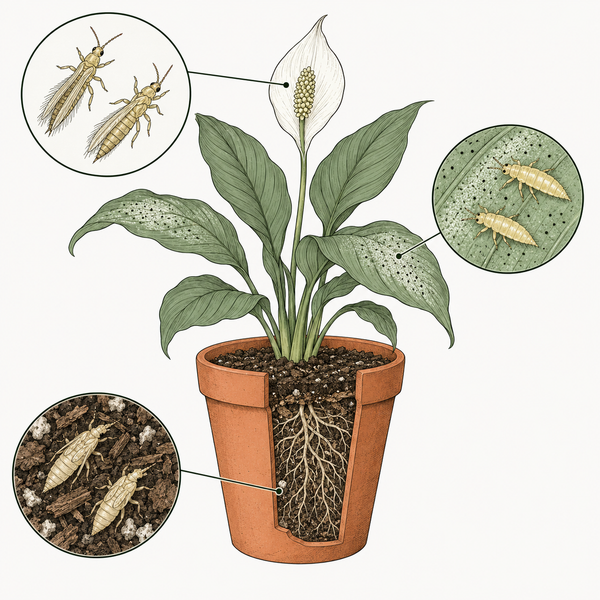
To understand how that happens, go back to the day a plant came home. It may have looked healthy because there was little damage to notice. Western flower thrips can hide in buds and developing foliage, while their eggs sit inside plant tissue, out of sight during an ordinary inspection.2
Now put that plant beside the philodendron. While you carry on watering and admiring new leaves, the insects can develop and reproduce. Eventually you notice the insects or their characteristic damage. That discovery feels sudden. The infestation may not be.
You cannot work backward from that damaged leaf to an exact arrival date. But you can follow its neighbors. The plant beside it may have been carrying thrips before either one showed enough damage to catch your attention, so the inspection needs to continue along the shelf.
How a passenger gets a ride
Plants are an established route for thrips to travel. The movement of cuttings, seedlings, and potted plants helped western flower thrips spread internationally.1 The same basic opportunity exists when a plant crosses your front door.
A big-box purchase, a specialist nursery plant, an online order, or a friend's cutting all have a history before you receive them. They may have stood beside other plants during growing or sale. You see the plant at the end of that journey, not every encounter along the way.
That's why keeping a new arrival apart for observation is useful even after a reassuring first look. It gives you another chance to see what was hidden before you put it beside everything else. Thrips do not check the receipt before moving in.
And the arrival needn't have roots. Western flower thrips also occupy flowers.2 A bouquet on the windowsill or stems cut from the garden belong in the same conversation as a new houseplant.
But you haven't bought a plant in months
That still leaves the outdoors. Adult thrips can disperse from surrounding vegetation, including on wind currents. Openings into growing spaces provide a route in, which is why greenhouse research has examined screens as a way to reduce incoming thrips.23 At home, consider the open window beside the plant shelf.
Then there is the plant returning from its summer on the porch. You think of it as part of the collection because it has always been yours. Biologically, it has just spent months somewhere else. Giving it time apart and repeat inspections on its return serves the same purpose as checking a new purchase.
If none of those routes fits, think about what else you have moved into the growing area. That includes what went into the pots.

The passenger can be below the leaves
Some thrips species spend their pupal stages—the transition to adulthood—in growing media. Moving contaminated material can therefore move an insect that a leaf inspection would never reveal.
Researchers demonstrated survival through this stage by adding western flower thrips pupae to commercial growing media and recording adults emerging later.4 The study wasn't a survey of unopened bags, but it establishes why contaminated media belongs among the possible routes.
That could mean the mix around an incoming plant's roots or loose material used for potting. Even tissue-culture plantlets encounter a new environment when they leave the container for acclimation. If thrips repeatedly appear after that move, look at what changed with it: the media, where it was stored, and the plants nearby. The repeated pattern gives you somewhere to investigate, even if it cannot identify the source on its own.
Keeping unused media covered and away from infested plants helps keep that connection from forming. Returning used mix to a clean supply can carry material from one pot into the next.
By now, the philodendron on the shelf may have several plausible connections to the infestation. You may never identify the original arrival. You can still use those connections to find other affected plants and change how new plants and materials enter the collection.
The newest plant may be responsible. But being the last one through the door is not a conviction.
Sources and further reading
The studies below explain the biology and movement of thrips. The household prevention suggestions are our practical application of that research.
- Kirk, W. D. J., & Terry, L. I. (2003). The spread of the western flower thrips Frankliniella occidentalis (Pergande). Agricultural and Forest Entomology, 5, 301–310.
- Reitz, S. R. (2009). Biology and ecology of the western flower thrips (Thysanoptera: Thripidae): The making of a pest. Florida Entomologist, 92, 7–13.
- Mouden, S., Sarmiento, K. F., Klinkhamer, P. G. L., & Leiss, K. A. (2017). Integrated pest management in western flower thrips: past, present and future. Pest Management Science, 73, 813–822.
- Herrick, N. J., & Cloyd, R. A. (2020). Effect of plant-growing media on western flower thrips, Frankliniella occidentalis, pupae and fungus gnat, Bradysia sp. nr. coprophila, larvae under laboratory conditions. HortScience, 55, 1323–1326.
