

Images are AI-generated illustrations. Cutaways and comparisons are conceptual, not field photographs or measured results. Every AI-generated image has been personally reviewed and approved by a human. Any mistakes are therefore co-signed by the human.
You released Diglyphus, and the damaged leaves still look damaged. This is one of the less satisfying features of successful pest control: stopping the insect does not undo what it ate.
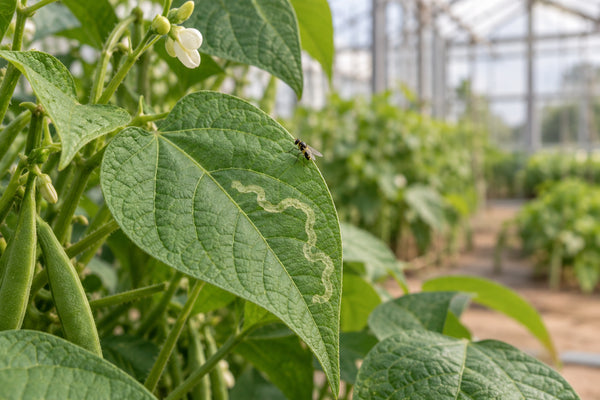
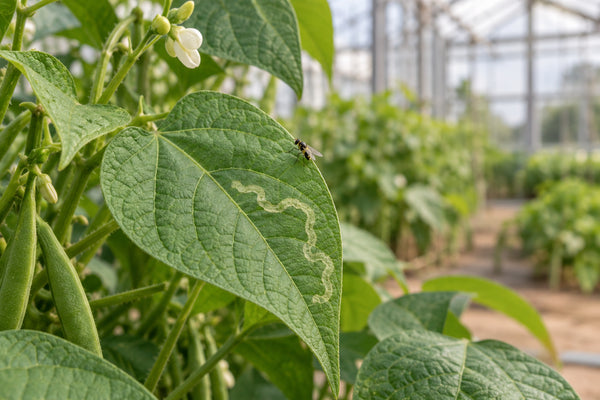
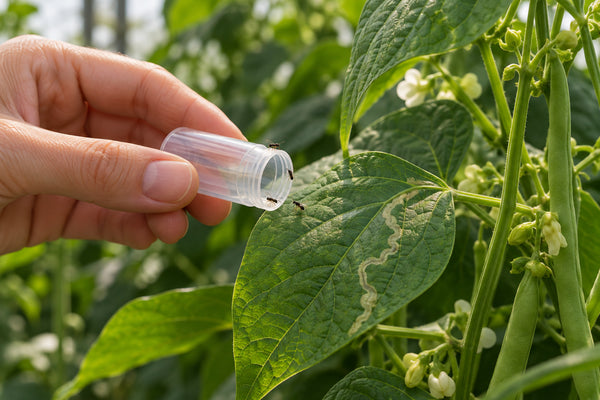
The pale trails are mines, tunnels made by leafminer larvae feeding inside the leaves. Those larvae are the pest’s young feeding stage, and the target of the tiny Diglyphus wasps you released. To judge progress, look for less feeding and fewer new mines. Waiting for an old tunnel to turn green again will be a long assignment.
Watch a few leaves closely
Choose several affected leaves you can find again, along with nearby leaves that appear clear. Photograph them before release, or now if you did not do it then. Revisit the same leaves regularly. Twice a week gives you a manageable routine for comparing them; the observations, rather than the calendar alone, should guide your next step.

Follow the end of each known tunnel. If it lengthens, feeding has continued there. Check clear leaves for new mines as well, and note any larvae you can see through the leaf. These observations distinguish an old mark from activity that is still happening.
Keep the sample honest. Record a leaf that falls or gets removed, and compare roughly the same amount of foliage each time. Six mined leaves out of ten inspected cannot fairly be compared with three out of four. Otherwise, changing what you count can make the infestation appear to improve all by itself.
A stopped tunnel leaves another question
A mine that stops extending suggests feeding there has stopped. It does not tell you why. A mature leafminer may have left the leaf to become a pupa, the stage in which it develops into a fly. Or the insect may have died. If you simply cannot see it, record that uncertainty rather than counting it as dead.1
A female Diglyphus paralyzes a leafminer and may lay an egg beside it. Her larva then feeds on that insect, eventually developing into a pupa of its own.

Small round emergence holes can also show where adult parasitoid wasps have left. A parasitoid is an insect whose young develop by feeding on a host and killing it; Diglyphus is one example. A hole alone cannot tell you which kind made it, because other natural enemies may already be present.2
There is another reason not to judge everything by offspring. Adult female Diglyphus sometimes kill leafminers by feeding on them without laying eggs. That attack leaves no young wasp to count, but it still stops a pest from feeding. Keep your attention on the living leafminers.
Why fresh mines can still appear
Suppose several familiar tunnels stop growing, but two previously clear leaves develop mines. You have evidence of less feeding in one place and new activity in another. Record both; neither cancels out the other.
The pest population can contain several stages at once. Eggs present when you released the wasps can hatch later. Pupae can develop into adult flies, which may lay more eggs. Diglyphus targets suitable larvae feeding inside leaves, so it does not attack all those stages at once. The leafminer life cycle explains why later activity needs another look.
The adults you released can begin attacking suitable larvae without waiting for their offspring to mature. Those offspring will need time to develop before they can search for leafminers themselves. In laboratory research, immature Diglyphus developed in roughly ten days at 77°F on two tested hosts, compared with about 27–28 days at 59°F.3 That measures development, not the number of days needed to clear your plants.
Across repeated checks, look for fewer occupied mines, less tunnel extension, and less fresh mining. Use that pattern alongside the repeat-release directions. If activity keeps increasing, let what you find guide the next step.
Give the next check a purpose
If you are unsure what made the mines, return to identification before ordering more wasps. Photograph the plant, both sides of an affected leaf, and any occupant you can see. A diagnostic service or Extension office can help establish whether the pest is a suitable Diglyphus host. A familiar squiggle is not enough to make that match.
If fresh activity stays concentrated on one plant or one part of the canopy, compare that location with where you released the adults. For the next scheduled release, follow the supplied directions and place them close to occupied foliage. Check the temperature there as well. The leaf beside a hot window may experience very different conditions from the thermostat across the room.
If the plants were recently treated, collect the product names, active ingredients, application dates, and whether each treatment went on the leaves or into the potting mix. Ask the supplier for a Diglyphus-specific compatibility check before the next release. That information is more useful than guessing a universal waiting period or assuming a dry leaf is safe.
If new mines repeatedly appear after plants arrive or near an entry point, inspect incoming plants again and investigate nearby sources of adult flies. Location is a clue, not proof of where the infestation began: eggs and pupae already present can also produce later activity. The arrival and life-cycle guide explains how to separate those possibilities.
Keep your release dates beside the photographs and inspection notes. If live larvae and fresh mining continue to increase across repeated checks, take that record to the supplier or diagnostic service for a revised plan. “These three leaves developed new mines after the second release” gives them something concrete to investigate. You do not need a laboratory notebook—just enough detail to show what changed.
Will the wasps stay afterward?
When leafminers become hard to find, it is tempting to hope the wasps will stay indefinitely in case another one arrives. Their young, however, need suitable leafminers to develop. Without hosts, the wasps cannot keep producing generations on the plant.
Adults can use sugar-rich food for themselves, and laboratory work with honey-fed Diglyphus shows that feeding on hosts also supports egg production.4 But a meal for an adult does not replace the insect its offspring needs. The adults may leave or eventually die, with their persistence depending on food and conditions.
You do not need to keep a few pests around to persuade the wasps to stay. Keep checking incoming plants and new growth, and investigate fresh damage if it returns. A successful release can reduce the problem without providing permanent protection.
The goal is less feeding ahead. The old leaf is under no obligation to look grateful.
Sources and further reading
- Capinera, UF/IFAS — American serpentine leafminer. Vacant mines, sampling live larvae, and departure to pupate.
- Pundt, UConn Extension — Leafminer pests of greenhouse crops. Scouting for dead larvae and emergence holes. See also UF/IFAS on Diglyphus immature stages.
- Bazzocchi et al. (2003) — Effects of temperature and host on pre-imaginal development. Abstract and introductory material reviewed; two laboratory host species, not a control deadline.
- Zhang et al. (2013) — Host feeding, egg maturation, and longevity. Controlled diets in laboratory females; these results do not predict adult persistence in a home. Host dependence follows the development described by UF/IFAS.
The repeat-photo routine and example are practical interpretation, not a field trial or a claim of measured FGMN results.