



How to apply beneficial nematodes, choose an applicator, and decide what belongs in the watering can with them.
Jump to the compatibility table ↓
A watering can is an entirely reasonable way to deliver several million pest-killing organisms. It is also probably the least dramatic thing you will do with several million pest-killing organisms.
Beneficial nematodes are microscopic roundworms that infect susceptible insects. For many houseplant owners, that means using Steinernema feltiae, or Sf, against fungus gnat larvae in the potting mix. Other species suit different pests and conditions. Whichever you use, the job is to get living nematodes to the pest while it is in a stage they can infect.
You can pour them, spray them, or send them through suitable irrigation equipment. Some can also be mixed with other treatments. The goal is the same with each method: distribute the dose evenly and keep the nematodes alive long enough to reach their target.
Start with the pest’s address
For fungus gnats, apply Sf to the potting mix. The flies circling your face are adults; the larvae you are treating live below them. Misting the leaves because that is where you noticed a fly sends the treatment to the wrong address. That is why the usual application is a soil drench: nematodes mixed into water and poured evenly across the potting mix to wet the area the larvae occupy.
In a lawn or garden bed, the same principle applies: match the nematode species, timing, and treatment depth to the susceptible pest stage. A root-feeding grub and a caterpillar sheltered in bark do not call for the same application. Check that match before opening the package, along with its storage instructions, use-by date, and recommended rate.
Applying nematodes with a watering can
For a houseplant collection, a clean watering can or jug is usually the simplest tool. Choose one without residues from cleaners or pesticides. Get everything ready before mixing: nematodes should go from the bucket to the plants promptly.
Outdoors, choose evening or suitable overcast conditions to limit heat and sun exposure. Check the temperature where you are applying them, too. For Sf, Cornell’s greenhouse guidance gives a growing-medium range of about 50–80°F; follow the range for your species and product.
- Moisten dry potting mix first. Let excess water drain. You want an evenly moist starting point, not a waterlogged pot.
- Mix the product in cool water as directed. Follow its instructions for releasing the nematodes from their carrier. Use the specified dose for the plants or area you are treating; adding water does not create more nematodes.
- Keep the mixture gently stirred. Remix before refilling the can and regularly as you work. Nematodes settle, so an unattended bucket can deliver very different doses at the beginning and end.
- Apply evenly over the potting mix. Work around the plant rather than pouring everything beside the stem. Use enough water to reach the target zone without sending most of the treatment straight through the drainage holes.
- Water in lightly where directed. A gentle follow-up rinse helps move nematodes off exposed surfaces and into the mix. Keep the treated zone moist afterward, while allowing drainage.

The water is doing two jobs. It distributes the dose during application, then leaves thin films of moisture through which nematodes can move between particles. Drying breaks that route, while prolonged saturation can leave too little oxygen. Keep the mix moist and let excess water drain.
Can you bottom-water nematodes in?
In our experience at FGMN, yes—but with substantially less effective fungus gnat control than when we apply them from the top. That comparison comes from our own use, not a controlled trial.
For treatment, we recommend a top-applied drench even if you normally bottom-water. It puts the nematodes directly into the upper potting mix where fungus gnat larvae feed. Adding them to a self-watering reservoir does not ensure an even dose throughout the pot.
Sprayers, hose ends, and irrigation systems
A pump sprayer can make a large collection easier to cover. Direct the spray at the treatment surface and use a suitable nozzle with openings large enough for the nematodes and their formulation. Fine screens can trap them or clog. Follow the product’s screen, nozzle, and pressure requirements. Keep the tank gently agitated and out of the sun.
A hose-end applicator can be useful for beds and lawns, provided it is suitable for nematodes and delivers the correct dose over the intended area. Practice with plain water to establish coverage before mixing. Flush sun-heated water from the hose first. A dial marked “fertilizer” tells you what the device was sold for, not whether its dilution and internal screens suit your nematode product.
Injectors, overhead irrigation, and drip systems are options for larger growing spaces. The challenge is delivering a consistent dose at the far end as well as the first outlet. Nematodes can settle in stock tanks and lines, and filtration needs to be configured for the application. Use a suitable nematode suspension rather than adding them to concentrated fertilizer stock.

Can nematodes be sprayed onto leaves or bark?
Yes, for specific pest-and-nematode combinations. Some programs use foliar applications against thrips; others direct nematodes into protected bark sites or active borer tunnels. The species and application method need to match the pest you are treating.
Above ground, drying and ultraviolet light make the job harder. A nematode on an exposed leaf has less protection than one in moist potting mix. Successful applications may depend on prolonged surface moisture, favorable humidity, or a tested wetting agent or protective formulation. An ordinary leaf mist in a dry living room is not equivalent to a greenhouse foliar program.
What can you mix with nematodes?
You can combine some treatments in one watering. The important distinction is between using them on the same plants and putting them in the same tank: a product may be suitable for one without being suitable for the other.
The research behind this table tested specific formulations with Sf nematodes. Use the ingredient names to find the relevant guidance, then confirm that it covers your formulation and application rate. Plain water is the simplest option when mixing compatibility is unknown.
| Ingredient | Application guidance |
|---|---|
| Bti | Compatible formulations can be mixed and applied promptly. |
| Trichoderma harzianum | Compatible formulations have been tested; check the formulation you use. |
| Streptomyces griseoviridis | Compatible formulations can be applied in the same mix. |
| Imidacloprid (systemic insecticide) | Compatible in laboratory testing. Confirm the formulation and rate for tank-mixing; apply granules separately as labeled. |
| Spinosad | Compatible formulations can be applied in the same mix. |
| Diflubenzuron | Compatible formulations can be applied in the same mix. |
| Azoxystrobin | Compatible formulations can be applied in the same mix. |
| Fludioxonil | Compatible formulations can be applied in the same mix. |
| Pure neem oil | Compatible at tested concentrations of 0.5–1%; added soaps can change compatibility. |
| Soil predatory mites | Release separately onto the growing medium. Do not put them in the watering can. |
| The Root Network | Can be mixed and applied with nematodes. |
| Hydroponic nutrients / fertilizer | Mix only when the full feeding recipe and strength are confirmed compatible. See below. |
| Concentrated nutrient stocks | Do not add nematodes directly to concentrates. |
| Other microbial blends | Check the finished blend before mixing. |
| Etridiazole | Do not tank-mix; testing found it incompatible. |
| Hydrogen peroxide / peroxyacetic acid | Keep out of the nematode mixture. |
Can I use my usual nutrient solution?
Some nutrient solutions are compatible with nematodes, but the nutrient line and feeding strength both matter. Check compatibility information for your complete recipe: base nutrients, calcium and magnesium supplements, boosters, wetting agents, and any reservoir treatments.
Use the actual amount per gallon when checking or asking the manufacturer. “Half strength” means different things on different feeding schedules. You need guidance that covers your nematode species and mixing the products together at that dose.
An EC reading measures the overall dissolved salt load; it does not identify the ingredients. There is no single EC cutoff that establishes compatibility for every nutrient recipe, and a pH suitable for the plant does not settle the question either. If compatibility guidance specifies an EC or pH range, check your finished solution against it.
For a confirmed mixture, fully dilute the nutrients and finish any pH adjustment first. Add the nematodes last and apply promptly. Never add them directly to nutrient concentrates or pour concentrated pH adjuster onto them. Approval for immediate application also does not mean they can sit in a recirculating reservoir.
If you cannot confirm your recipe and strength, apply the nematodes in plain water at an appropriate watering. You do not need to buy a meter just to do that.
Bti and nematodes can target the same larvae
Bti—Bacillus thuringiensis subsp. israelensis—is a bacterium used to control fungus gnat larvae. The larvae have to eat it for it to work. Nematodes reach the same pest another way: they enter susceptible larvae and infect them. Both treatments belong in the potting mix, where the larvae are feeding.
You can use Bti and nematodes in the same fungus gnat control program. You do not have to choose one simply because both are biological treatments. Combining them also does not change their target: neither application is intended to knock down the adult gnats flying around the room.
Whether they can share a watering can depends on the Bti product. Research supports mixing a tested Bti formulation with Sf nematodes, but a ready-to-dilute product and water made by soaking granules are not necessarily the same mixture. If your product’s compatibility guidance covers mixing with nematodes, prepare it at the directed dilution, add the nematodes, and apply promptly. Otherwise, apply the two separately according to their directions.
Root inoculants have a different job
Microbial root products often get grouped together with Bti because they also contain living microorganisms. That does not make them interchangeable. Bti is being applied here to kill fungus gnat larvae; a root inoculant is being added for its effects around the roots. Sharing a watering can is a matter of convenience, not a sign that they do the same thing.
The Root Network can be mixed and applied with nematodes. Compatible formulations of Trichoderma harzianum and Streptomyces griseoviridis have also been tested. For another microbial blend, check compatibility for the finished product, including its other ingredients. A list of beneficial microbes alone does not tell you how the complete mixture will affect nematodes.
Can nematodes be used with systemic insecticides?
Yes. Imidacloprid, the active ingredient in some houseplant systemic granules, has been found compatible with Sf nematodes in laboratory testing. Having used a compatible systemic on a plant does not mean you have to abandon nematodes for fungus gnat control.
“Systemic” means the pesticide is taken up and moves within the plant. It does not identify a single ingredient, so compatibility with imidacloprid cannot answer the question for every systemic insecticide. Look at the active ingredient on your label first.
For compatible granules, follow their application directions and apply the nematodes as a water drench. The granules do not need to go into the watering can. If you have a liquid systemic and want to combine the applications, check that its formulation and dilution are suitable for tank-mixing with your nematodes.
Why neem and soap need separate consideration
A bottle labeled “neem” can contain more than neem oil. It may include ingredients that help the oil disperse in water or spread over a surface. Those ingredients matter because the nematodes will be sitting in the entire mixture, not just its named active ingredient.
In a laboratory study, pure neem oil at the tested rates did not harm Sf survival or their ability to infect insects. But neem oil mixed with a bactericidal soap increased nematode mortality. That explains the distinction in the table: evidence for pure neem oil does not establish compatibility for every neem spray or homemade oil-and-soap mixture.
Use the compatibility information for the actual formulation you intend to apply. Do not add dish soap to the nematode water to help it spread. If a particular application calls for a wetting agent—a product that helps water spread across a surface—use one confirmed compatible with nematodes at the specified rate. An ordinary potting-mix drench does not need an improvised soap recipe.
Keep peroxide out of the nematode watering
If you use hydrogen peroxide to treat potting mix or clean an irrigation system, keep that treatment separate from your nematode application. Research found a hydrogen peroxide/peroxyacetic acid formulation incompatible with Sf. A treatment used to sanitize a growing system is not something to add casually to water carrying living biological controls.
Separate applications also require attention to what remains in the pot or equipment. If you recently used a sanitizer, check its guidance for when biological controls can be introduced. There is no single waiting period that covers every product and concentration. Adding the nematodes a few minutes later is not, by itself, evidence that the treatment is compatible.
Give them time to work
After application, keep the treated zone moist for the period recommended for your nematodes. Outdoor guidance commonly calls for a week or two. For potted plants, maintain moisture while allowing drainage; do not follow the treatment by deliberately drying the potting mix out the next morning.
Over the longer term, correct persistent overwatering and remove decaying plant debris that provides breeding sites for fungus gnats. Those changes help keep the next generation from replacing the one you just treated.
Repeat applications may be needed as more susceptible pests become available, so follow the schedule for your target and product. Judge progress by pest activity over time. The adult gnat that flies past tomorrow has not disproved a treatment aimed at larvae. It has merely continued being annoying.
Sources and further reading
- Shapiro-Ilan et al. (2006). Application technology and environmental considerations for use of entomopathogenic nematodes in biological control. Research review of delivery equipment, environmental limits, and aboveground applications.
- UC IPM. Fungus Gnats. Pest location, Bti and nematode use, and moisture management.
- Lee & Dreves. Entomopathogenic Nematodes. Pacific Northwest Pest Management Handbooks. Species selection, timing, storage differences, and aftercare. Product directions take precedence over generalized ranges.
- Miles et al. (2012). Using Entomopathogenic Nematodes for Crop Insect Pest Control. PNW 544. Preparation, mixing, equipment hygiene, and fertilizer cautions.
- UC IPM. Nematode Application Tips. Soil drenches and targeted borer applications.
- Colorado State University Extension. Insect Parasitic Nematodes. Water requirements and delivery to soil pests.
- UMass Extension (2017). Using Beneficial Nematodes. Settling, agitation, cool tanks, equipment, and prompt application.
- Pundt, UConn Extension (revised 2024). Beneficial Nematodes. Greenhouse Sf applications, repeat treatments, and injector considerations.
- Cornell Greenhouse Horticulture. Supplemental information for insect management guidelines. Drip-line distribution, injectors, Sf temperatures, and peroxide incompatibility.
- Cornell IPM. Insect-killing nematodes. Compatibility depends on the combination, rate, and timing; general biological-control context.
- Bednarek & Gaugler (1997). Compatibility of Soil Amendments with Entomopathogenic Nematodes. Distinguishes short-term compatibility from effects on longer-term persistence.
- Compatibility of Steinernema feltiae with Pesticides and Plant Growth Regulators Used in Glasshouse Plant Production (2003). Tests particular pesticide formulations with Sf nematodes.
- Effect of Neem and Selected Fungicides on Viability and Virulence of Steinernema feltiae (2002). Laboratory evidence on tested neem, soap, fungicide, and peroxide formulations.
- University of Missouri Extension. Hydroponic Nutrient Solutions. EC measures overall dissolved ions; it does not identify the full nutrient composition.
- Quantification of pH tolerance levels among entomopathogenic nematodes (2021). Species and solution chemistry affect pH tolerance; this is not a universal hydroponic mixing approval.
- Laznik & Trdan (2014). The influence of insecticides on the viability of entomopathogenic nematodes under laboratory conditions. Reports imidacloprid compatibility with Steinernema feltiae; responses varied among nematode species and strains.
- Pundt, UConn Extension (2024). Managing Fungus Gnats on Vegetable Transplants. Explains ingestion of Bti by fungus gnat larvae and nematode drench applications.
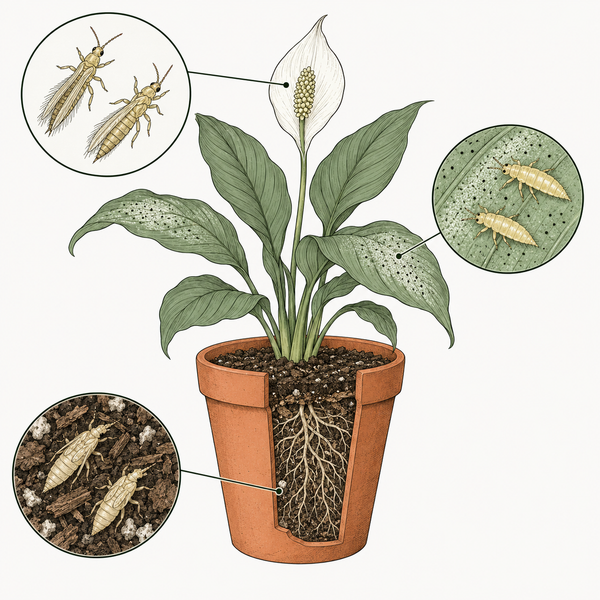
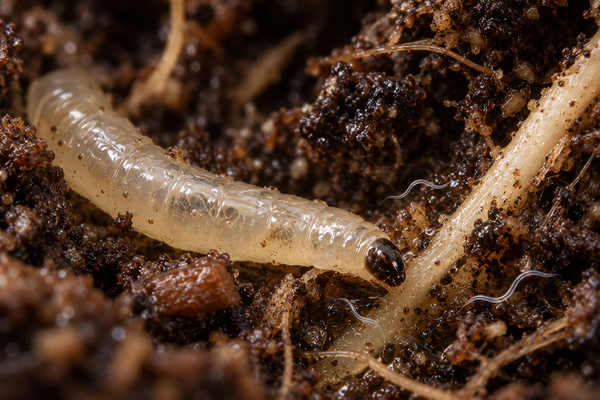
AI-generated header and conceptual illustrations. Nematodes are enlarged for teaching.
