



Jump to the November map and SF/SC guide
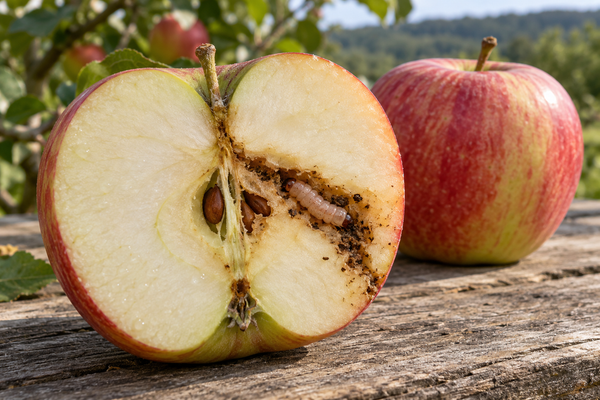
There is nothing grosser than biting into an apple and finding a caterpillar. By then, it has already done much of the damage, conveniently protected from whatever you might spray on the outside.
That is the problem with codling moth. Its caterpillars feed inside apples and pears, where they are difficult to reach. But they eventually leave the fruit to find shelter—and that gives us another opportunity to treat them.
Beneficial nematodes can attack those sheltered caterpillars. The trick is getting the nematodes to the right place while conditions are moist and warm enough for them to work. [1]
The caterpillar eventually has to leave
A young codling moth caterpillar bores into an apple or pear and feeds inside, often tunneling toward the core. You may notice a small pile of reddish-brown crumbs around the entrance. That is frass: caterpillar droppings mixed with chewed fruit. The hole can look fairly modest considering what is happening behind it. [2]

Once it has finished feeding, the caterpillar crawls out and finds somewhere to spin a cocoon. Loose bark, cracks in the trunk, and debris beneath the tree all offer shelter. During the growing season, it may become a pupa and then emerge as an adult moth. The caterpillars that will spend winter there stay curled inside their cocoons until spring. A cocoon does not necessarily mean the caterpillar has already turned into something else. [3]

Those sheltered caterpillars are what an autumn nematode treatment targets. By then, we are treating the trunk and the ground around it, rather than spraying apples in the hope of reaching something buried inside.
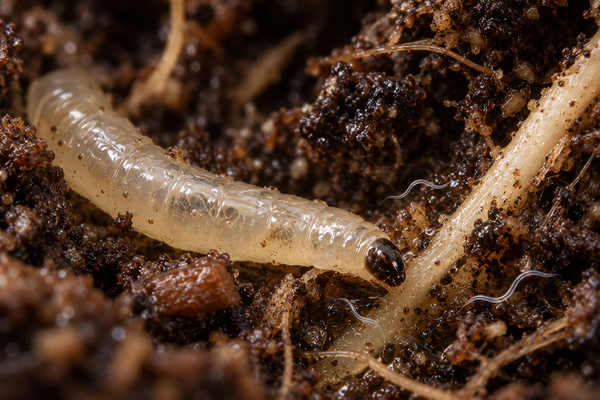
Beneficial nematodes are microscopic worms that can enter a susceptible insect and release bacteria that help kill it. They travel through thin films of water, so a wet bark crevice can give them a route to a caterpillar in its cocoon. This is the opportunity we are trying to create when we apply them. [4]
Choosing SF or SC for autumn treatment
The two nematodes used here are Steinernema feltiae (SF) and Steinernema carpocapsae (SC). SF works at cooler temperatures, making it the more useful choice for many autumn applications. SC needs warmer conditions. As a rough guide, look for temperatures above about 50°F for SF or 59°F for SC during treatment. If it is too cold for either, switching species will not solve the problem. [5]
The November map gives you a starting point for your region. Check conditions around your own tree before applying; a warm coastal garden and a cold inland orchard can share a state without sharing suitable treatment weather.

Applying nematodes around a backyard tree
After harvest can be a useful time to treat: caterpillars are sheltering for winter, but there may still be enough warmth for the nematodes to work. The window closes earlier in cold regions, so use local extension guidance for timing rather than borrowing a date from an orchard several states away. [3]
Check the application rate before you mix. A dose for fungus gnats in a houseplant pot does not tell you how to treat an apple tree. You need directions for codling moth that account for the area being treated and the water needed to cover it. If those are missing, ask for application advice rather than trying to convert a pot dose into a tree dose.
Choose a time when the treated area will stay moist and temperatures will remain suitable afterward. Strong sun and drying wind work against you; a mild evening is often easier to work with. Have your watering equipment ready before mixing, and follow the nematode product’s storage and mixing directions. [7]
Wet the bark and ground first. Then apply the mixture to the rough lower trunk, crevices around low branch junctions, and the ground near the base. A watering can can cover the ground; a suitable sprayer makes it easier to reach the bark. Cover both, because caterpillars sheltering on the trunk will not be reached by watering the soil alone. Keep the treated areas moist without flooding them for at least 24 hours afterward, as Montana State recommends for backyard applications. [3]

Keep the bark damp afterward
The follow-up watering is part of the treatment. Once the mixture leaves the sprayer, the nematodes still have to move into the cracks where caterpillars are hiding. If the bark dries too soon, they can dry out before reaching them.
This is also why a humid evening does not replace wetting the tree. Research with SF found that the water applied to the treatment surface mattered as well as the humidity of the air. Orchard trials have also improved results by helping treated surfaces retain moisture. Plan to keep the bark and ground damp after application, even if the air already feels humid. [6] [8]

Do they actually work?
Yes—orchard experiments show that nematodes can kill codling moth caterpillars inside their cocoons. That gives us a way to reduce the number surviving to become moths. It does not tell us that every apple will be protected next year. [1]
Some caterpillars will be tucked into places the mixture misses, and moths can fly in from nearby untreated trees. Montana State still describes nematode use in home plantings as experimental, even with encouraging orchard research behind it. Treat them as one way to reduce the population, while continuing to protect the fruit during the growing season. [3]
Protect the apples while you reduce the moths
Start by removing infested apples from the tree and picking up fallen fruit promptly. A caterpillar left inside can finish eating, crawl out, and find a place to continue its life cycle. Getting rid of the apple before that happens removes the caterpillar with it. [2]

For a few small trees, bagging young apples before caterpillars enter gives you another way to protect them. The bag forms a physical barrier around the fruit while it develops. Put it on before the damage starts; wrapping an already infested apple just packages the problem. [2]

If you use treatments aimed at newly hatched caterpillars, timing matters: they need to be reached before they tunnel into fruit. A codling moth pheromone trap helps show when adult moths are active, and your extension service can help translate that activity and local temperatures into treatment timing. The trap provides information; hanging one is not, by itself, a treatment plan. [2]
This gives you two different opportunities: protect the fruit before caterpillars enter, and use nematodes against sheltered larvae after they leave. An autumn treatment will not undo this year's damage. Its purpose is to leave fewer moths ready to start again in spring.
Sources and evidence notes
- Entomopathogenic nematodes for control of codling moth in apple and pear orchards. Peer-reviewed field research examining species, temperature, equipment, additives, and post-application irrigation. Abstract consulted.
- UC IPM — Codling Moth. Fruit injury, sanitation, bagging, monitoring, and treatment timing.
- Montana State University — Managing Codling Moth in Home Orchards. Lifecycle and backyard application guidance; explicitly distinguishes promising biological controls from demonstrated home-orchard performance. Its regional calendar is not applied nationally here.
- Entomopathogenic Nematodes for Control of Insect Pests Above and Below Ground. Peer-reviewed review of nematode biology and applications.
- USDA ARS — Microbial control of lepidopteran pests of apple orchards. Research review summary of species-specific temperature and moisture requirements.
- The influence of humidity on the effect of Steinernema feltiae against diapausing codling moth larvae. Peer-reviewed controlled experiments; moisture responses are not a guaranteed backyard efficacy rate.
- UC IPM — Insect Parasitic Nematodes. Sunlight exposure and protected, moist application sites.
- Post-application of anti-desiccant agents improves efficacy against diapausing codling moth larvae. Peer-reviewed experimental work summarized by USDA ARS. Experimental additives are not presented as home recipes.
- NOAA Climate Prediction Center — November climatological data, 1991–2020. Approximate regional boundaries informed by November temperature patterns; this SF/SC map is an editorial guide, not a NOAA treatment recommendation.
