



Persimilis is probably the best-known predatory mite. A celebrity, one mite say.
If you have looked into using beneficials for spider mites, there is a good chance you already know the name. Its full name is Phytoseiulus persimilis, and its reputation rests on its appetite for two-spotted spider mites and certain close relatives. These are the pests feeding on your plant; Persimilis hunts and eats them. [1]
It earns that reputation by eating pests, but its life involves more than an appetite. Persimilis can learn, recognize familiar company, and produce eggs whose characteristics reflect the conditions their mother experienced. [4–6] All of this happens on a scale that makes an entire family easy to mistake for a few specks.
Before we get to the leaf, though, its history takes us through Algeria and Chile.
One species, two names
In 1957, the mite specialist C. Athias-Henriot formally described Persimilis from material collected in Algeria. Around the same period, German researcher G. D. Dosse studied a predator obtained from Chile and described it as Phytoseiulus riegeli. Researchers subsequently recognized them as the same species. Persimilis was the name that stayed. [2]
The Chilean mites helped set European biological-control research in motion. They offered the possibility of deliberately using one mite to suppress another. That history also explains why accounts of where Persimilis “comes from” can name different places: the location where a species was described and the source of an early research population answer different questions. [2] Neither establishes its entire native range.
Before the bottle, there was the leaf
Persimilis also lives in the field. Researchers collecting natural populations in coastal Turkey and Sicily found it in spider-mite colonies on crops and weeds, including beans, cucumbers, eggplants, castor bean, and bindweed. The collection sites included roadsides, small farms, and home gardens, with no known releases of the predator at those locations. [9]
Those records give us a more useful picture of its habitat than a pin on a map: suitable prey scattered among plants in a landscape. As a colony is exploited, predators can leave for other patches. In laboratory comparisons, populations collected from different sites differed in when they dispersed; they did not all wait until the last prey was gone. [9] The name identifies the species, not one identical schedule for every mite.
A small orange specialist
An adult Persimilis is about 0.02 inches long, with a pear-shaped body, relatively long legs, and usually an orange to reddish-orange color. Younger stages are paler, and its eggs are oval. [3]
Its diet gives it a very particular place on the plant. Persimilis specializes in web-producing spider mites, especially members of the genus Tetranychus. [1] The webbing that announces trouble to a plant owner is part of the predator’s hunting habitat.

That specialization helps explain its reputation, but it also gives “predatory mite” a narrower meaning than “eats whatever is wrong with this plant.” Persimilis is not a general-purpose answer to thrips, scale, or every other mite. Its life is closely tied to finding suitable spider-mite colonies. [1]
Growing up among spider mites
A new generation starts with what a female can put into her eggs. In one experiment, moderately food-limited Persimilis produced fewer, larger eggs destined to become females; with plentiful prey, they produced more, smaller female eggs. Californicus and Andersoni did not show that same adjustment under moderate food stress. [10]
That is a balance between producing more daughters and investing more in each egg. Severe shortage gave a different result, so “less food makes bigger eggs” would miss the point. The response depended on how much food was available. [10]
A mother’s humidity conditions can reach into the next generation too. Dry-exposed females in another study laid eggs better able to withstand dryness, but also laid fewer eggs. [6] Such changes are called maternal effects: the offspring’s characteristics are influenced by the mother’s circumstances. An egg cannot walk to a damper leaf, so how it begins life can matter.

Persimilis begins as an egg, hatches into a six-legged larva, then passes through two eight-legged nymph stages before becoming an adult. Those nymph stages are called protonymph and deutonymph. The larva does not feed; eating begins after the first molt into a nymph. [3,7]

Not feeding does not mean nothing important happens in that brief larval stage. Experiments have shown that early encounters with other Persimilis influence how the mites respond to familiar individuals later. [8] Before the young mite has eaten its first meal, its social surroundings can already matter.
There is a life beyond the appetite
Hunting also involves learning. Experiments with females show that experience can change how they respond to odors associated with food. [4] The chemistry around a colony becomes part of their education.
The other predators sharing a leaf matter too. In choice experiments, females preferred familiar groups and could distinguish them by odor. [5] Previous encounters can influence where a female settles and lays her eggs, bringing us back to the next generation.
Searching, learning, encountering neighbors, and producing another generation—all in a habitat we can cover with a fingertip. Eating spider mites is how Persimilis became famous. There is rather more going on under the leaf.
Sources
- McMurtry & Croft (1997). Life-styles of phytoseiid mites and their roles in biological control.
- Mori & Imabayashi (1975). Suppression of tetranychid populations using Phytoseiulus persimilis. Historical taxonomy discussion.
- Cornell University. Phytoseiulus persimilis natural-enemy profile. Identification and basic biology.
- Drukker et al. (2000). How predatory mites learn to cope with variability in volatile plant signals in the environment of their herbivorous prey. Author manuscript reproduced in 2001 thesis.
- Muleta & Schausberger (2013). Smells familiar: group-joining decisions of predatory mites are mediated by olfactory cues of social familiarity.
- Le Hesran et al. (2020). Maternal effect determines drought resistance of eggs in the predatory mite Phytoseiulus persimilis.
- UC IPM. Phytoseiulus predatory mites. Identification and life stages.
- Schausberger (2005). The predatory mite Phytoseiulus persimilis manipulates imprinting among offspring through egg placement.
- Revynthi et al. (2018). Prey exploitation and dispersal strategies vary among natural populations of a predatory mite. Field collections and experimental comparisons.
- Walzer & Schausberger (2015). Food stress causes sex-specific maternal effects in mites.
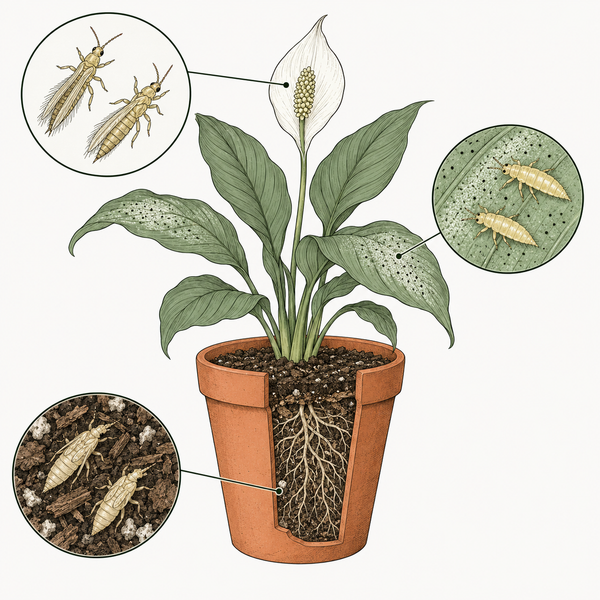
The header and teaching illustrations are AI-generated, not field photographs. Conceptual scenes enlarge specimens and simplify their surroundings; they are not identification measurements or drawings of numerical results.
