



Somewhere between turning on the heat and locating your lip balm, you changed the climate around your plants.
The plants stayed in the same pots. Their predatory mites kept the same address. But the air became drier, the window became colder, and that lovely spot above the heating vent developed a few management problems.
Inside a heated home, winter does not necessarily stop pests or the beneficials that eat them. What can change is the pace at which each population replaces itself. An adult predator may keep feeding while fewer of its offspring survive. For a while, pest control can look much the same. The shortage arrives with the next generation.
What happens between generations
Heating air without adding moisture lowers its relative humidity. The amount of water vapor needed to reach saturation rises with temperature, so the moisture already present becomes a smaller percentage of that amount. Cold outdoor air brought inside can therefore feel dry after it warms, even on a damp winter day. The heater does not have to remove water for the humidity reading to fall. [16]
For Phytoseiulus persimilis, the spider-mite specialist, dry air can make that shortage begin in the egg. Eggs cannot move to a better spot, and their water balance is less forgiving than an adult’s. A plant may still have feeding predators without supporting enough young to replace them.
Humidity also changes through the day. In a laboratory study at 77°F, fewer than 20% of persimilis eggs hatched under constant 60% relative humidity, while more than 73% hatched under the fluctuating humidity treatments. Those results came from particular laboratory conditions and mite strains; they do not make 60% a universal dividing line between success and failure. They show why one afternoon reading cannot describe everything an egg has experienced. [1]

A small temperature and humidity monitor near the foliage can reveal a pattern the thermostat misses: a warm afternoon, a cold night beside the glass, or a sharp drop in humidity when the heat runs. Check the range over several days. Moving a plant out of a vent’s direct airflow or away from cold glass may improve its conditions without changing the whole room. Preserve the light the plant needs when you move it.
If the growing area needs more humidity, a humidifier can provide sustained adjustment. A quick misting supplies a brief wetting, not a record of the humidity between sprayings. The aim is suitable air around the foliage, without continually wet leaves, condensation, or waterlogged potting mix. [2]

Temperature can slow reproduction even where moisture is adequate. In a laboratory study of Amblyseius swirskii, females fed pollen produced an average of 1.3 eggs over their lives at 59°F, compared with 16.1 at 77°F. A female surviving at the cooler temperature was not building the same population. These are laboratory results, not a forecast for a particular houseplant. [3]
Which winter problem belongs to which mite?
Predatory mites differ in their prey, habitats, and tolerances. Choosing among them starts with the pest, then the conditions where the predator will live. A cool-tolerant mite that does not eat the relevant pest is an admirably comfortable bystander.
| Beneficial | The winter distinction |
|---|---|
| Phytoseiulus persimilis | A specialist on certain spider mites. Dry conditions can interfere with egg hatch; it does not enter winter diapause. Favorable conditions and suitable prey remain necessary. [1, 4] |
| Neoseiulus californicus | Generally more tolerant of dry conditions than persimilis and able to use a broader range of food. That flexibility does not make it independent of temperature, moisture, or prey. [5] |
| Amblyseius andersoni | Used against several pest mites and active across a broad temperature range. UConn Extension describes its tolerance of cooler conditions; an activity range is not a promise of equal control throughout that range. [6] |
| Amblyseius swirskii | Used against young thrips larvae and whitefly eggs and young stages. Population growth slows in cool conditions, so a cool room deserves attention even when daytime temperatures seem comfortable. [3, 15] |
| Neoseiulus cucumeris | Used mainly against young thrips larvae. Its development depends on temperature, and adequate moisture supports egg hatch. A cool or dry growing area can affect the next generation. [8] |
| Stratiolaelaps scimitus | A soil-dwelling predator of fungus-gnat larvae and other small prey. Its growing medium, including moisture and temperature, is the relevant habitat. Conditions beside a leaf do not describe conditions inside a pot. [9] |
For soil predators, follow the plant’s watering needs while avoiding prolonged extremes in the upper potting mix. Keeping a pot saturated to favor a beneficial can create a different problem for its roots. Soil predators also cannot replace a foliage predator merely because both are sold as mites.
The sachet has its own small climate
A slow-release sachet contains a breeding system: predators, food mites, and carrier material. Predators emerge over time. The packet is therefore more than packaging, and a place that repeatedly dries or overheats it can affect that production.
Hang sachets in sheltered foliage according to the product directions, away from direct sun and heating vents. Keep them intact, leave their supplied exit unobstructed, and do not add water. Water resistance varies among sachet designs, so follow the specific directions about irrigation exposure and replacement intervals. A sachet does not last indefinitely just because it is still hanging there. [7]

When another release has a purpose
Sachets provide a gradual supply of predators for prevention. Bottles provide a direct release for treatment. Replacing a prevention sachet is not equivalent to treating an established infestation: predators need to reach the pests in sufficient numbers while damage is continuing. A treatment release and prevention sachets can be used together when they fit the chosen species and pest-management plan. [17]
Some biological-control programs already rely on repeated introductions. They supply predators when an established population is absent, too small, or unable to keep pace with continuing pests. Winter conditions may increase that need indoors, but they do not automatically do so in every room.
Follow the pests and the plant’s new growth. Compare similar leaves over time for live pests and fresh injury; old scars will remain after feeding stops. If pests continue increasing, first revisit their identification, where treatment reached, recent pesticide exposure, and the conditions around the plants. Adding predators to the same unsuitable environment can reproduce the same disappointing result. [10]
Where conditions suit the chosen beneficial and pests remain active, another release can supplement control. If the growing area cannot meet that species’ needs, a different compatible beneficial or another pest-management approach may be more useful. Timing and quantity depend on the pest, predator, and release method; there is no scientific basis for a universal “winter means twice as many” rule.
Beneficial insects add another seasonal complication. In Orius insidiosus, a small predatory bug used against thrips, short days can induce reproductive diapause—a seasonal pause in reproduction. A heated room does not necessarily remove the day-length signal. That response differs among species and populations, so a winter plan needs the identity of the insect as well as the room temperature. [11]
Why a winter shipment can contain a cold pack
A winter delivery does not remain at one outdoor temperature for its entire journey. The conditions inside an insulated package depend on its design and on the temperatures and delays it encounters.
Cold packs help absorb incoming heat. Controlled cooling slows the activity and metabolism of beneficial mites and insects during transit; insulation slows heat exchange with their surroundings. The purpose is a suitable transport temperature, not freezing the contents. Excessive cold can also injure them. Pack placement and separation from the organisms are part of the design. [12]
Winter shipping can be successful, but the presence of a cold pack cannot guarantee that every species and life stage will tolerate every journey. Temperature and exposure time both matter. Research on a particular 72-hour shipping procedure found that Orius insidiosus retained survival and predation performance. A separate lady-beetle study found that simulated temperature extremes reduced egg hatch. Neither result supplies a universal safe shipping duration. [13] [14]
Avoid prolonged exposure after delivery and follow the supplied handling and release directions. Do not improvise extra warming or refrigerator storage. If severe weather threatens transit or timely receipt, postponing a release may be the more suitable biological decision.
Once beneficials reach the plants, the room becomes their environment again. The thermostat may be set for you. The space beside the leaves deserves a reading of its own.
For gardens and unheated growing spaces, read Where Beneficials Spend the Winter.
Sources
Research supports the biological explanations below. University and extension publications provide growing and sachet guidance.
- Le Hesran et al. — Persimilis egg survival under dry and fluctuating conditions.
- University of Maryland Extension — Temperature and humidity for indoor plants.
- Lee and Gillespie — Swirskii development and reproduction at different temperatures.
- UC IPM — Phytoseiulus predatory mites.
- UConn Extension — Biological control of spider mites.
- UConn Extension — Andersoni and other spider-mite predators.
- UConn Extension — Slow-release sachets and sheltered placement.
- University of Florida IFAS — Cucumeris biology and environmental requirements.
- Kansas State University — Stratiolaelaps scimitus.
- UMass Extension — Integrated pest management.
- Research on photoperiod and reproductive diapause in Orius insidiosus.
- Casada, Ram, and Flinn — Thermal design of shipping containers for beneficial insects.
- Bueno et al. — Orius performance after storage and simulated shipping.
- USDA ARS — Shipping temperature exposure and lady-beetle egg viability.
- University of Florida IFAS — Swirskii prey and biology.
- National Weather Service — Temperature and relative humidity.
- Cornell IPM — Direct releases, slow-release sachets, and preventive control; swirskii preventive and curative releases.
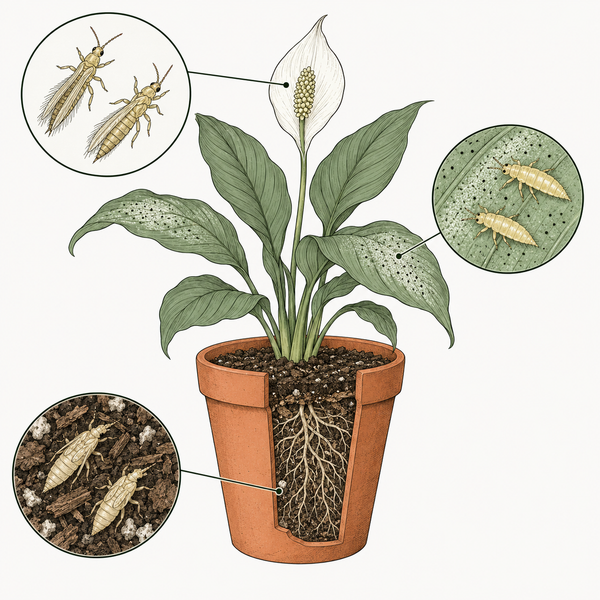
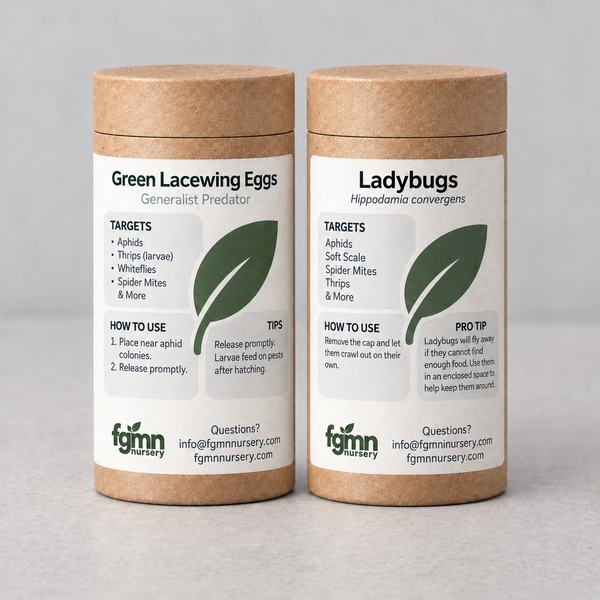
AI-generated photographs and conceptual illustrations. Illustrated organisms are enlarged and are not identification guides.
