




You have released cucumeris, followed the instructions, and still have thrips. Ordering more is an understandable response. Before you repeat the release, find out what you would be repeating.
The useful distinction is between a treatment that is still working through the population and a setup that keeps preventing the mites from doing their job. Start with what is changing on the plants.
Follow live pests before old damage
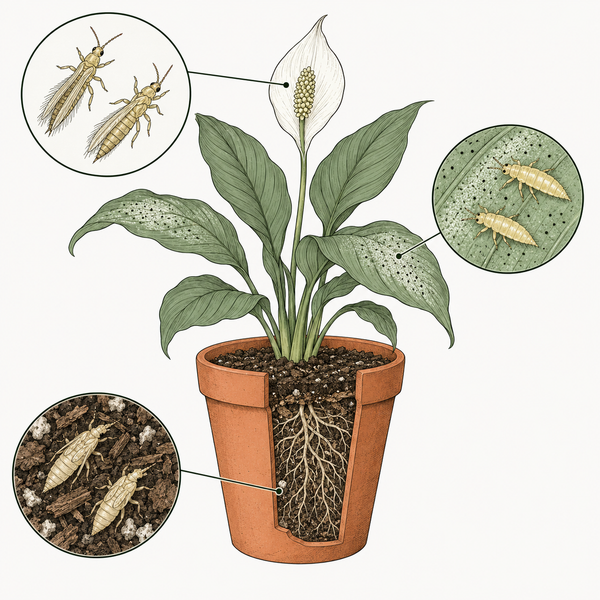
An old scar remains after the feeding stops. Photograph a few marked leaves, inspect new growth, and repeat your live-pest checks in the same places. That gives you something firmer than deciding whether the whole collection looks better today.
If pest pressure is falling and new leaves are healthier, the old leaves are not evidence that the mites failed. If live pests keep increasing or fresh damage continues spreading, work through the conditions below while maintaining the repeat-treatment plan. The progress guide covers that timeline in detail.

Check where the mites actually arrived
Look for a pattern. Are the plants that received treatment improving while the ones across the shelf are not? Did most of the carrier land on a few leaves? Does one sachet serve a connected canopy, or is it hanging beside several separate pots?
A release count can be correct while coverage is poor. Distribute treatment onto the plants that need it, following the product instructions. Do not expect a gap between pots to be covered simply because it falls inside the measured shelf area.
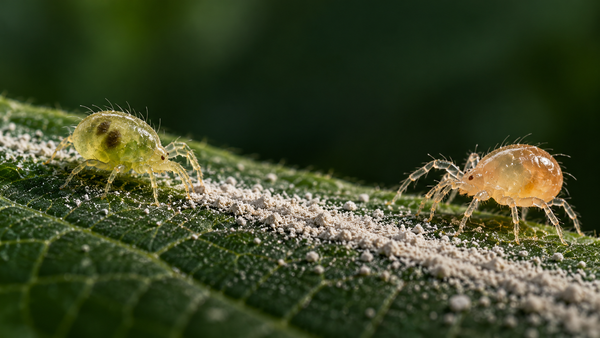
With sachets, inspect the location as well as the number. In cucumeris research, sheltered canopy placement sustained production better than exposure on the bench. Move a packet out of direct sun and drying airflow rather than giving the same exposed spot a second packet. The placement guide explains the mechanism.
Then look at the conditions they entered
Consider the whole day around the plants: heat near a window, dry air from a vent, and cooler periods overnight. Also make a list of recent plant treatments, including spot treatments, oils, soaps, and systemic products. Ask about compatibility for the actual active ingredient and application date before releasing into the same conditions again.
Seeing a moving mite does not answer all of this. It shows that mite is alive. It does not establish that eggs are surviving, that the population is building, or that enough predators are reaching the affected leaves.
This is why “I saw one” is useful information and a very small census.
If the setup looks right, revisit the target
Cucumeris primarily intercepts young thrips larvae. Older larvae are harder prey, and adults already present can remain visible. The young-larval target window explains why repeat treatment belongs in the plan from the beginning.
Do not ask a prevention sachet to carry an established infestation. Bottles are for treatment; sachets are for prevention, and you can use them together. If pressure was already substantial at release, the plan needs to address that starting population as well as the next larvae.
Persistent disappointment also makes identification worth revisiting. Different thrips species use different parts of the plant and can respond differently to predators. A carefully collected specimen may tell a diagnostic service more than another photograph of silvering.
Make the next round a changed plan
Repeat treatment is expected with thrips. Repeating an unexamined setup is optional. Record what you changed—coverage, sachet location, environmental conditions, or predator choice—and continue the same pest checks so you can see whether the trend responds.
If fresh damage and live pest numbers continue rising despite a correctly followed program, get help reviewing the identification and control choices. Bring the release dates, treatment history, and plant photographs. That is much more useful than “the mites did nothing,” even when that is exactly how the situation feels.
Sources and further reading
- Buitenhuis, R., Glemser, E. & Brommit, A. (2014). Practical placement improves the performance of slow-release sachets of Neoseiulus cucumeris. Biocontrol Science and Technology, 24(10), 1153–1166. doi.org
- van Houten, Y. M., van Rijn, P. C. J., Tanigoshi, L. K., van Stratum, P., & Bruin, J. (1995). Preselection of predatory mites to improve year-round biological control of western flower thrips in greenhouse crops. Entomologia Experimentalis et Applicata, 74, 225–234.
- Arthurs, S., et al. (2009). Evaluation of Neoseiulus cucumeris and Amblyseius swirskii as biological control agents of chilli thrips on pepper. Biological Control, 49, 91–96.
