


Aphidius Ervi
10% off your first 4 orders, then 15% off every order after.
Heads up—this is just an estimate. We only ship when the bugs are happy and ready to travel (Mon–Thurs). If a colony needs a beat to peak, or we're propagating a fresh batch, your order might hold up to a week. Treatment bottles jump the line when you've got an active infestation.
Sizing guide
How our sizes work
Sizes are set by how many plants you are treating — not by how much material is in the container.
Every size on every product page names its own coverage right there in the dropdown, so you never have to come here to find a number. Medium — Up to 25 Plants (2,500 Mites) tells you the tier and the count in one line. This page is for the part the dropdown cannot tell you: how to pick between two of them.
These are rough middles. The ladder runs smallest to largest within each product, so a Medium of one species covers more ground than a Medium of another — a nematode drench and a beetle release are not the same job. The count on the size you are looking at is always the real answer.
Pest pressure moves you up the ladder
Plant count is only half the sum. The other half is how much pest is already there. A closed tent holding fifteen plants with thrips on every growing tip needs a larger release than a bright room holding forty plants with a few gnats — the population you are outnumbering is bigger, and the enclosed space lets it rebound faster.
Coverage figures assume a typical active infestation. Adjust from there:
Under heavy pressure, two releases beat one large one. Take the larger size and plan a second release 7–14 days later, which catches the eggs that had not yet hatched the first time.
A few things work differently
A few products read in square feet rather than plants, because that is how they are applied — the outdoor and area-scale releases. Those are Sc and Hb nematodes, Coleomegilla, and the aphid specialists Ervi, Matricariae, and Aphidoletes. Same ladder, different unit.
Sf nematodes and Triple Blend size by plants and pots, like everything else. They are soil drenches for potted plants, so count your pots rather than your floor.
Slow-release sachets have no size. They are sold by the sachet, and you place one per plant or one per few plants depending on pressure. Sachets are a prevention tool — they hold a population in place before a problem starts. If something is already established, a bottle is the correct answer.
Sizing up is cheaper than sizing twice. Predators need enough prey to establish and enough of themselves to find it. Underdosing is the most common reason a release underperforms, and it usually costs more in the end than the larger size would have. When you are between two sizes, take the larger one.
Still not sure? Tell us what you are growing and what you are seeing, and we will size it for you.
Aphidius Ervi
At A Glance
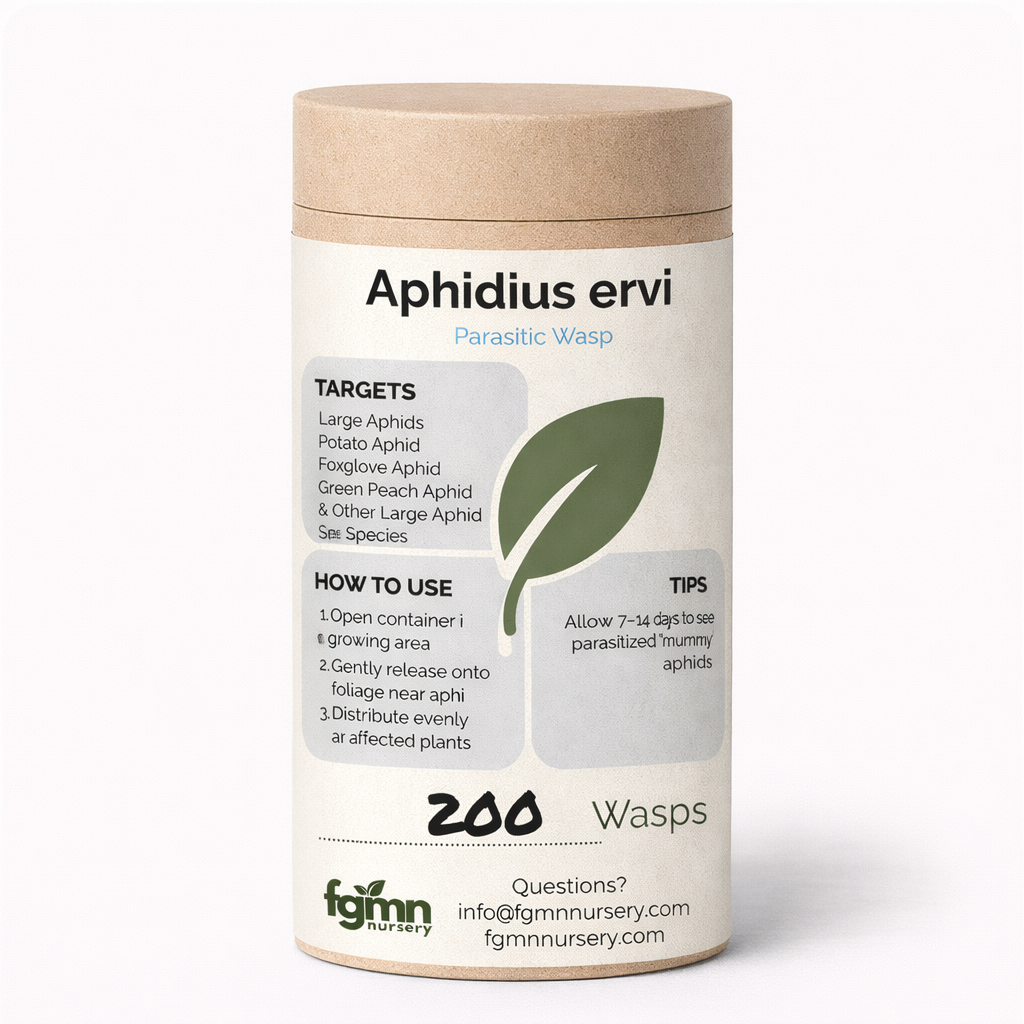
Aphidius ervi is a powerhouse in Integrated Pest Management (IPM), specifically engineered by nature to target and eliminate larger aphid species. Unlike generalist predators, this slender, black parasitic wasp is a specialist with an extraordinary searching ability, making it an essential tool for growers of greenhouse vegetables, ornamentals, and cannabis.
Field Notes — Aphidius ervi
| Species | Aphidius ervi |
| Common name | Aphid parasitoid |
| Type | Parasitic wasp — endoparasitoid |
| Ships as | Mummies or adults, depending on the batch |
| Sold by | Count |
| Size | 4–5mm. Noticeably larger than matricariae, narrow-waisted, dark. Does not sting people |
| Hunts | Large-bodied aphids — potato aphid (Macrosiphum euphorbiae), foxglove aphid (Aulacorthum solani), pea aphid, glasshouse potato aphid |
| How it works | Female lays a single egg inside a live aphid. The larva develops internally, kills the host, and the aphid hardens into a papery tan-brown mummy glued to the leaf. A new wasp emerges roughly a week later |
| Also kills by | Host feeding and unsuccessful stings. Aphids drop off leaves and stop feeding when a female works the colony, cutting damage beyond the parasitism count |
| Eats opportunistically | Nothing else. No alternate host outside aphids |
| Also eats | Nectar and honeydew — adults need a sugar source. Flowering plants nearby extend adult lifespan |
| Won't touch | Thrips, whitefly, mites, mealybugs, scale, fungus gnats. Green peach aphid is a poor host — that's matricariae's job |
| Best against | Large-bodied aphid species, at low to moderate density, scattered across a collection |
| Optimal temp | 65–77°F (18–25°C) |
| Humidity | 50–80% RH. No high-humidity requirement |
| Light | Needs daylight to search and fly |
| Egg to adult | Roughly 2 weeks at 70°F; mummies appear in about a week |
| Adult lifespan | 2–3 weeks with a sugar source, considerably less without |
| Establishes | Yes, while suitable hosts are present. Population collapses when they run out |
| Deploy | Immediately on arrival. Open the container in the canopy — hang mummy cards in shade if that's the format |
| Release timing | Morning, in daylight. Repeat weekly while aphids are active |
| Refrigerate | No |
| Compatible with | Predatory mites, Stratiolaelaps scimitus, beneficial nematodes, lacewings, ladybugs, Coleomegilla, springtails, Diglyphus, Aphidius matricariae |
| Keep separate from | Broad-spectrum and systemic insecticides — systemics move into the aphid and kill the developing wasp. Yellow sticky cards will catch adults; pull them at release |
| Chemical interval | One day after neem oil or insecticidal soap. Never with sulfur, at any dilution |
| Safe around | Pets, children, plants |
Target Pests
Environmental Needs
Selection Guide
How to Use
How They're Shipped
Join Karen's Live Shows — Pests, Plants & Predators on PalmStreet.
Every Friday at 7pm EST — plus additional shows throughout the week. Ask your pest questions in real time — we answer everything.

The Weekly Newsletter
A weekly excuse to be weird about bugs at parties.
Weekly dispatches on the quietly alarming things happening in your soil. All of it real.
No spam. Leave whenever.
You're in
The first strange true thing arrives next week.
FAQ
What is your Live Delivery Guarantee?
We guarantee that your beneficial insects will arrive healthy and ready to work. Because we are shipping live organisms, we use packaging and expedited shipping to ensure their safety. In the rare event that your order is compromised during transit, please take a photo of the package and contact us within 24 hours of delivery so we can make it right.
Will these wasps sting me, my family, or my pets?
How do I know if they are actually working?
What makes A. ervi different from other parasitic wasps?
Can I use these alongside my current pest sprays?
Do I need to get rid of the ants on my plants first?
How long can I keep them in the bottle before releasing?
Help! I'm overwhelmed
Yeah, it's a lot the first time you're using predatory mites. Please email us at info@fgmnnursery.com and we'll be happy to help!
I don’t see anything moving in my bottle or sachet. Does that mean they’re dead?
Not at all! In fact, go ahead and deploy them.
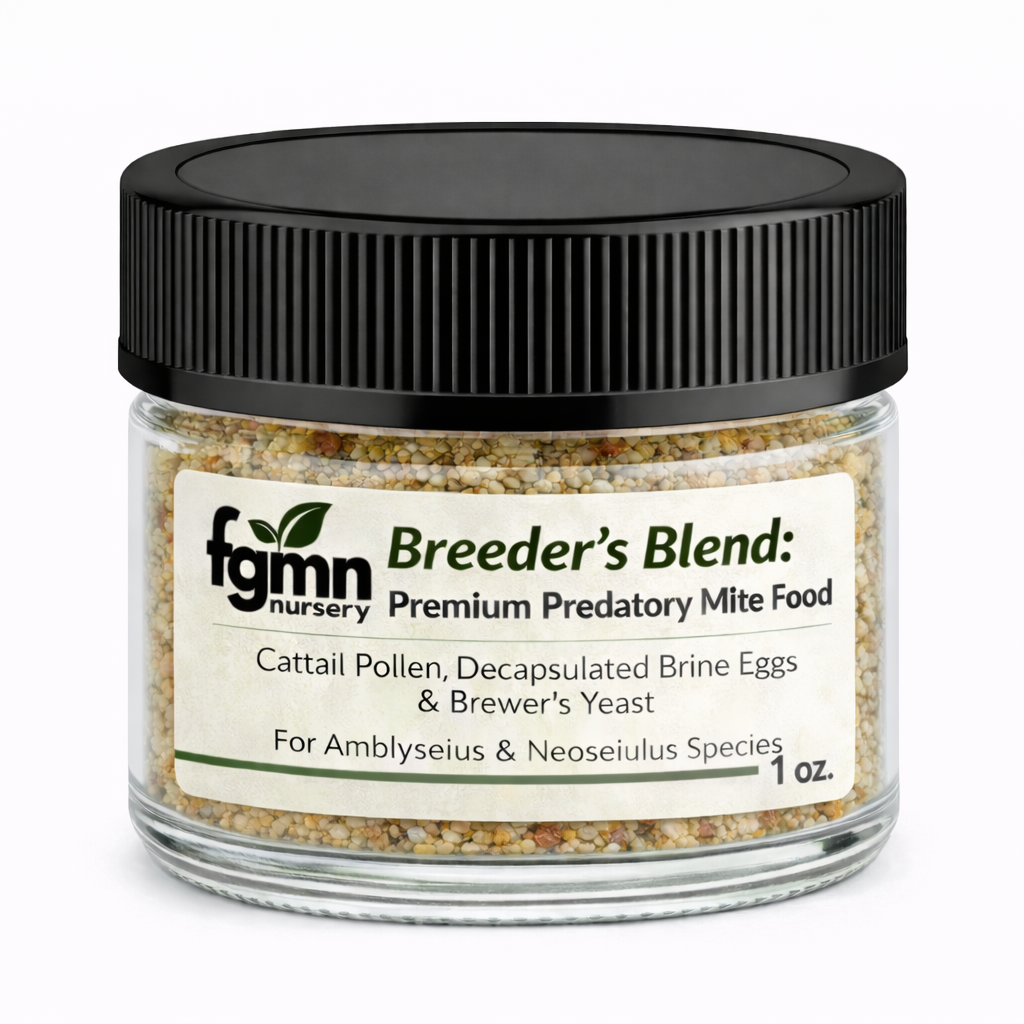
Predatory mites are microscopic (often less than 0.5mm) and naturally blend into their carrier medium (bran or vermiculite).
- For Bottles: The mites often huddle in the center of the bottle for insulation during transit.
- For Sachets: These are "slow-release" nurseries. The mites stay tucked deep inside the breeding media and emerge one by one over 2–4 weeks. Seeing an "empty-looking" sachet or bottle is not proof of a loss; it is simply how they are packaged for maximum survival.
Mite Matters

Cucumeris: Why It Works (and Why It Fails)
Cucumeris is reliable, widely researched, and genuinely effective — within a specific set of conditions. Here's what it actually does, what it won't do, and how to tell if it's the right species for your situation.

My Plant Has Webbing. Help.
Webbing on a plant isn't always spider mites — and the mite that causes the most damage indoors doesn't produce webbing at all. Here's how to tell what you're actually looking at before you treat.

Native vs Invasive Ladybugs
Most ladybugs you'll encounter are red with black dots — and that description fits native, introduced, and invasive species equally. Here's how to actually tell them apart, what the harlequin ladybug has been doing to native populations, and where the real ecological concerns are.