




1
White cottony fluff in the leaf joints.
Soft, and it squashes wet and sticky.

Pest season where you live
Type a ZIP and see what’s active this month, what’s at its worst, and when to get ahead of it.
What’s bugging you?
Most common
Other pests
Every pest we treat →Meet the beneficials
Most asked for
More predators and helpers
Every beneficial →Plant care
Field Notes
Guides
Before you buy
Pest guides

Mealybugs
Know for sure. Then meet the beetle that dresses like them.
Check that it's mealybugsIs it mealybugs?
Soft, and it squashes wet and sticky.

Not all of them. The rest hide in leaf joints, under leaves and on the roots.
The easiest check? Look in the leaf joints and under the leaves. Root mealybugs show as wilting in moist soil, with white wax on the roots or inside the pot.
Not quite matching?

Released crypts already? Bigger, up to half an inch, with long wax strands. Those are yours.

Tiny pale fliers near a colony with two white tail threads are male mealybugs. Fungus gnats are darker and stay by the soil.

Meet the mealybugs
A soft bug in a wax coat.
Wax, wings and a beetle in disguise.
Mealybugs are small, oval, segmented insects dusted in white wax. The young start out bare and quick, then settle and grow their coat.

What it eats
Mealybugs suck sap, which weakens the plant. The sticky waste, honeydew, lands on the leaves below, and black sooty mold grows on it.
Where it lives
Four places to look on one plant.

Tucked where a leaf meets the stem.
Off to females on other plants.
They live in the soil, out of sight.
No plant is too isolated. The males fly.
The life cycle
In a warm room. The generations overlap.
 Week 1
In a cottony sac that sheds water.
 Weeks 1–2
Tiny, pale and quick. Spreads before it grows any wax.
 Weeks 2–5
Settled, and building its coat.
 Week 5 on
Wingless and fully waxed. Stays put.
 Week 5 on
Winged and gnat-like, with two long tail threads. Never feeds, and lives a day or two.
Swipe for the next stage →
How fast they multiply
100–200
eggs in one cottony sac.
She fills it over 10 to 20 days, so eggs, crawlers and adults share one cluster.
Every stage, all year. Your living room has no winter.

Why sprays miss
The waxy coat, and a habit of hiding in tight spots, keep contact sprays off them. The sac keeps the eggs dry, so the colony comes back.

A different kind
Long-tailed mealybug keeps her eggs inside her until they hatch, and trails two tail threads longer than her body. The beetles eat it but can't breed on it.
What to get
Our pick for you
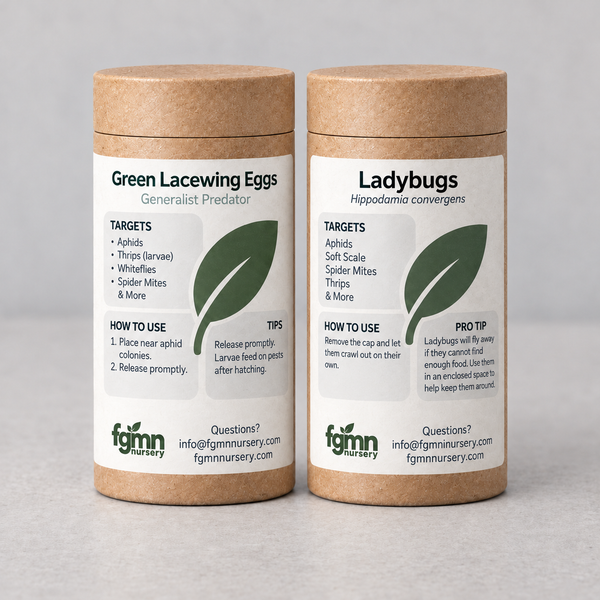
Cryptolaemus larvae can't fly, so they stay on the plant you put them on and feed until the colony is gone, egg sacs included.
See Cryptolaemus larvaeOur pick for you
Cryptolaemus adults fly, so they find colonies you haven't spotted, and the females lay their eggs right inside them. Serious infestation? Add larvae to the worst clusters too.
See Cryptolaemus adultsOur pick for you
Root mealybugs live below where Cryptolaemus hunts. Stratiolaelaps scimitus is a soil mite you top-dress onto the pot, and it works the root zone. Mealybugs on the stems too? Run both in the same pot.
See Soil mites (Stratiolaelaps)| If you see | Our pick | Why |
|---|---|---|
| Clusters on a few plantsWhite tufts in the leaf joints of one or a few plants |  Cryptolaemus larvae |
Cryptolaemus larvae can't fly, so they stay on the plant you put them on and feed until the colony is gone, egg sacs included. |
| A whole collection or greenhouseColonies scattered across many plants | Cryptolaemus adults |
Cryptolaemus adults fly, so they find colonies you haven't spotted, and the females lay their eggs right inside them. |
| Wilting, with white on the rootsThe plant droops in moist soil, with wax on the roots when you unpot |  Soil mites (Stratiolaelaps) |
Root mealybugs live below where Cryptolaemus hunts. |
What the beetles like. A warm room, 64–90°F, since cool rooms slow them and adults may fly off. Bright light, unusual for a predator; adults are busiest on sunny days. And a real colony: adults leave a plant with too little to eat, and larvae can't.
Our suggested plan
Release day
Ants dealt with first. Evening, right at the colonies.
About 2 weeks
Release again if mealybugs are still there.
Stop
For a typical infestation. Every other week or monthly is usually fine. A light one may need less. A heavy one may need adults and larvae together. Long-tailed mealybug needs repeat releases. Adjust to what you see, or ask us.
How to release
Confirm it's mealybugs. Squashes wet and sticky. Already confirmed above.
Wait out any spray.
Something else? Send us its active ingredient. If the label says longer, the label wins.

Baits or sticky barriers, two or three days before release. Ants farm mealybugs for their honeydew and go after your predators.
The same day they arrive, in the evening, right at the colony.

The beetles are often thirsty after shipping.

Tip the tube, hulls and all, at the base of the plant. They crawl up. Don't squeeze them.

Open the container by them in the evening. Skip the white shirt; they land on light colors.

About a teaspoon at each stem. Don't water them in.
Leave the white larvae alone. Bigger, with long wax strands. Those are yours.
The white fluffy things in the box are your predators. Don't squash them.
What to expect
Larvae take a day or two to reach the mealybugs. Adults may wander before they settle.
Colonies thin, starting where you released. New white, waxy larvae appear. They're yours.
No new colonies. Old sooty mold and damage stay.
Still finding colonies at two weeks? Go again. None two weeks in a row? You can stop.
Larvae disappeared? They're pupating on the stems. Beetles later.
Why treatment fails
The one step you can't skip. Bait or barrier first.
White fluff after release is often your own larvae. Go by size and wax.
Buy the size for the number of infested plants.

Prevention
Mealybugs almost always arrive on a new plant or cutting. Check its leaf joints and stems before it joins the others, and keep it apart for a couple of weeks.
The beetles are for colonies you can see, not insurance.
Reusing a pot? Check it. Mealybugs love a hand-me-down.
Often shows up with

Squashes wet and leaves honeydew too. The mealybug destroyer takes its crawlers.
Questions
Yes. Cryptolaemus montrouzieri is safe around people, pets, plants and food crops. The beetles are strictly carnivorous, don't eat leaves, roots or fruit, and leave no residue.
Where the beetles can breed, one release often does it: they need mealybugs to reproduce, and a real colony is a nursery for them. Long-tailed mealybug is the exception. It bears live young and makes no egg sac, so the beetles eat it but can't breed on it, and repeat releases are the plan.
Adults fly to find food. If there aren't enough mealybugs to keep them busy, or the room is cool, they move on. A generous release onto a real colony keeps them where you put them. For a small, isolated problem, larvae are the better choice because they can't leave.
No. Cryptolaemus hunts on stems and leaves and doesn't go below the soil line. If a plant wilts in moist soil and you find white wax on the roots or the inside of the pot, pair it with a soil predator: Stratiolaelaps scimitus or beneficial nematodes. Both can work in the same pot.
Not while the beetles are out. Before release, neem is done once it's dry and insecticidal soap needs a day. Synthetic pyrethroids need 8 to 12 weeks. Residue can harm the beetles or cover up the scent of the mealybugs they hunt by.
If something’s wrong when it arrives, email info@fgmnnursery.com within 72 hours of delivery for a replacement or store credit.
By continuing to checkout you agree to our Shipping Policy and Live Delivery Guarantee.
If something’s wrong when it arrives, email info@fgmnnursery.com within 72 hours of delivery for a replacement or store credit.
By placing your order you agree to our Shipping Policy and Live Delivery Guarantee.


