



1
Shells along the stems.
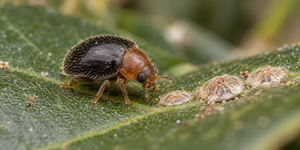
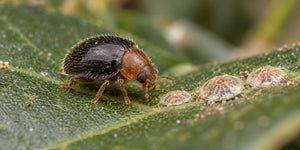
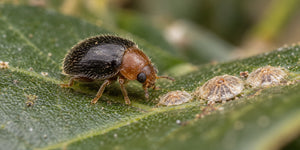
Small shells or domes, lined up along stems and leaf veins.

Pest season where you live
Type a ZIP and see what’s active this month, what’s at its worst, and when to get ahead of it.
What’s bugging you?
Most common
Other pests
Every pest we treat →Meet the beneficials
Most asked for
More predators and helpers
Every beneficial →Plant care
Field Notes
Guides
Before you buy
Pest guides

Scale
Tiny shells drinking your plant. Meet what eats them.
Check that it's scaleIs it scale?
Small shells or domes, lined up along stems and leaf veins.

Soft scale drips honeydew, and sooty mold grows on it.

Yellow to orange young. The sign scale is still active.
Which scale?

Flat and hard. The cover pops off dry and the body stays behind. No honeydew.

Larger and rounded. Squashes wet and leaves the plant sticky.
Wash your hands either way.

Meet the scale
A sap-drinker under a shell.
No obvious head, and no rush.
Scale are sucking insects related to mealybugs and aphids. Each one lives under a cover from 1/25 to 1/4 inch long.

What it eats
Scale push tiny mouthparts into stems and leaves and drink the sap. Leaves yellow and drop, and twigs can die back.
Where it lives

Lined up along the plant's plumbing.
Walking off to find a spot of their own.
Many kinds keep them under the shell.
The life cycle
Crawlers hatch, wander, then settle. Once they settle, their legs drop off.

Under the mother's cover.

Yellow to orange. The only stage that moves.

Growing its cover.

Under its finished cover.
Swipe for the next stage →

Why sprays miss
A hard cover keeps sprays out, and some systemic insecticides don't control armored scale at all.

Strange company
Soft scale drips honeydew. Ants guard it to keep the supply coming, and they attack beetles too.
Who eats scale? Two beetles.
What to get
Count a typical six-inch plant as 1, a large 8 to 10 inch plant as 2, a dense shrub or specimen as 3 to 4. A potted citrus by its leaves; between two sizes, the larger.
Our pick for you
Rhyzobius, for armored scale. It chews through the cover, and its larvae feed underneath.
See Rhyzobius lophanthaeOur pick for you
Cryptolaemus, for soft scale. It eats the crawlers, and mealybugs too if you have both.
See Cryptolaemus montrouzieriOur pick for you
Rhyzobius, for a mix. Armored scale is its main meal, and it eats soft scale and mealybugs when it meets them.
See Rhyzobius lophanthae| If you see | Our pick | Why |
|---|---|---|
| It pops off dryArmored scale |  Rhyzobius lophanthae |
Rhyzobius, for armored scale. |
| It squashes wetSoft scale. Sticky leaves usually mean this one |  Cryptolaemus montrouzieri |
Cryptolaemus, for soft scale. |
| I scraped a few and got bothSome pop off dry, some squash | Rhyzobius lophanthae |
Rhyzobius, for a mix. |
Our suggested plan
Release day
Onto the worst stems.
Every 2–3 weeks
While crawlers keep turning up.
Stop
You're done.
A light case may need just one round. Go by the crawlers, or ask us.
How to release
Confirm it's scale. Small shells along the stems and veins.
Take yellow cards down. Adult beetles fly, and the cards catch them.
Wait out any spray.
Another product? Tell us its active ingredient. The label's wait wins if it's longer.

Bait or block them 2 to 3 days before.

The day they arrive, right against the stems.

Then the next worst.
What to expect

Small, dark, quick beetles are Rhyzobius. White, woolly larvae that pass for mealybugs are Cryptolaemus. Both are ours.
Rhyzobius larvae are scruffy and gray, like tiny alligators. Leave them be.
Fewer new crawlers, and dry, chewed shells.
Live crawlers still turning up? Go again.
Why treatment fails

Scale is slow. Give it about four weeks.

The beetles do their best work right on the colony.
A wet spray at release. It coats and kills the beetles.

Prevention
Most scale stick to a few kinds of plant. If one plant keeps getting it year after year, it may be worth growing something scale leaves alone.
Questions
While there's scale to eat, they stay. Once it's gone, the adults fly off to find more.
No. A systemic moves into the scale and reaches the beetle eating it.
Some do. They're tiny, delicate and winged, and rarely seen. Some kinds have no males at all.
If something’s wrong when it arrives, email info@fgmnnursery.com within 72 hours of delivery for a replacement or store credit.
By continuing to checkout you agree to our Shipping Policy and Live Delivery Guarantee.
If something’s wrong when it arrives, email info@fgmnnursery.com within 72 hours of delivery for a replacement or store credit.
By placing your order you agree to our Shipping Policy and Live Delivery Guarantee.