




1
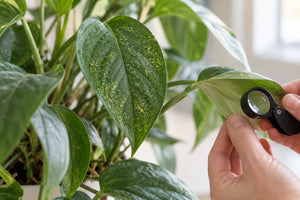
Tiny pale dots on the leaves.
Like the leaf was sanded, often worst along the veins.

Pest season where you live
Type a ZIP and see what’s active this month, what’s at its worst, and when to get ahead of it.
What’s bugging you?
Most common
Other pests
Every pest we treat →Meet the beneficials
Most asked for
More predators and helpers
Every beneficial →Plant care
Field Notes
Guides
Before you buy
Pest guides

Spider mites
Know for sure. Then send in the mite that eats mites.
Check that it's spider mitesIs it spider mites?
Like the leaf was sanded, often worst along the veins.

The later sign. Mostly under the leaves and between stems.
The easiest check? Turn a speckled leaf over and look underneath.
Webbing isn't the first sign. It's the last. By then, they've unpacked.
Not quite matching?

White powdery patches that wipe off. Nothing moves, and there's no speckling.

Meet the spider mites
A spider's tiny cousin.
A colony that builds its own fort.
Eight legs, an oval body, two dark spots, and under 1/20 inch long. Yours is most likely the two-spotted spider mite, Tetranychus urticae.

What it eats
A spider mite pierces a leaf cell and sucks it out. Enough dots, and the leaf turns dull, bronze or yellow.
Where it lives
Scroll down the plant to see where.

They feed and lay there, side by side. Up top you see the dots.
The silk is a shelter. It keeps many predators out, and newcomers move right in.
Hot, dry and thirsty: their happy place. Keep yours watered.
The life cycle
At 77°F. Every stage lives on the underside of the leaf.
 Days 0–3
Round and clear.
 Days 3–5
Pale, six legs, and feeding at once.
 Days 5–9
Two stages, now with eight legs. The dark spots appear.
 Day 9 on
Lays within a day or two, and spins as the colony grows.
Swipe for the next stage →
How fast they multiply
200
eggs from one female.
Over a life of two to four weeks. In the heat, a whole generation can take less than a week.

Why sprays miss
Many insecticides barely touch spider mites but kill the predators that eat them, and a jump in mites often follows. The eggs often ride out a spray too.

A winter coat
Where winters get cold, mated females turn red or orange and wait out the winter under bark and leaf litter. Same mite, winter coat.
Now, who eats them.
What to get
Our pick for you
Neoseiulus californicus eats spider mites and handles warm, dry rooms. It lives on pollen when spider mites are scarce, so it stays on the plant after the first wave.
See Neoseiulus californicusOur pick for you
Persimilis and californicus together. Persimilis walks into the webbing and eats every stage; californicus copes with drier air and cleans up the stragglers.
See Spider Mite Rapid ResponseOur pick for you
Phytoseiulus persimilis is the spider mite specialist. It goes straight into webbing that stops other predators and eats eggs, nymphs and adults. Take heavy webbing off with a jet of water first.
See Phytoseiulus persimilisOur pick for you
Four predatory mites in one bottle (andersoni, californicus, swirskii and cucumeris) for mixed or unclear pests. If you know it's only spider mites, persimilis or Rapid Response is the better match.
See Special Blend| If you see | Our pick | Why |
|---|---|---|
| Speckling, no webbing yetPale dots on the leaves and tiny moving specks underneath |  Neoseiulus californicus |
Neoseiulus californicus eats spider mites and handles warm, dry rooms. |
| Webbing on the plantsAn established colony, in an ordinary or dry room |  Spider Mite Rapid Response |
Persimilis and californicus together. |
| Webbing in a humid roomAbout 60% humidity or more, or you can keep it there |  Phytoseiulus persimilis |
Phytoseiulus persimilis is the spider mite specialist. |
| Something else is there tooThrips, broad mites, or you can't tell which mite |  Special Blend |
Four predatory mites in one bottle (andersoni, californicus, swirskii and cucumeris) for mixed or unclear pests. |
Our suggested plan
Release day
Persimilis onto the worst spots, californicus wider.
Every 2–4 weeks
While new leaves still pick up speckling. Two or three rounds is the normal course.
Stop
New growth stays clean. Then switch to a sachet.
Spider mites are its only food. When they're gone, it starves or leaves. That's the job finishing, not failing.
For a typical infestation. Every other week or monthly is usually fine. A light one may need less. A heavy one may need a closer repeat, every 2 weeks at the closest: a second persimilis release 2 weeks after the first. Adjust to what you see, or ask us.
How to release
Confirm it's spider mites. Dots, specks that walk, or webbing. One is enough.
Mark the hot spots. The plants with webbing or the most dots get the first predators.
Wait out any spray.
Different spray? Send us the active ingredient. A longer label wait always wins. Never release with a sulfur burner running.
Release them the day they arrive.

A strong stream takes thick webbing off. A light mist helps the mites stick.

Small piles near the webbing, worst plants first.

Onto the infested plants and the plants touching them.

Group plants or run a humidifier if you can.
Waiting on your order? Hose the leaf undersides. Not a cure. Just rude.
What to expect
The speckling you have stays. Those leaves were fed on before the predators arrived.
Webbing stops spreading, and new speckling slows.
New leaves come in without speckling. A few stragglers aren't a new infestation.
New speckling on new leaves? Go again.
Two or three releases is normal for a settled colony. Nobody missed.
Why treatment fails
Residue harms predatory mites as easily as pests. Check the waits above.
The room picks the mite. Dry air? Californicus or Rapid Response.
Split across too many plants, the predators can't outnumber the pest. Size it to the plants you're treating.

Prevention
A sachet lets predatory mites out over four to six weeks, so they're already there when the first spider mites land. One every 3 to 5 feet of shelf, or one on a large plant.
It won't catch up with webbing you can see. That needs a bottle.
They usually come home on a new plant. Or the air turns hot and dry and they invite themselves.
Often shows up with

Twisted new growth beside the dots. Andersoni takes both.
Field Notes
 Spider Mites Are on the Menu
 Californicus or Persimilis?
 You Did Not Lose to a Spider Mite. You Lost to Ninety-Six of Them.
 Spider Mites Brought Their Own Security
 Spider Mites Have Winter Plans
 Spider Mites Have a Type
 My Plant Has Webbing. Help.
 How Predatory Mites Use Chemical Signals
 Follow the Pests After Release
 Seven Ways To Waste Your First Mite Release
Questions
Every plant with dots or webbing, plus the plants touching them. Spider mites travel on hands, sleeves, tools and air currents, so neighbors often have them before they show it.
It helps persimilis more than it hurts the mites, so a humidifier or grouped plants make it work better. On its own, humidity won't clear a colony that's settled in.
Yes. Persimilis, californicus and andersoni are safe around people, pets, plants and food crops. They don't bite, can't feed on plants and leave no residue, so there's no wait before anyone can be near the plants.
If something’s wrong when it arrives, email info@fgmnnursery.com within 72 hours of delivery for a replacement or store credit.
By continuing to checkout you agree to our Shipping Policy and Live Delivery Guarantee.
If something’s wrong when it arrives, email info@fgmnnursery.com within 72 hours of delivery for a replacement or store credit.
By placing your order you agree to our Shipping Policy and Live Delivery Guarantee.


